
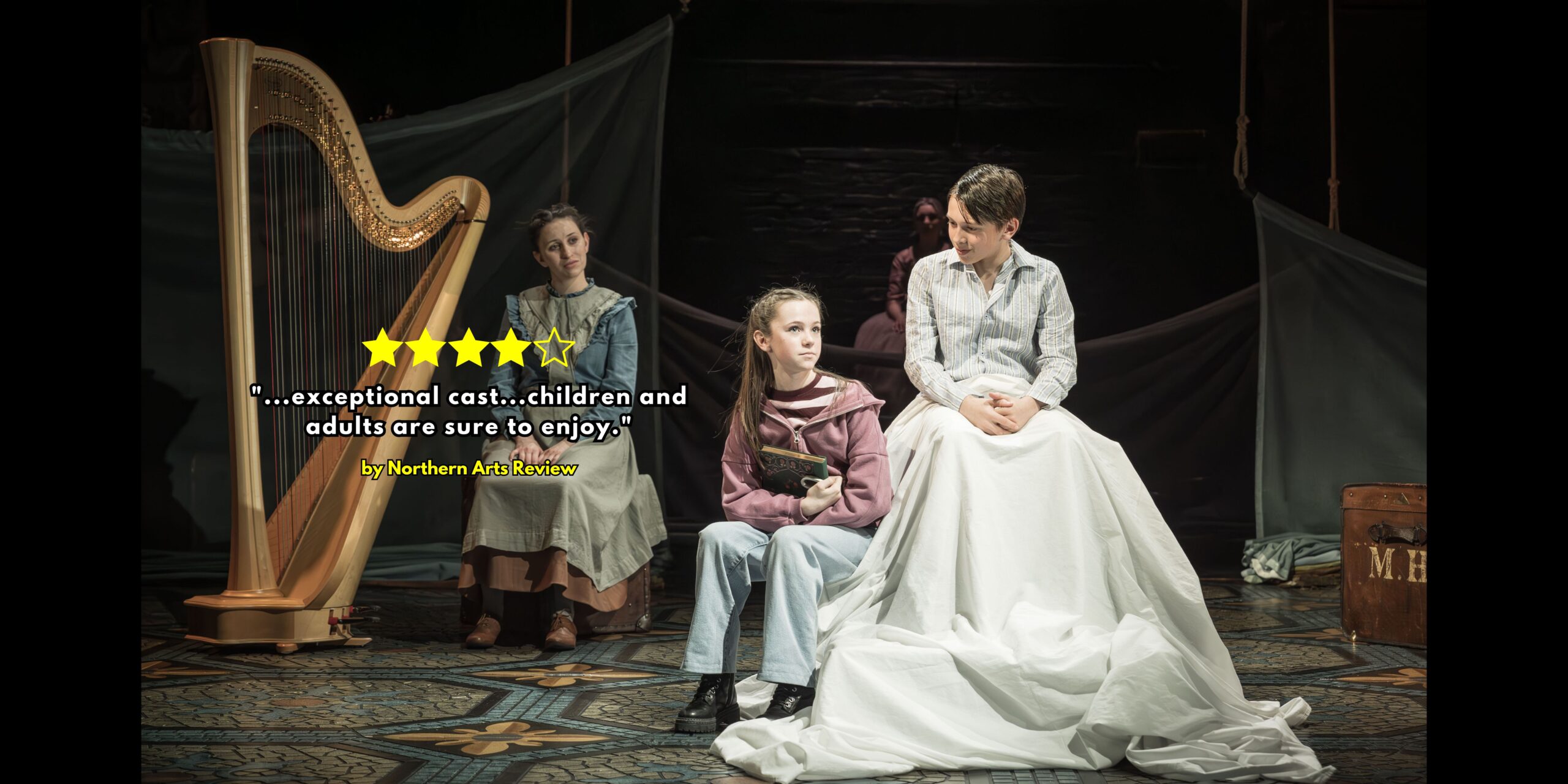
“…exceptional cast…children and adults are sure to enjoy.”
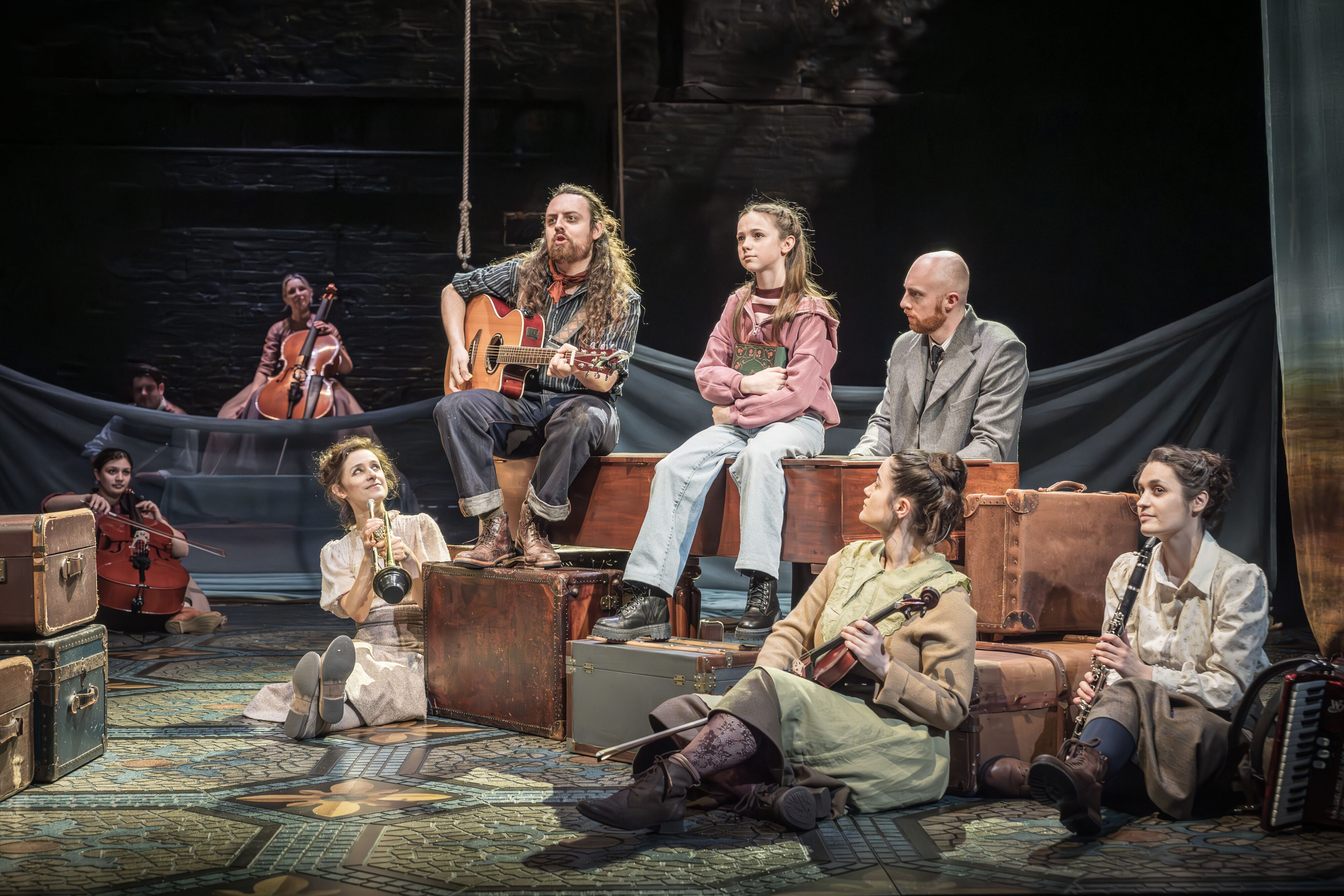 Cast of The Secret Garden – The Musical (Photo by Marc Brenner)
The Secret Garden – The Musical by Frances Hodgson Burnett, adapted by Marsha Norman York Theatre Royal
By Sean Sable
My sister was absolutely bananas for The Secret Garden when we were kids. We had this lovely illustrated, cloth-bound volume that got read into soft rags. A VHS cassette of the 1987 Hallmark adaptation skipped and fuzzed as the tracking slipped from worn-out tape. My nephew is named Colin. That’s how much this book was a load-bearing part of the imaginative architecture of our childhood. Misselthwaite Manor, the Yorkshire moors, moaning corridors and a garden locked by grief—what more could a little spooky kid like me want in a book? So, I’ll admit that walking into York Theatre Royal for opening night of The Secret Garden—The Musical felt a little like going to visit a time and place I’d half-invented.
The Secret Garden—The Musical has music by Lucy Simon and book and lyrics by Marsha Norman, whose Pulitzer Prize-winning pen turned Frances Hodgson Burnett’s 1911 novel into a Tony Award-winning Broadway hit in 1991. This production is directed and designed by John Doyle, in a welcome return to the theatre where he served as Artistic Director from 1993 to 1997. Brought to life by a cast of actor-musicians, the story follows Mary Lennox, an orphan whose parents died from a cholera outbreak in India. Arriving in North Yorkshire to live with her grief-stricken uncle Archibald, she takes up residence in the sprawling Misselthwaite Manor. There she finds a household stricken by grief and loss and a sickly cousin named Colin hidden in the west wing. A walled garden, once tended by her deceased aunt Lily, becomes the subject of curiosity and a place of renewal.
Doyle’s set, co-designed with David L. Arsenault, opens on the company lifting dust sheets from a collection of trunks and period furniture arranged on a tiled floor. On the right a desk doubles as a piano, and on the left, a harp sits in the middle of clutter. The design is unfussy shorthand for a house that has been in a state of torpor for a decade. Much of the set remains the same throughout, minimising the need for scene changes which keeps the storytelling pacey. At its most successful, layers of semi-transparent backdrops paint a picture of the expanse of the Yorkshire moors. With creative lighting, actors can be picked out behind the scrims, creating a sense of depth and watchful atmosphere. At one point, a chandelier glows through, giving us just a hint of the gothic atmosphere of the original book.
Johanna Town’s lighting design leans into tonal colour washes, with the opening scene bathed in a ghostly grey-blue light. Some of my favourite moments were when the lighting turned dramatic, a near orange spot picking out a single actor in a sea of deep blue, or the electric green of a thunderstorm. Similarly, Tom Marshall’s sound hits its stride in the storm sequence as it supports a propulsive, winding tension from the chorus, their voices becoming deliciously urgent.
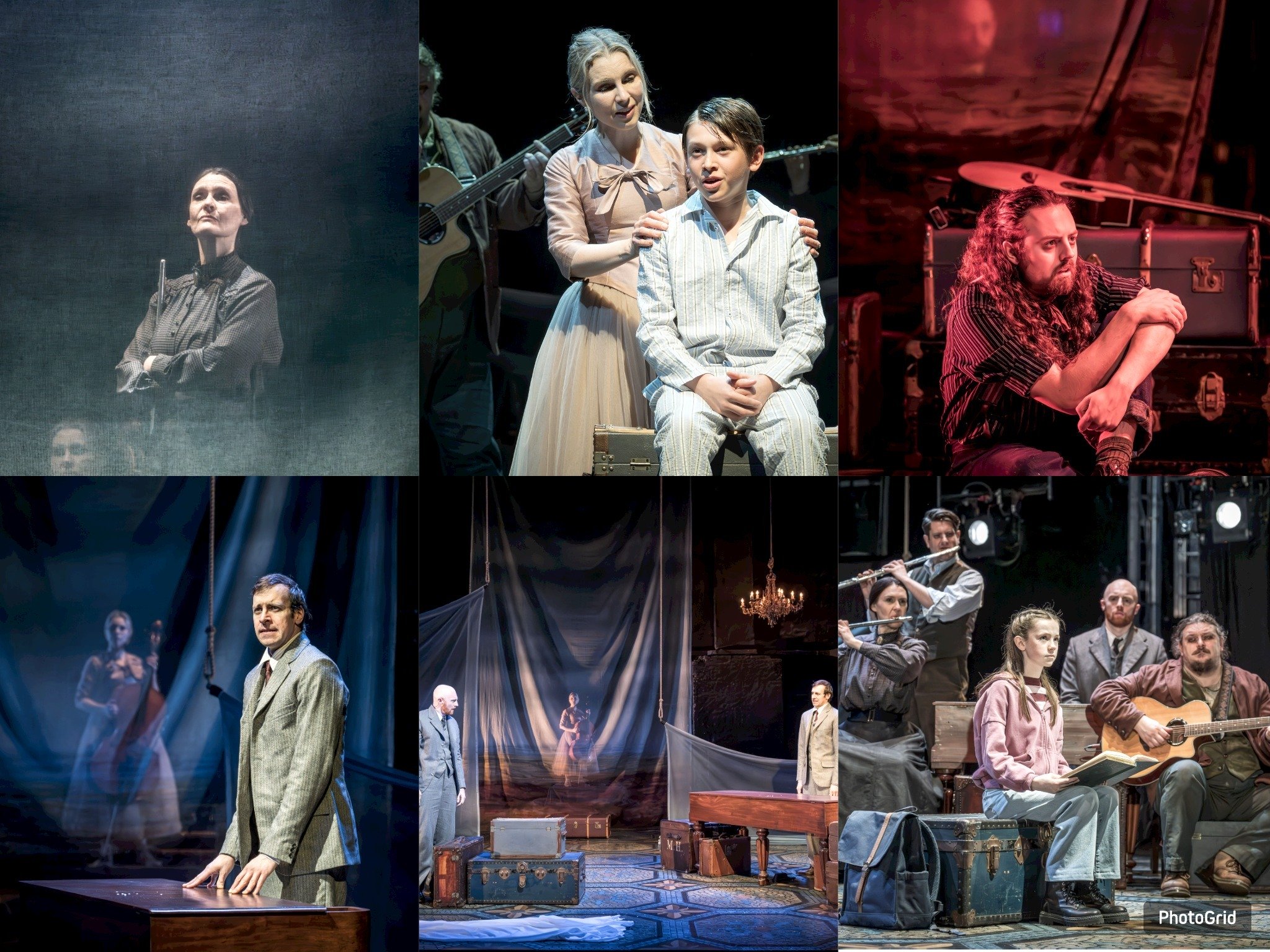
The cast of singer-musicians is exceptional, and Henry Jenkinson’s Archibald is a warm, expressive baritone whose voice would feel at home on any West End stage. Elliot Mackenzie’s Dickon had an easy warmth, and it was a genuine pleasure watching him slip between character and instrument as though there was no distance between the two. Joanna Hickman’s Lily was one of the best voices of the evening, with an ethereal quality that had an almost operatic delicacy. Across the whole company, the musicianship was of a remarkably high standard. We were treated to harp, flute, French horn, clarinet, piano, violin, guitar and more. I’m a fan of the integrated music format and watching the performers strip away from the chorus and drop into character was an absolute delight.
I wish, for the sake of the high calibre of the performances, that I could say that the production was without its faults. But as my husband and I walked home, we had both come to the same conclusion independently: the storytelling was the weak link. The original 1991 production was a leisurely two hours and twenty minutes, and the adapted RSC staging (the lineage this adaptation follows) had a similar runtime. So, pruning the story back to ninety minutes was always going to be something of a feat and it was inevitable that much would be left on the cutting room floor.
The instinct to create a family-friendly no-interval production is certainly one I can support. But the dramaturgy lost sight of what made the source material—the book—work. It shifted the focus away from Mary, an orphan followed by grief into a labyrinthine mansion of gothic proportions, and onto her uncle—an adult who misses his deceased wife. Whilst Archibald has my sympathies, he shouldn’t be the protagonist of the story. Yet he was. He was the one who had a significant on-stage journey from absentee melancholic uncle to warm father figure.
The Secret Garden is a story that captivates children’s imaginations and has done for well over a hundred years. The garden’s metaphor for grief and isolation touches on something universal and deeply human about the desire to pull away from the world when we lose someone close. Seeing the garden rediscovered in a retelling this musically accomplished is always going to be a delight and The Secret Garden—The Musical is a family-friendly night out that children and adults are sure to enjoy.
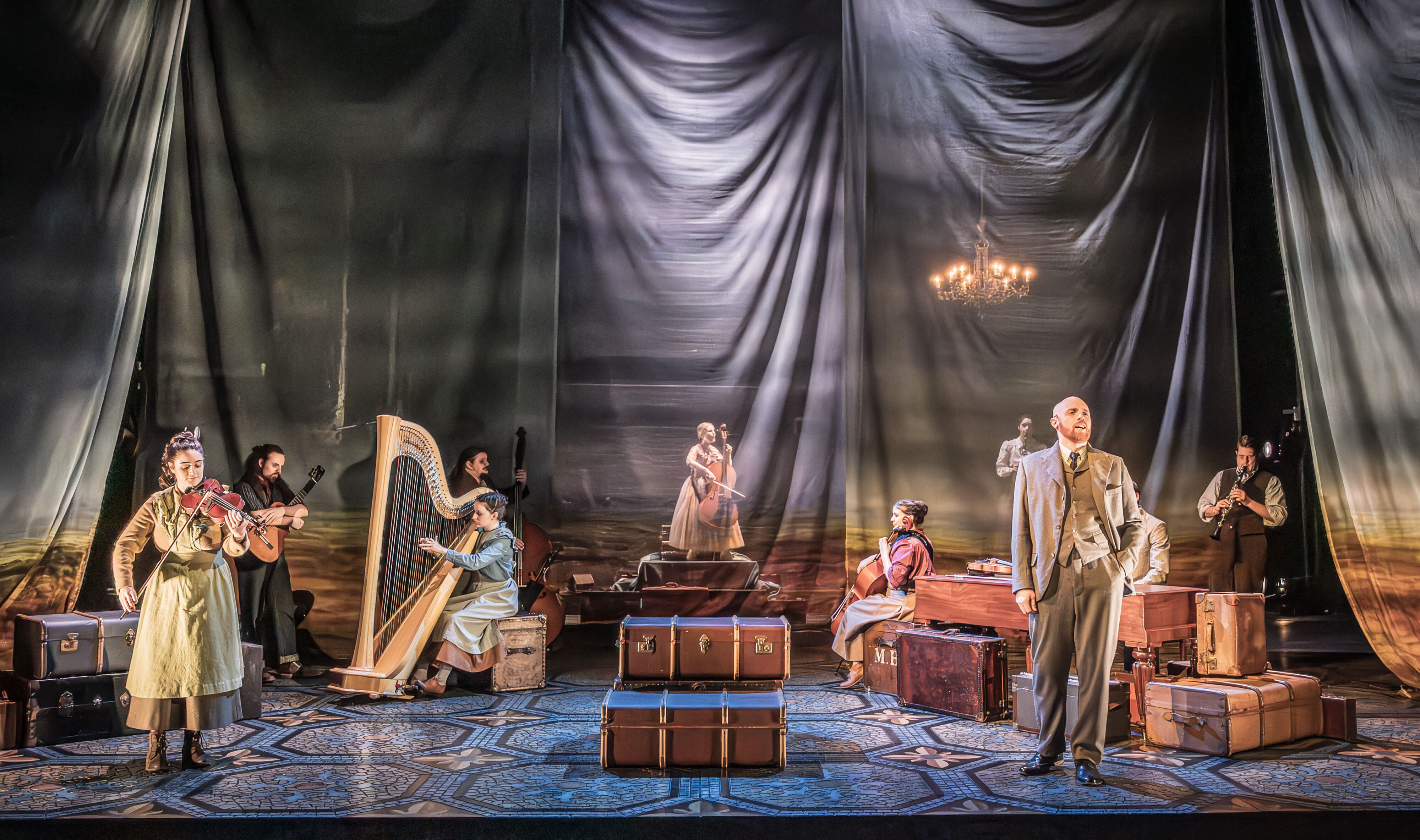 Cast of The Secret Garden – The Musical (Photo by Marc Brenner)
The Secret Garden – The Musical plays at York Theatre Royal until Saturday 04 April. Tickets are available here.
Sean Sable is a Yorkshire based freelance writer and editor specialising in Young Adult and Horror fiction, frequently at the same time. When she isn’t buried under a pile of books and manuscripts, she is looking for her keys and having extensive one-sided conversations, in Swedish, with her deaf cat. You can find her online at: www.seansable.co.uk
Post Views: 0
Comments are closed.