
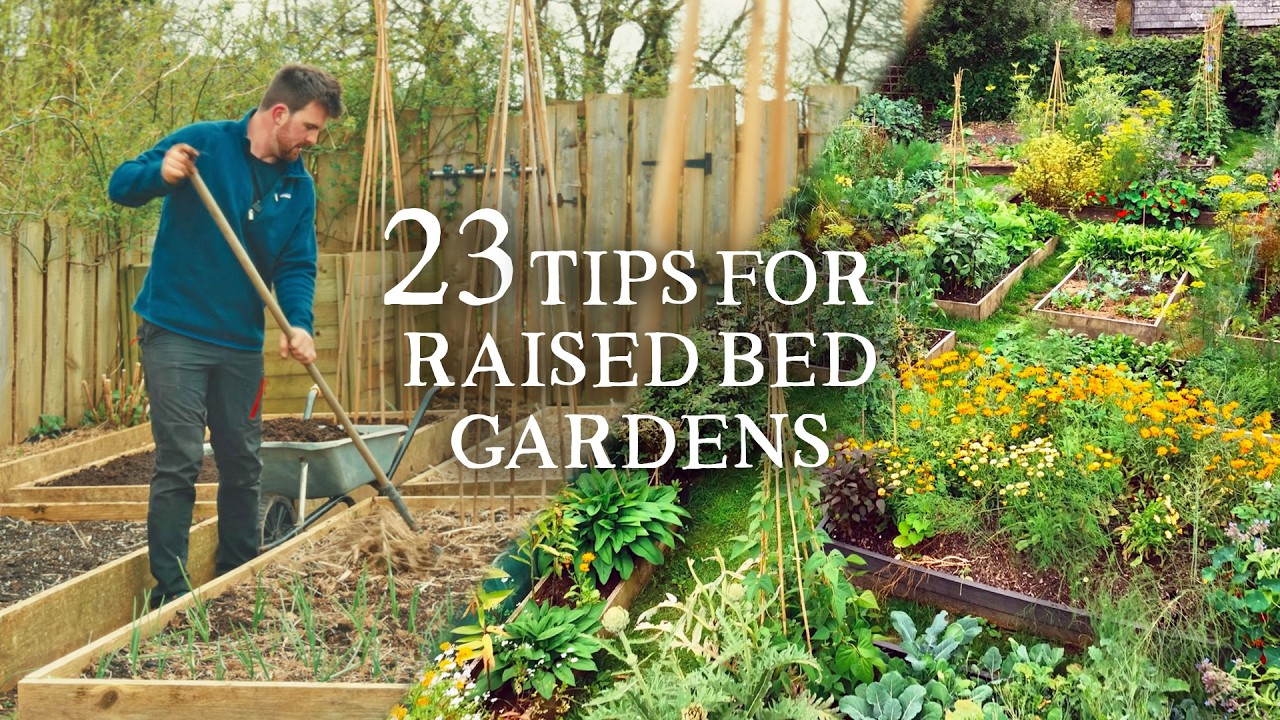
Here’s a collection of my top tips for raised bed gardening success. Often it is the little things that add up and make a big difference and that is what I hope you get from this video. Want to learn more? Get my latest book here: https://geni.us/HowToGrowFood
#growyourownfood #raisedbedgardening #gardeningtips
25 Comments
I took dozens of screenshots to gaze at and get inspiration from. Beautiful garden, helpful video!! Thanks!
Excellent insights, as always.
I consider myself blessed. I'm in Alabama, and I started out with great soil. Where my garden is was a horse pasture for 50 years, and although it was quite compacted, it was also rich beautiful soil.
I tilled it the first few seasons out of necessity, all the while layering it with leaves and straw, and it's just gotten better.
With that said, I still garden the way humans have for thousands of years, in the ground.
One tip i would say put 19 gage hardware cloth with 1/2 inch X 1/2 inch mesh to prevent gophers to eat roots and killing plants
Just here to say I liked the appreciation for the Japanese Wineberries! 🙂 Great video as a whole.
I’ve made really long beds 3ft wide on my plot… I think I need to put a small gap in them with some wood-chip so I don’t start stepping over them 😅
What I do for slugs is go out at night with a headlamp and pick them off by hand and squish them.
Do that three nights in a row.
These numbers are examples but accurate ratios.
First night you'll get 40
Second night 20
Third night 5.
Repeat in a week if necessary.
But what I'm trying to show is that even after just two nights the numbers dwindle dramatically.
Works like a charm.
The goal isn't eradication, it's management.
Great tips on the height and width of the beds and the reason for it, plus all the other tips. Thanks🙂
A little extra to add to your points about the size of raised beds. Years ago, I did the research for building accessible raised beds for the housing co-op we lived in at the time. Today, I live on an acreage; my husband has been physically disabled for almost 15 years now, and I have officially been recognized as disabled just this past year, so all that previous research is coming in handy now.
When it comes to the needs for mobility and accessibility, the beds should be no more than 4' wide if accessible from both sides, and about waist high. Two feet wide if only accessible from one side. Anything wider would require extra tools to be able to reach the centre. The length can be variable. The paths should also be 4' wide and hard packed. That gives enough space for a wheelchair or walker to turn in – and for any wagons or wheelbarrows. You can also build "shelf" beds with enough space under the growing area that allow for a wheelchair to fit under, plus 8-10" soil depth. The one we had built was at the request of one wheelchair using neighbour. I'm glad I actually measured him in his powered wheelchair, because it turned out to be taller than typical, so the recommended space under the shelf bed I had seen recommended would not have been high enough. It did mean only 8" of soil depth to keep the bed from being too high, but he was very happy to be able to finally grow some herbs!
When it comes to low raised beds (anything up to a foot high), you might want to go only 3' wide. The lower it is, the harder it is on the back to reach the middle.
In our case, we are on a fixed disability income and can't afford to buy materials to build raised beds. We do, however, have a lot of dead spruce trees that need to be cut down to reduce the fire hazard. I've been slowly using those to build raised beds. My first experiment was a high raised bed is 4 logs high, and 4' wide on the outside and 9' long. With the width of the logs, the actual growing area is about 3' wide inside the logs. I'd built some other raised beds using some scrap lumber I found that gave me 3' x 9' beds, and I've been building covers for them at that size. My main garden area beds will be 4' wide on the outside, framed by logs, and 18' long. This will allow me to keep building 3'x9' covers that can fit all on the beds, with two fitting over beds in the main garden area, thanks to the width of the logs I'm using to frame the beds. To start with, I'm framing beds at least 1 log high, but am also working on pairs of beds that will be joined with trellis tunnels, that will start at 2 logs high. I can increase the heights over time, as we're able to harvest more of the dead spruces. I do plan to leave some beds only 1 log high; that's enough to compensate for our poor soil conditions and protect from spring flooding, but will also make it easier to harvest tall things like corn or pole beans. Others will stay at 2, maybe 3 logs high, for those plants with "in between" heights, and finally high raised beds (4 logs high) which are ideal for low growing things, like bush beans, root vegetables and such.
Slugs can be a sign that the soil microbe life is lacking or not balanced enough to get rid of plant residue or other waste fast enough. Ants can also be a sign of this. In moist conditons this waste creates smells that attract slugs. Diluted Bokashi juices over a year spread widely directly before rain helped in my garden.
But in some cases only nightly anihilation runs 😉 will help. Especially if the ground does not freeze deep enough in winter where you live.
Also important, if you use cellulose rich materials like woodchips, straw or dried leaves and want to compost in place on your beds over winter you will need to add some green (nitrogen rich) materials. Otherwise the brown cellulose rich
materials will extract nitrogen from the soil while breaking down, creating a deficit in the next season. The last gras clippings of the season or manure left to mature on top are great for that. Then in spring just till it all in. I create my mulch layers over the season with this in mind and alternate between different materials. Also ask your neighbors, they would propably love to safe themselves a trip to the dump and will give you their gras clippings, leaves etc. Even more if you gift them some of your left over harvest over summer.
How to tell you're still a young, healthy gardener: You didn't think to mention that a waist-high raised bed is best for gardeners who are wheelchair users, or have bad backs or knees!
Thank you so much for your knowledge and tips. Much appreciated. We will be following along and watching your amazing gardening skills. We have just ordered 4 metal raised beds and are excited about getting started…..
Thank you Huw! Great video! Taking notes and growing veg! 🙏💚🌿
Great video. When I built my beds I was younger and fitter and had more time. I’m definitely going to cover a few beds this year and mulch the ones I work on come autumn for the winter.
At 73 the sides of my raised beds are about 24 inches tall. This is also because of the Bermuda grass in my garden. I have found if it isn't in raised over a foot tall, the grass gets in. Most of the rest of the garden is just filled with containers. You just do the best you can with the garden you have.
My top tip is if the only time you have to do a reset of a bed, to plant out a single bed, or to do a spot of weeding and tidying of that single bed is after dark…then crack on and do it!
I work 12½ hour shifts, plus travel time, I'm on a 14 hour day quite often, but if it isn't lashing down with rain I'll quite often just sort out something in 1 or two raised beds as I get out of the car after work. I wouldn't think anything of doing just that in the lovely long evenings of summer, so I just pop on a head torch or a woolly hat with a built in torch and I'll do a little bit of something before I even set foot in the house. No weeding or planting to do, then do a quick slug hunt or just a general health check on a few beds. Little and often beats saving it all up for your days off every time! 👍🏻🌱
Thank you so much for this knowledge! Your gardens look so inviting and productive!
i dont have any compost sellers around. is it okay to use rotten manure as compost with fertilizers?
I just received my book about 5 minutes ago! I’m so excited!
Definitely not enough room between beds , rotten setup
Do you feel treated lumber is safe to use now for raised beds?
15:18 try limewash on bords, simple and efective
5:25 😍 OMG! Bro Your garden is a heaven.✨
Nice work ❤❤❤
Thanks one of the best tips is to direct sow as much as possible i generally go for modules mostly i will think more 👍 now on ❤