
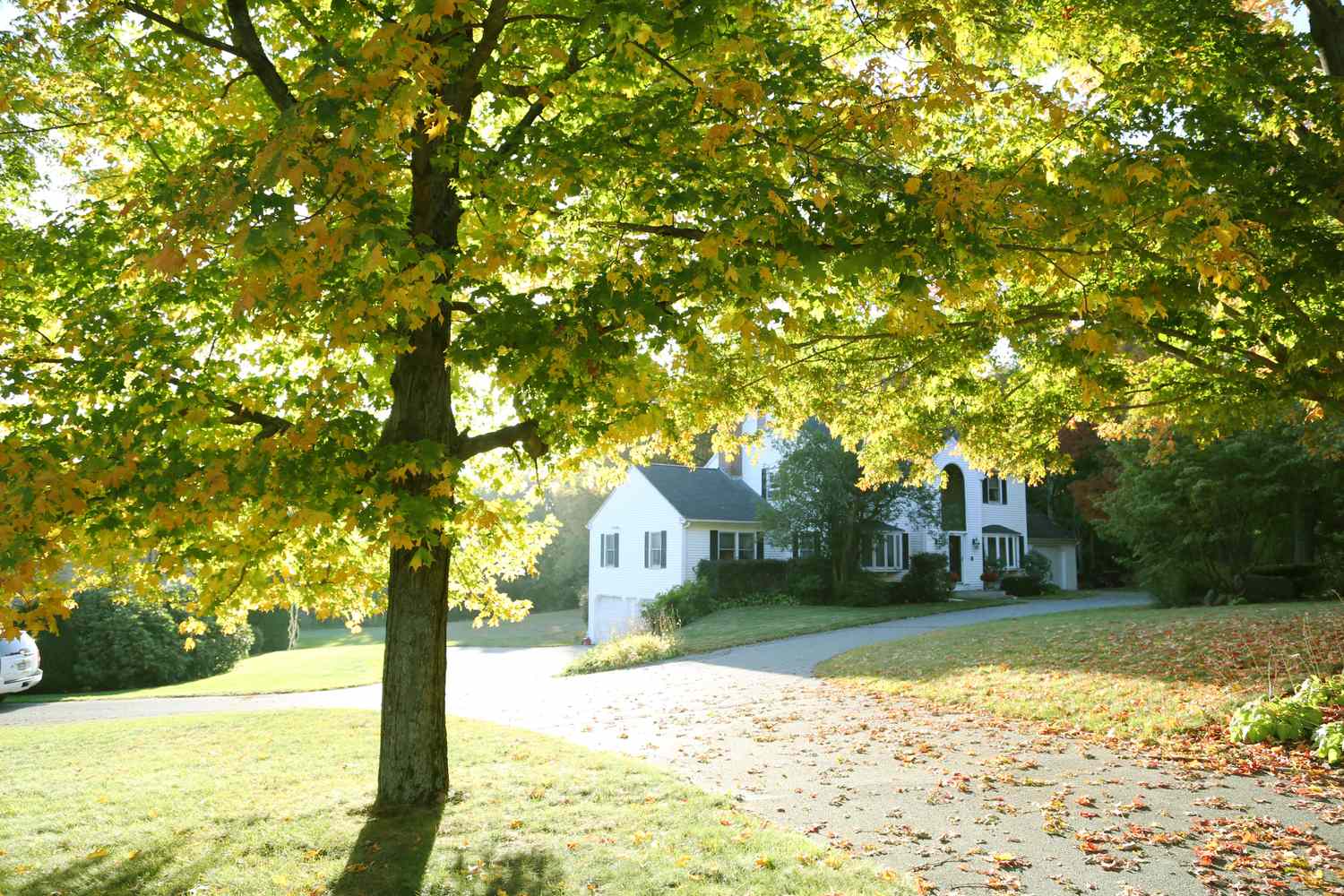
A picturesque driveway lined with towering trees might be the vision, but you’ll want to think twice before deciding on what to plant. Some trees can harm your car or your pavement, and what started off as a dreamy landscape can quickly turn into a maintenance nightmare.
How can you determine which trees to plant next to a driveway, and which to place elsewhere? We spoke to experts about the varieties you shouldn’t select for this important piece of real estate.
Eastern Cottonwood
The eastern cottonwood (Populus deltoides) is a fast-growing giant and is popular for providing shade.
“However, in late spring, they release seeds that can clog your car’s air intake and radiator,” says Adam Passo, district manager of Davey Tree Services. “Their roots aggressively seek moisture, which can damage driveway concrete as they search for water.”
Instead, plant a cottonwood at the back of your property where it can grow to its massive, 100-foot height—ideally in a large, low-lying field, or near a creek.
Black Walnut
Credit:
Catherine McQueen / Getty Images
Black walnut trees (Juglans nigra) have sprawling canopies that are often broader than they are tall.
“If planted near a driveway, they will quickly grow over it and rain massive quantities of walnuts on the cars below,” says Mason Hanrahan, a tree risk assessor with Tim-O-Tree. “A fresh walnut is almost as big as a tennis ball and weighs up to four ounces—it can cause real damage.”
These trees can be beautiful landscape features, but they need plenty of room. “Plant them in a large, open space away from gardens or other trees,” he says. “Walnuts poison the ground around them with a toxin called juglone. This suppresses competition from other vegetation.”
Italian Cypress
An Italian cypress (Cupressus sempervirens) needs open space for soil drainage and can have issues with retaining moisture in the soil.
“This tree in particular does not do well with heat reflection from concrete,” says Levi Williams, an arborist at Tree Scouts Tree Service. “This tree can even end up damaging the driveway concrete with its expansive root system.”
Italian cypress grows best in full sun and in soil with good drainage. It doesn’t do particularly well in heavy clay soils.
Coast Redwood
Redwoods (Sequoia sempervirens) are commonly planted as privacy screening trees on small properties. However, over time, they become towering trees with roots that can damage driveways and home foundations.
“Because of redwoods’ extreme height, they have root systems that extend beyond 100 feet to support their size,” says Ward Dilmore, head landscape designer at Petrus Landscaping. “We have commonly seen these trees pushing up asphalt in driveways over time, and some driveways become inaccessible with very old trees planted nearby.”
Instead, redwoods should only be planted on larger properties.
American Elm
Credit:
Tom Harwood / Getty Images
The American elm (Ulmus americana) is considered a classic tree because of its beautiful, vase-like shape. However, its root systems are incredibly shallow and wide-reaching.
“Because the roots stay so close to the surface, they are famous for sidewalk heaving,” says Passo. “On a driveway, they will create long, spiderweb cracks and eventually lift entire sections of asphalt or concrete.”
Plant it in the middle of a large front yard with at least 20 to 30 feet of open soil in every direction, so its roots can spread wide.
Boxelder
The boxelder (Acer negundo) is a native maple found throughout the Midwest and the East, and is often considered a weed tree because it grows anywhere.
“These trees are the primary host for boxelder bugs,” Passo says. “While these bugs are harmless to humans, they will swarm your car and your garage by the thousands in the fall, looking for a place to hibernate. Additionally, the wood is very weak and prone to shattering during heavy ice storms.”
Passo suggests not planting boxelders at all if you have better options. “But if you must, keep them in a wild perimeter fence line,” he adds.
Silver Maple
Silver maples (Acer saccharinum) have some of the most destructive roots on the planet. “Their roots grow quickly and close to the surface of the soil,” Hanrahan says. “They are notorious for cracking foundations, lifting sidewalks, and even rupturing water mains. Some municipalities advise against—or even forbid—planting them.”
If planted near a driveway, a silver maple’s roots will push up against pavement, causing cracks and bumps. They also have weak wood and are prone to structural defects, making them vulnerable to storm damage.
“If you want a maple near a driveway, plant a smaller variety with less aggressive roots,” Hanrahan suggests, “such as Japanese maple or amur maple.”
Red Mulberry
Credit:
bgwalker / Getty Images
Common across the country, mulberry trees (Morus rubra) produce an abundance of dark, juicy berries.
“If you park a car under a mulberry tree in the summer, the berries drop and stain everything purple—but the real nightmare is the birds,” says Passo. “They eat the berries, sit in the tree, and leave purple presents all over your car that contain acids, and can eat through your paint.”
Plant mulberry at the edge of a wood lot, away from driveways and sidewalks, so wildlife can comfortably eat the berries.
Golden Bamboo
There are many varieties of bamboo (Phyllostachys aurea), and this one grows from rhizomes. “This means it will grow like grass,” says Dilmore. “And since bamboo is a type of grass, it will shoot up new spikes of bamboo through asphalt and small cracks in a driveway.”
Clumping bamboo varieties are much easier to control than running varieties. “So if you are hoping for a bamboo grove, select varieties that won’t grow out of control,” he says.
Sweet Gum
Sweet gums (Liquidambar styraciflua) can drop thousands of spiky seed pods along sidewalks and driveways. “These can make a real mess and become very slippery after a rain,” Dilmore says.
“They have a very nice fall color, but there are better alternatives that don’t have messy seed pods,” he says. “Japanese maples would be a great alternative, with better form and beautiful fall color.”
Comments are closed.