
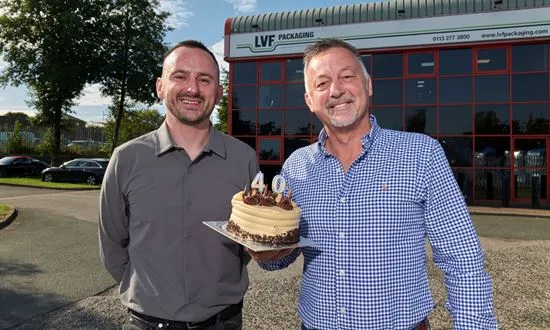
Harry Coates and his son Nigel began Leeds-based LVF Packaging by building a small vacuum forming machine as a project that was meant to keep Harry occupied following his retirement from Leeds-based games company, John Waddington’s – with the first business secured coming from Waddington’s itself.
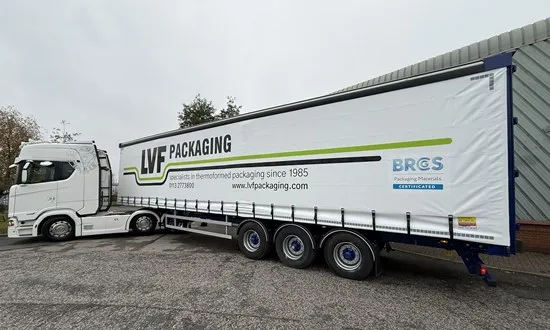
Forty years later, the business, which was initially known as Leeds Vacuum Formers, is run by Nigel’s son, Daniel.
It turns over £9m per annum; is based in 25,000 sq. ft. premises on the Hunslet Business Park in Leeds; and its products can be found on the shelves of virtually every leading supermarket chain in the UK, plus a plethora of High Street shops.
Daniel Coates provides insights into how the market has changed over the years; past, current and future trends; and the challenges packaging manufacturers face in a world where everything is scrutinised to the ‘nth degree’.
What are you early memories of the business?
I wasn’t even born when my dad and grandad decided to build that first ever thermoforming machine in the garden shed. But I love that they decided it was a good idea, went ahead, did it and then somehow persuaded John Waddington’s to award them the production of its board game plastic trays.
And the business has overseen a fascinating period; the birth of the internet, digital technology and communications. A virtual reinvention of how new products are developed. New materials, new manufacturing processes, entirely new markets. And a focus on sustainability and green practices that probably never crossed the mind of manufacturers, retailers and consumers back in the mid-1980s.
Are there any developments that you’d say have been game changers for the business?
There have been two big game changers for us over the last 40 years. In the early noughties we got BRC Accreditation for the first time, which opened up the food market to us. And to give you an idea of what a game changer that proved to be, today 90% of our business is food packaging.
We sell directly into Morrisons – you’ll find our logo on a lot of their meat packaging – but trays and packs manufactured by us are in virtually every other supermarket in the UK; supplied into them by food producers and the supermarket’s buying arms.
Secondly, in around 2010, we brought product development in-house – cutting associated costs and putting the timescale of new product creation and sales firmly in our own hands. Both of these changes turned us from a small business into one that could begin to look big, but we did it in a way that didn’t sacrifice our key, founding principle – caring for our customers through the delivery of high-quality products, which will always be supplied on time. And, of course, we will also always compete on price.
What has been the biggest change in the industry as a whole?
Back in the early days (so I’m told!), there was a whole load of different materials that were specified by customers and required to be stocked and used by manufacturers. The main ones were PET, PET-G, HIPs and PVC. Their use wasn’t standardised – what one client used PVC for, another would want PET. So the onus was on businesses like ours to be prepared. PET already stood out from the others at the time – especially in the thermoformed packaging industry, where it was seen as ideal for a multitude of packaging applications, in particular confectionery, due to its impressive levels of rigidity and clarity. And when combined with its low production costs, it started to become the material of choice.
When rPET came along the entire picture changed. PET-G, HIPs and PVC fell completely out of favour; and PET was overshadowed by its newer, greener little brother, which at the time had a minimum of 30 per cent post-consumer waste content. Since then that percentage has grown and grown and today we offer packaging solutions using rPET with a 100% recycled content for those who want it.
The pressure on the packaging industry over the last few years to move away from any form of plastic has been huge, but where are we now?
There’s been a lot of time and money spent on looking for alternative materials, which will deliver all the benefits of rPET, but with none of the perceived drawbacks of plastic. The truth though is that we’re no closer to finding one and that’s because plastic is still the only viable option.
If you’re trying to package burgers, mince – pretty much any meat –there’s still no better material than clear rPET mono. It’s highly recycled, highly recyclable, has great barrier properties and keeps the food fresh for longest. And, from a purely business point of view, it’s the cheapest material. Everyone knows those facts, which is very much why no alternative material has been found.
There are some areas that have moved away from plastic packaging – most notably confectionery, where cardboard is now in the ascendancy. Just take a look at the Easter eggs when they hit the shelves. They used to represent a big chunk of business for us, but that’s gone now.
Interestingly, while the plastic packaging debate has raged, our turnover and sales have increased every year. And that’s only going to go one way because of improved recycling streams, increases in recycled content in the materials used and the fact that a significant number of businesses that switched from plastic to cardboard are coming back. Put simply, if you’ve got a clear rPET, mono skin pack then it is guaranteed that it can be recycled. In comparison; cardboard with a PE liner to allow it to be sealed can’t be recycled. Carboard that food has soaked into can’t be recycled. And the consumer is very unsure what cardboard products can be recycled and what can’t. All we really need to stop the plastic arguments is for the Government to take the money raised by the Plastic Packaging Tax and pour it into developing proper, joined up recycling streams across the entire country. Removing any confusion and helping to create a truly circular economy for plastic packaging.
What else should we be looking out for in the packaging world over the next few years?
Because of the Plastic Tax, customers want to protect profits by reducing the weight and size of packaging manufactured for them. This desire to take the weight out of everything will lead to a significant change in how packs look. The compressed mince packs we see in many supermarkets could well be the shape of the future – although a lot of customers seem to dislike the look and feel of them, which may send everyone scurrying back to the drawing board searching for inspiration. From a manufacturer’s perspective, it’s all about efficiency. To remain competitive, we need to use as little material as possible and still make as good a product as possible. And this needs to be done while making sure that the material is as highly recycled and as recyclable as possible. It’s quite the challenge, but we love nothing more. Interestingly, there’s been a change in the way we’re asked about recycling. It used to be – is it recyclable? Whereas recyclability is now very much assumed, so instead the question is how recycled is it? As a result, the amount of recycled content will continue to grow – right up until everything is made out of 100% recycled material. Something we’re close to offering our customers. Another major consideration will be the carbon footprint. It isn’t a big part of things at the moment but over the next decade it will become vital. Where are you getting your energy from? How green is it? And as packaging is an energy intensive process – no matter what the material – there’ll be a huge focus on that. To prosper as long as we have, we’ve always had to be ahead of the curve with new trends and legislative changes, and with green energy we’re certainly there. We have a solar system that will run our factory on solar energy alone on the sunniest of days and a battery that saves energy generated on non-operating days. And as technology develops, we’ll develop with it.
Looking at 2026 – what issues will be sticking out for you?
We used to be a very seasonal business – with big surges in production requirements for the Christmas and Easter periods. This has certainly altered in recent years and we’re very much busy all year round. With EPR now in full effect we expect 2026 to very much follow-on from 2025 in which will be doing all we can to reduce the weight of packaging. We’ve already reduced material gauges on many lines as far as they can go, but we’re starting to see customers investing in equipment that will allow them to process even thinner gauge items. We’re also seeing a push to reduce tray sizes. Where products may have been in an industry standard size previously, we’re now seeing requests to place them in the next size down or in some cases in bespoke trays. The aim being to get the packaging as efficient as possible. Given our in-house design capabilities and the flexibility we have in production, this works well for us and we feel we are well placed to help with our customers’ needs to trial new sizes and gauges.
Comments are closed.