
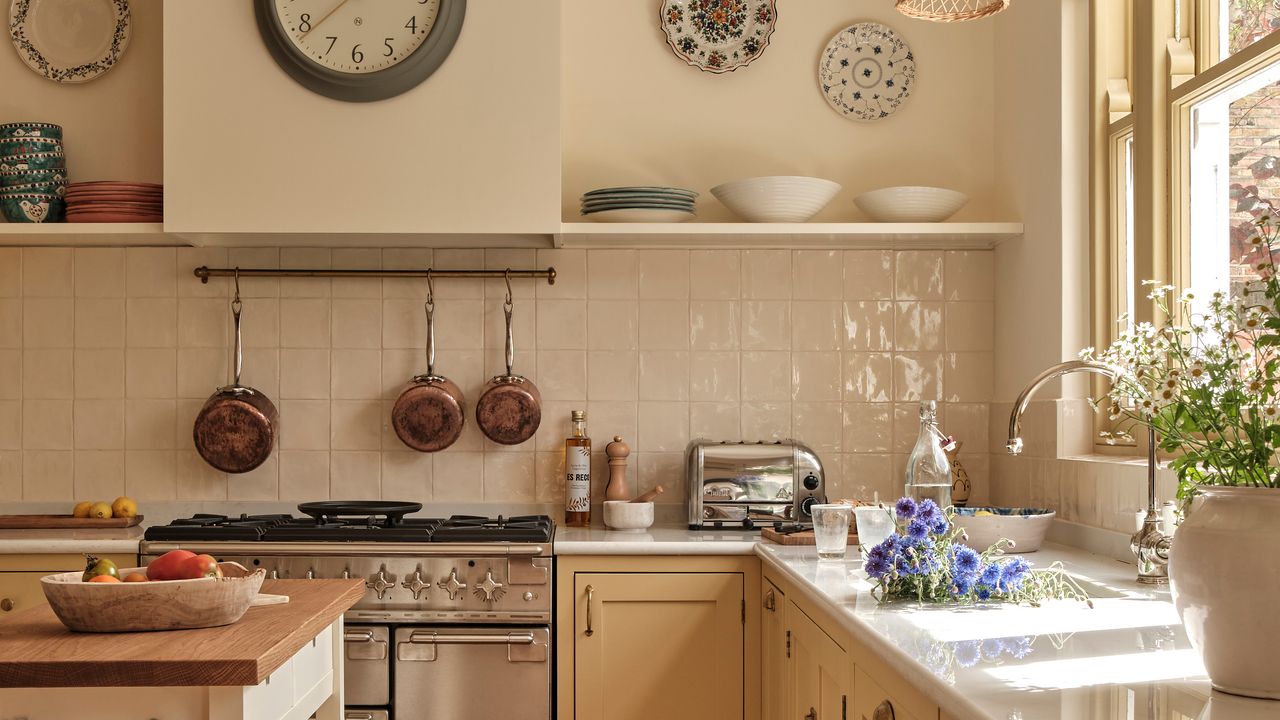
It is not just designers who are favouring yellow as a room’s canvas. Paint experts are also falling in line. Edward Bulmer, whose eponymous natural paint company offers each of its shades in a variety of strengths, likes to suggest sticking to the shades made using the earthy yellow ochre pigment (as opposed to its brighter mineral counterpart, Manganese Oxide). For him, Persian Ochre, Warm Stone and Quaker are all shades made using predominantly yellow ochre.
Lucy also points out that yellow can beautifully complement wallpaper with similar tones in it. In a recent London project, the dark hallway was wallpapered in GP & J Baker’s ‘Fern’, which has shades of yellow in it, and the ceiling painted in ‘Lute’ by Edward Bulmer – a favourite of Lucy’s. ‘I chose the 60% strength, which is not quite as overpowering as 100% might be in a space like this, but it’s gentle but really warm and adds a sense of light. It also blends really well with the wallpaper, where a white might jar’.
Is it any yellow that can work, or only certain shades? According to Brandon Schubert, ‘warmer, richer yellows are easier to work with. [I’m] thinking about India yellows, which often skew towards orange, or stronger egg-yolk yellows, which feel like purer yellows’, he says. Brandon explains that the richer colours are more flexible in different lights, and tend not to change appearance as much as paler ones, which can be tricky if you’re using it as a neutral base throughout the house. Lucy’s go-to’s certainly have these bolder undertones, though are the perfect balance of warm yet understated: for her Edward Bulmer’s ‘Indian Block Yellow’ and ‘Buff’ and Atelier Ellis’ ‘Sadhika’ are perfect.

Interior designer Natasha Quick urges us to ‘always look at the light in the room, as a south facing room with buckets of light will bring out the yellow pigments even more so test your shade of colour in the space first to see how it feels’. ‘Lute’, the Edward Bulmer shade which enlivened the aforementioned hallway ceiling, is also one of Natasha’s favourites, being one of the ‘earthy yellows’ that she gravitates towards.
Now you have a great neutral, you can think about how to introduce colour through other means – and which ones would work best. Lucy is a firm believer that you can put most colours with it (even, she delights, yellow, having recently discovered that a mustard-coloured sofa from Susan Deliss was a fantastic pairing for her sitting room walls in a lighter yellow). For Brandon, ‘greens and oranges are great with yellows. Blue and purple are trickier to get right, but can create a high-intensity contrast that really brings the room to life’. Natasha is partial to a quieter pairing, suggesting subtle layers of neutrals. ‘Yellow is wonderful paired with a yellow based white like Pointing from Farrow and Ball. It just adds another layer to the eye, working together with all your other textures and fabrics adds to a wonderfully warming and sophisticated space’.
Comments are closed.