
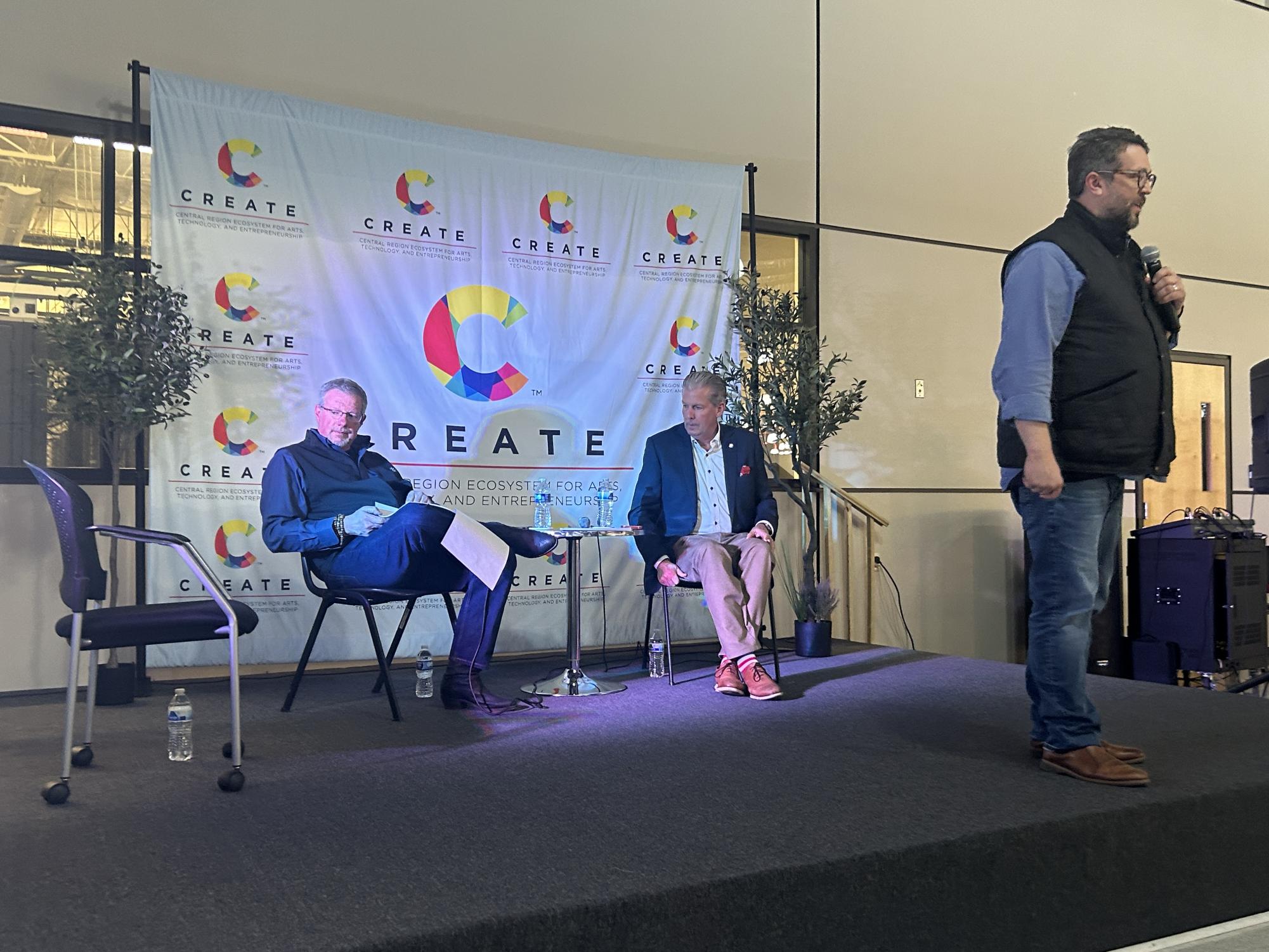
A Startup Garden event at WKU’s Innovation Campus on Thursday provided insight into the Warren County government’s plans for the region’s future.
The event centered on the BG 2050 Project, an initiative commissioned by the Warren County government that seeks to prepare the area for its projected growth to nearly twice its current size by 2050.
The BG 2050 Project is backed by InnoEngine, a strategy firm that “helps organizations across sectors unlock new value, often by doing something they’ve never done before, or through a model they haven’t used before,” according to its website.
Startup Garden is a speaker series hosted by Central Region Ecosystem for Arts, Technology & Entrepreneurship, a client of InnoEngine. The events focus on serving local entrepreneurs whose businesses have potential for audiences beyond the region.
Speakers at the Startup Garden included InnoEngine founding partner and CREATE Innovation Fellow Sam Ford, Warren County Judge Executive Doug Gorman and CREATE Programs Director and WKU Innovation Campus CEO Buddy Steen.
“As Nashville is one of the fastest growing cities in the United States, attracting a lot of tech and creative talent, the Bowling Green area has to think about the part it plays just north of Nashville,” Ford said.
Sharing Ford’s sentiment of learning from other cities, Steen discussed the reason for BG 2050’s creation.
Steen remarked that Murfreesboro, Tennessee saw a dramatic increase in its population in a short amount of time, and that this uncontrolled surge didn’t benefit residents’ standard of living. “So our leadership, with Doug Gorman, created a BG 2050 group to look at how we can grow like Murfreesboro in size, but do it in such a way that it happens for the good of the people,” Steen said.
Gorman looked to the future as well, hoping that the region’s economy could become more diverse.
“We’ve been very, very successful at attracting manufacturers here to the community,” Gorman said. “But a couple years ago, we started to realize we also need to start adding more tools to the toolbox.”
During the event, the speakers provided an overview of how BG 2050 worked with machine learning tools Polis and Jigsaw to launch “What Could BG Be?,” which Jigsaw’s website describes as “the largest town hall in United States history.”
Polis, a machine-learning system designed to survey input from large groups of people, allowed Bowling Green residents to provide input on how they’d like to see the community develop.
Over the course of one month, participants contributed 3,940 ideas, which 7,890 participants voted on. In the end, participants weighed in on these ideas 1,034,868 times.
After collecting this data, Jigsaw, an AI designed to examine large quantities of information and generate solutions from it, generated a report highlighting subjects for BG 2050 volunteers to explore and develop recommendations for Warren County leadership.
The final report released to the public highlights areas such as infrastructure, transportation, economic development, environmental sustainability, affordable housing and education.
Following the event’s conclusion, Veronica Butler, a sophomore triple-major in international affairs, political science and Mandarin Chinese, said she was excited for Bowling Green’s future.
Butler said while the task of adjusting to Bowling Green’s upcoming growth may seem scary, she’s excited to see “where we go next.”
“When you look at how our community is ready to support our small businesses, bring new people in and really raise our economy from the ground up, it makes it really a lot more exciting than scary,” Butler said.
Comments are closed.