
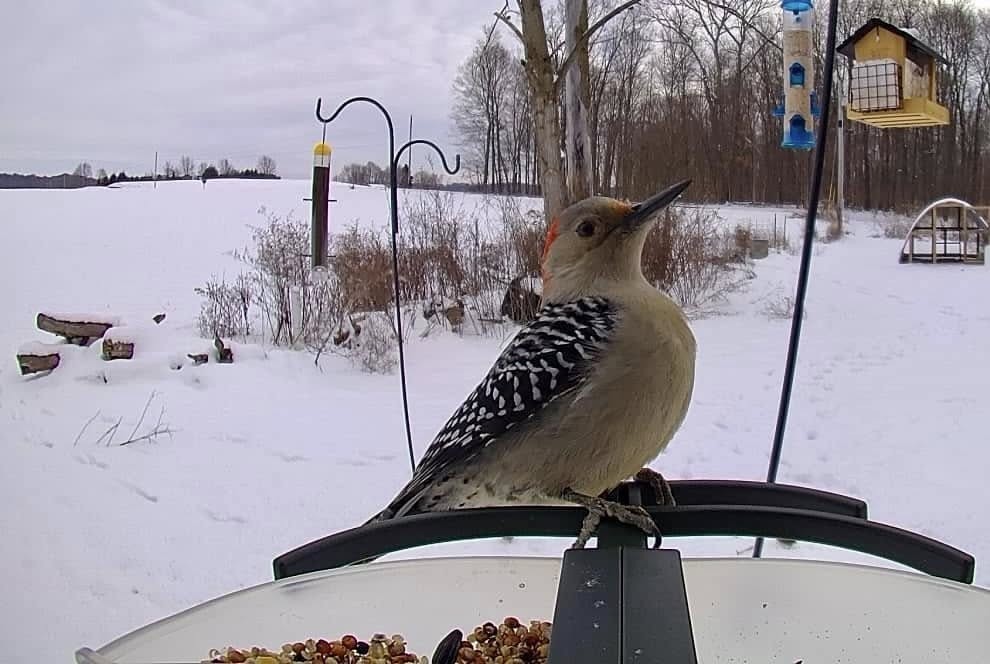
Starting in late fall, I feed the woodpeckers suet cakes. A while ago, I was at Home Depot picking up a shovel for a job when I heard someone asking how to fix a woodpecker that was leaving holes in their barn.
One of my readers was standing at Home Depot and asked if we could solve this problem organically. These folks couldn’t tell me the type of insect we were looking at. Our woodpeckers are like my grandson.
My grandson only likes to eat specific foods, and it takes a lot to get him to venture beyond his usual menu and try something new.
One of my regular companions this time of year is an insect eater, a huge Red Headed Woodpecker (Melanerpes erythrocephalus), who really likes the peanut butter and suet cakes that I set out on a tree in my front yard.
After feeding a few generations of woodpeckers, they all know where to get breakfast.
When this large bird flies onto the tree feeder, the rest of the birds scatter to other shrubs and trees. This large bird acts as the boss bird at the feeder.
If you compare the Woodpecker to the tiny Sparrow, it’s no wonder they scatter and give him space. Woodpeckers feed primarily on beetles, grubs, and ants when they start hammering with their beaks.
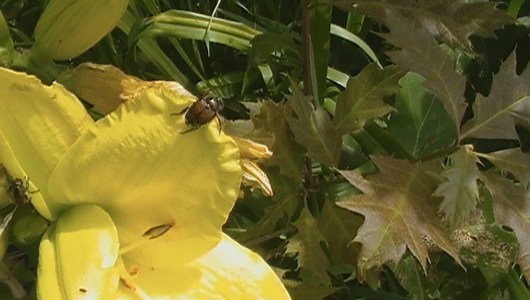 This woodpecker beetle is feeding on a day lily. Credit: Eric Larson.
The other side of this story is the insect that the Woodpecker focuses on. From an entomological perspective, woodpecker activity is typically associated with the presence of specific insect taxa.
The principal suspects include termites (Isoptera), powderpost beetles (Lyctinae), carpenter ants (Camponotus spp.), roundheaded borers (Cerambycidae), carpenter bees (Xylocopinae), and sawflies (Symphyta).
Of these, only beetles and ants are primary dietary targets for woodpeckers. Accurate pest identification is essential, as effective management strategies depend on targeting the relevant taxa which will narrow down how you would address the pests.
One challenge in properly treating a pest problem is identifying the pest accurately. If you don’t identify the insect, as you may guess, you may not adequately treat the problem.
Barns are normal magnets for these pests, this mean that you may be looking at either type of insect.
Replace the damaged wood on your barn and coat the adjacent area with insect wood treatments with Borax-based compounds. Boracare is one of the products I recommend.
You may try Chlorpyrifos or Timbor. Keep in mind these are toxic and need to be handled with caution. Diatomaceous earth and boric acid can help destroy nests.
There are several botanical insecticides that are less toxic than traditional chemicals. Then apply a coating of paint, shellac, varnish, paraffin wax, or another wood coating to the unfinished wood.
If you regularly inspected the piles of unfinished wood around your house and removed them, you would come close to controlling the problem.
Round head borers are a little different, but you wind up with most of the same treatments.
If you have not used kiln-dried wood with a moisture content below 20% and then treated it, the problem may persist.
This may just be the start; you need to keep your eyes peeled for further infestation. I read that a crushed mothball and vinegar mixture has been used to kill these beetles by placing a container of the mixture near the infested wood.
Carpenter ants (Camponotus spp.) are a little different.
Target these ants with a compound called Ortho-Klor Ant Killer Dust. The infected areas around the building’s base, such as baseboards, window sills, and door frames, need to be treated with this compound.
If possible, treat the nest. Logs, wood piles, and stumps near any of these areas need to be removed. So that these insects don’t get back into the barn, you really should seal up as many of the paths into the barn as possible.
Sealing structural ingress points is a fundamental aspect of effective long-term exclusion.
In cases of severe or intractable infestations, fumigation may be the ultimate solution to these pest problems. Professionals should be brought in at this point.
The dangers you face can be dramatic. Just like the Kenny Rogers song, know when to hold them and know when to fold them. What I’m saying is that you need to know when to get a professional.
It is important to recognize that woodpecker activity serves as an indicator of underlying entomological issues. Attack the food source to solve the problem.
I hope that you have a good stroll through your garden this week and see some early flowers. Woodpeckers can be both a form of entertainment and a challenge. If you have a challenge, drop me an email at ericlarson546@yahoo.com.
Comments are closed.