
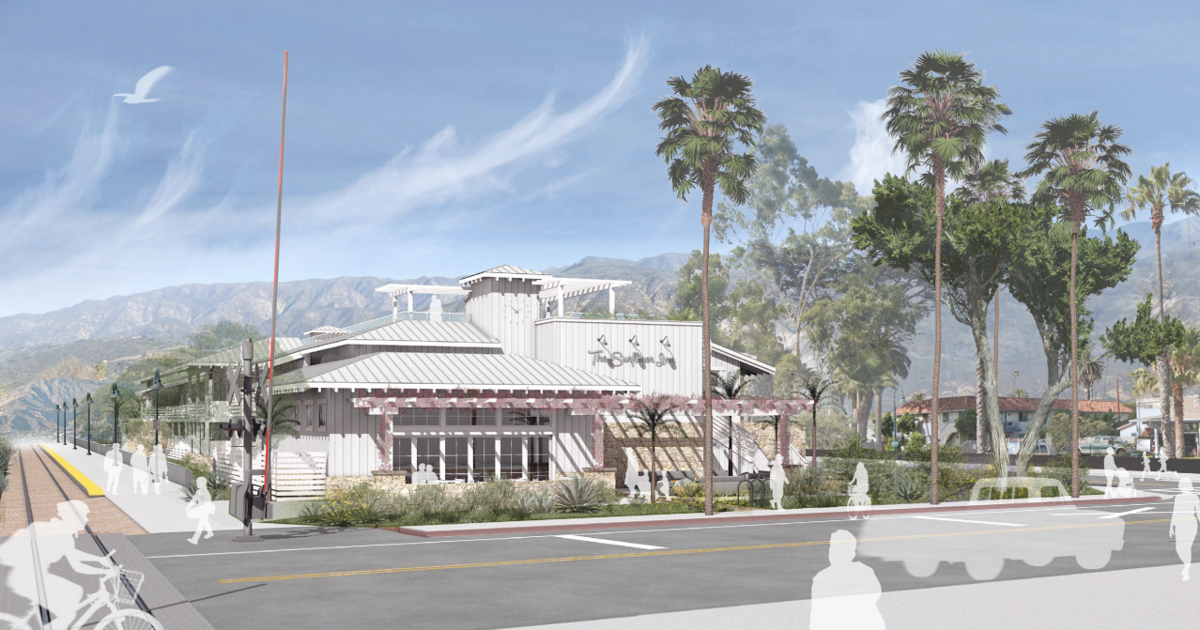
Concerns about parking safety, wildlife movement and the future of Carpinteria’s community garden dominated public comment Wednesday as the city of Carpinteria’s Environmental Review Committee (ERC) reviewed the Draft Environmental Impact Report (EIR) for the proposed Surfliner Inn Project.
After hearing a staff presentation and nearly two hours of public testimony focused largely on alternatives to the project — including options that would reduce or eliminate a proposed new public Parking Lot #4, alter parking configurations, extend existing Parking Lot #3 and relocate the community garden or remove the inn’s rooftop amenities — the committee voted unanimously to forward the draft EIR to the Planning Commission with a list of requested clarifications and potential revisions.
The ERC is chaired by the city’s Community Development Director Nick Bobroff and includes Public Works Director John Ilasin, city of Carpinteria Environmental Program Manager DeLayni Millar, Vince Simonson and Jenny Slaughter, who was not present for the meeting.
“Our responsibility here is to make a recommendation to the Planning Commission … with any comments or feedback or recommendations that we have for additional information or analysis,” Bobroff said, emphasizing that the committee is advisory and does not approve the project or the environmental document.
Ilasin made the motion to forward the draft EIR to the Planning Commission, subject to staff addressing the committee’s comments. The motion passed unanimously.
Project overview and review process
Principal Planner Mindy Fogg, the city’s project planner, and consultant Brian Allee of Environmental Science Associates presented highlights from the draft EIR, which was prepared under the California Environmental Quality Act (CEQA).
The proposed project from project applicant 499 Linden Manages, LLC at Linden Avenue and the railroad tracks would build a two-story, “contemporary cottage style” hotel with 36 guest rooms and a footprint of about 15,500 square feet, along with a manager’s unit, visitor center, back-of-house offices and a café, according to the presentation. A rooftop lounge would include a bar, event space, and a pool and spa.
The project also proposes changes to city parking: a reconfigured Parking Lot #3 with 46 surface spaces and a new public Parking Lot #4 with 93 spaces, plus a public restroom and other site features, staff said.
Allee said the draft EIR analyzes 16 issue areas, including aesthetics, air quality, biological and cultural resources, geology, greenhouse gas emissions, hazards, hydrology and water quality, land use, noise, transportation and utilities.
Public review of the draft EIR runs from Jan. 22 through March 9, with written comments due by 5 p.m. Monday, March 9, according to Fogg’s presentation. A Planning Commission hearing date has not yet been announced.
Alternatives take center stage
Much of the public comment focused on the EIR’s five analyzed alternatives:
• No Project Alternative
• Alternative No. 1: No New Parking on Lot #4
• Alternative No. 2: Single-Loaded City Parking on Lot #4
• Alternative No. 3: Extended City Parking Lot #3 and Relocated Community Garden
• Alternative No. 4: No Rooftop Uses (no rooftop bar, seating, event area or pool)
Fogg said the alternatives were selected to reflect concerns raised during the earlier notice of preparation and scoping process, including questions about the location and configuration of Lot #4 and potential noise from rooftop activity.
Wildlife corridor dispute and calls for surveys
Committee member Vince Semonsen, a biologist, raised early questions about the EIR’s biological resources discussion, pointing to what he described as conflicting language about wildlife movement along the rail corridor near the site.
“One says there is no wildlife movement along the railroad corridor, but the other one says there’s possible wildlife movement … between the Carp Marsh and Carp Creek,” Simonson said, adding that the connection between the Carpinteria Salt Marsh area and other open spaces “seem to be important to keep connected.”
Later, multiple speakers echoed those concerns and criticized the draft EIR for relying on existing data rather than field observations.
Kristin Larson, an environmental attorney with Tellus Law Group speaking on behalf of homeowners Marla Daily and Kirk Connelly who live adjacent to Lot #4, told the committee she saw “no evidence that actual surveys, physical surveys of wildlife use, movement, reliance on or movement through” Lot #4 were conducted. She also said a letter from the California Department of Fish and Wildlife included recommendations she did not see reflected in the draft EIR.
Giti White, a Beach Neighborhood resident, argued the report incorrectly dismissed habitat value because Lot #4 is not riparian. “It is a historic wetland area that periodically inundates,” White said. “There is no evidence anybody walked the land.”
Ariana Katovich, also speaking for Tellus Law Group, urged the city to conduct “comprehensive wildlife movement and nighttime analysis” to capture dawn, dusk and overnight conditions, when she said many terrestrial animals move through urban-adjacent open spaces.
In committee deliberations, committee member Semonsen said additional documentation would help resolve disputes over whether Lot #4 functions as a corridor.
“They definitely could use some additional studies of Lot #4’s open space — cameras … nighttime, daytime,” Semonsen said, calling such monitoring “pretty standard in wildlife studies now.”
Millar agreed and suggested broadening the study area to compare open space and residential conditions. “A lot of the concerns were about the wildlife corridor there,” she said. “It would put everyone’s mind at ease if we had studies there.”
Community garden relocation draws sharp criticism
Alternative No. 3, which would extend Parking Lot #3 and relocate the community garden, prompted some of the most pointed testimony.
Susie Anderson, who said she has lived in Carpinteria about 35 years, told the committee the draft EIR did not adequately address impacts of moving the garden, which she said has been in place for nine years.
“As a result of those nine years of mulching and composting and growing with strictly organic material, the soil of the garden … is loamy, open and productive,” Anderson said. She argued relocating it would destroy a mature, living ecosystem and require years to rebuild soil health and habitat.
Teda Pilcher, a community gardener for nearly a decade, said the garden’s current setting — including mountain views and its role as a gathering space — is part of its value. Relocation, Pilcher said, would mean “undoing all the work” gardeners have put into the site and would change sun exposure and the garden’s character.
Several speakers also questioned whether moving the garden to an area near Lot #4 would expose it to additional shadow, noise and disruption.
Parking and safety: “Not CEQA,” but still a dominant theme
While staff repeatedly noted that parking supply and traffic congestion are generally treated as social and economic issues outside CEQA’s environmental scope — particularly after a statewide shift in traffic analysis to vehicle miles traveled under SB 743 — speakers argued parking and circulation create real safety and environmental consequences in the project area.
Bobroff pressed staff on why parking impacts were not addressed more thoroughly in the draft EIR’s transportation section. Fogg said CEQA focuses on physical environmental effects such as air quality, noise and biological resources, and that parking sufficiency and congestion are typically evaluated during project planning rather than in an EIR.
Deputy City Attorney Cody Sargeant added that traffic analysis standards changed after SB 743, shifting the focus away from congestion.
Even so, speaker after speaker described the proposed Lot #4 access as hazardous because of its proximity to the rail crossing, heavy pedestrian activity near The Spot restaurant and the mix of bikes, cars and visitors.
Public commenter Victor Garza said the draft EIR did not include what he described as key agency responses, including feedback from the California Public Utilities Commission about safety issues near the tracks. He also criticized a drainage analysis that treated a decomposed granite path as impervious.
Resident Leslie Gascoigne argued the city should obtain a new parking and traffic study that reflects recent development and changing downtown demand, including newly opened or approved projects. Gascoigne questioned assumptions behind shared or “conjunctive” parking and urged the city to study peak-season conditions.
Sean White called the proposed left turn into Lot #4 “a suicide mission with a train track attached,” and criticized the EIR’s conclusion that the project would have less-than-significant aesthetic effects.
Nathan Pratt, who said he conducted his own parking analysis, argued that hotel operations are effectively “24-hour” uses and that shared-parking assumptions “are not considered a best practice” for hotel planning.
During committee feedback, Bobroff said that while the city is limited under CEQA in how much it can evaluate parking supply and congestion, the draft EIR’s discussion of transportation hazards could be strengthened.
“I do think that the discussion about hazards in the transportation section could use a little bit more in-depth discussion about … turning movements in and out of Parking Lot #4 and potential for conflicts with pedestrians and cyclists,” Bobroff said.
Millar also referenced the volume of public concern about traffic and parking and suggested an updated study could help.
Fogg said staff would “take a harder look” at the transportation discussion within the limits of CEQA and intended to bring more traffic and parking evaluation to the Planning Commission as a planning consideration outside the EIR.
Aesthetics, view corridors and photo simulations questioned
Multiple speakers argued the draft EIR’s aesthetics analysis understated the project’s effect on Carpinteria’s “small beach town” character and key views toward the ocean and mountains.
Local Annie Sly cited city General Plan objectives and policies that call for preserving unobstructed views and development compatible with surrounding patterns. Sly said the key viewpoint photos and renderings in the draft EIR were misleading and did not accurately reflect how the building would appear from Linden Avenue and nearby streets.
Resident Gary Campopiano echoed that criticism during public comment, arguing the analysis relied on photos taken from “unusual locations” and in conditions that obscured ridgelines. He urged the city to provide a more accurate three-dimensional analysis of view impacts.
Flood maps, stormwater and “DG path” dispute
Katovich raised concerns about flooding risks and urged the report to incorporate updated FEMA mapping and the city’s hazard mitigation priorities.
Ilasin, who also serves as the city’s floodplain administrator, confirmed that updated FEMA floodplain maps have been approved and that the new flood insurance rate maps will take effect June 10. He suggested the draft EIR be corrected to reflect that update for consistency.
Several commenters disputed the stormwater baseline used in the EIR’s hydrology analysis, focusing on whether a decomposed granite path on Lot #4 should be treated as impervious. Garza and others said the path appeared to absorb rainfall during recent storms and questioned whether the drainage conclusions accurately reflected current conditions.
Bobroff asked staff to “dig into that a little bit more” and clarify how perviousness assumptions affected pre- and post-project runoff analysis.
Committee’s requested refinements
Beyond the calls for wildlife monitoring and clarified hydrology assumptions, Bobroff highlighted several specific items he said should be strengthened or cross-referenced in the final EIR and related conditions: add a replacement obligation for trees intended to be protected in place if they die due to construction impacts; cross-reference cultural resources mitigation to reflect both an archaeologist and a tribal representative monitoring ground disturbance; note that although municipal code allows broad construction hours, the city typically imposes more restrictive hours for large projects; and expand discussion of pedestrian and cyclist conflicts near the proposed Lot #4 driveway.
Ilasin also noted a terminology correction in the transportation section, saying references to a “Class 2 bike path” should be reviewed because a Class 2 facility is a bike lane.
Fogg told the committee many comments were technical and would be addressed through responses to comments and potential revisions in the final EIR. She also said the notice of preparation date is typically used as the baseline for an EIR, but that staff would consider whether updated information — such as revised FEMA maps — could be incorporated.
Fogg added that the project objectives included in the draft EIR were drafted by staff during EIR preparation and were not previously adopted by the City Council or other hearing bodies.
With no further comments, the committee voted to recommend that the draft EIR move forward to the Planning Commission with the committee’s requested changes and clarifications.
Written comments on the draft EIR may be submitted to the city through 5 p.m. Monday, March 9, according to the project schedule presented at the meeting.
Comments are closed.