
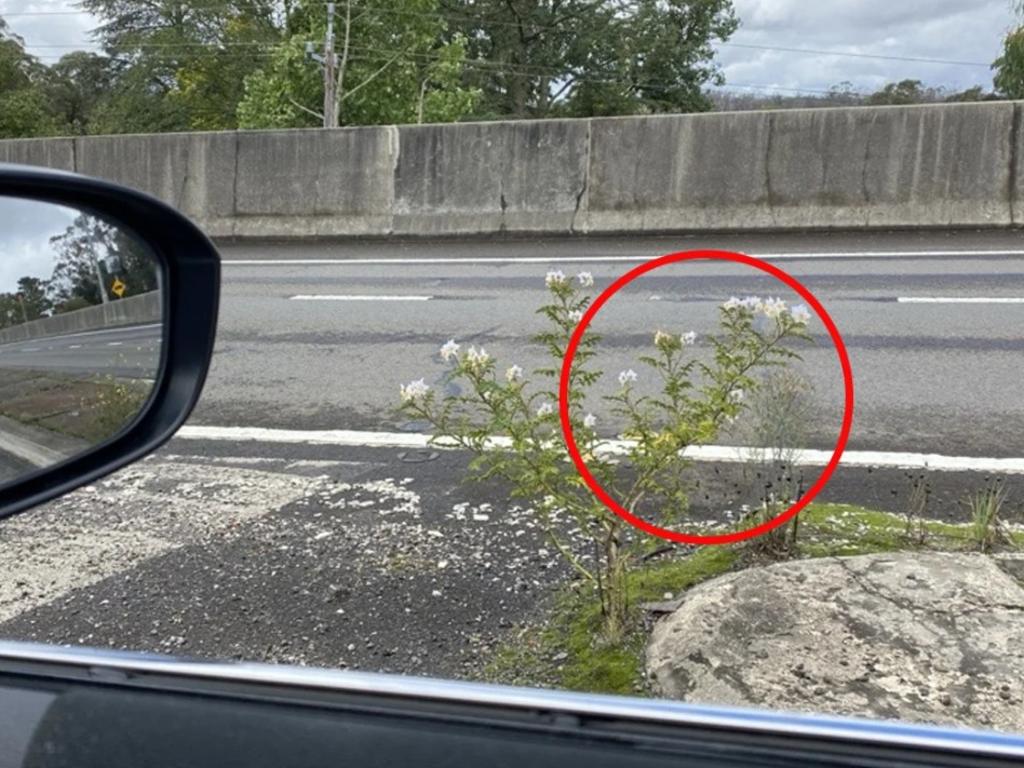
Aussie homeowners have been issued an urgent warning to stop mowing as a toxic weed spreads across the country.
Authorities say sticky nightshade “will actually spread” when mowed or chopped, making the gardening problem worse.
Greater Sydney’s Local Land Services (LLS) renewed the alert this week after the species were spotted along roadsides throughout the city.
“Sticky nightshade is more than a weed; it’s an invasive pest that can injure your animals and choke out your pasture,” it warned.
“Growing up to 1.5m tall, it’s covered in nasty prickles with white or pale blue star-shaped flowers.
Mowing or slashing this will further spread it, the LLS said. “If you see it, report it to your local council biosecurity weeds officer.”
MORE: Trapped Aus tradie’s urgent caravan warning
Woman’s $240k bill after neighbour’s act
Couple pays $39k after sad 25m dirt ‘regret’

Authorities say sticky nightshade “will actually spread” when mowed or chopped, making the gardening problem worse. Picture: Greater Sydney LLS
Research from the CSIRO and the Centre for Invasive Species Solutions found that the cost of weeds is about $4.9 –$5 billion per year.
Over the past 60 years, invasive plants have cost Australia around $200 billion, making them more expensive than feral cats or rabbits.
Dr Carol Booth from the Invasive Species Council told Yahoo News that billions were being spent annually to remove escaped garden plants.
Aussies have labelled sticky nightshade “bad news” on social media as it spreads through NSW, Victoria and Queensland.
“This weed is bad news. I have seen it coming up in cracks in concrete and in relatively undisturbed bushland,” one woman said.
“Needs a higher biosecurity rating and funding for mapping.”
“This is all along the Great Northern Road, which will see a lot of transport with the opening of the new airport. Everyone seems to just watch it grow and spread,” a second said.
“Northwest Sydney is covered in it,” a third commented.

Sticky nightshade is considered an invasive weed in several Australian states as it produces lots of seeds, which help it spread rapidly. Picture: Greater Sydney LLS
Most records indicate that sticky nightshade arrived in Australia as a contaminant in imported horse or drought fodder.
While it was first recorded in Toowoomba, Queensland in the 1920s, it has seen a “marked rise” in records over the last few decades.
The species has since been documented in Western Australia, NSW, Victoria, the ACT, and Queensland.
“Governments should be putting a lot more resources into elimination and prevention,” Dr Booth said.
The expert warned that without more action, future generations would be left to manage “yet another invasive threat.”
Sticky nightshade is considered an invasive weed in several Australian states as it produces lots of seeds, which help it spread rapidly.
MORE: Tradie’s warning after 6m Aussie backyard find
Horrifying reason tenant forced out of home
Aus warned: Blur your home on Google Maps
Comments are closed.