
Milli Proust is standing in the expansive walled garden of her new home, a Grade II-listed farmhouse set in 58 acres on West Sussex’s South Downs. There are characterful, gnarly trees and an ancient wisteria winds its way across the front of the house, but mostly it’s a vast, bare and very muddy blank canvas. “I have a strong sense of what I want to do and how I want it to feel,” says the floral designer and flower farmer, who moved here a few months ago with her husband Ted Dwane, bassist for the band Mumford & Sons, and their three-year-old son Rex. “But I’m going to allow it to unfold and not jump ahead.” For now, beyond the stone walls there are mounds of builder’s bags, big machinery and tradesmen at every turn.
After years of cramming her previous garden with cutting beds and maximising every square inch with flowers, she finally has space. There are two large polytunnels for growing and a one-acre flower field. The house now links via glass walkways to an oak-framed barn, an HQ for the seed and floral design company she founded in 2018 and now runs with her business partner Paris Alma. But perhaps most exciting, for now at least, is the walled garden and the potential of a fresh start.
 In the Well Garden, a spring mix of Narcissus ‘White Marvel’ and ‘Bell Song’, Tulip ‘La Belle Époque’, Wallflower ‘Sunset Apricot’ and Fritillaria Imperialis ‘Orange Beauty’
  Yew topiary balls, Narcissus ‘Tête-à-tête’ and Euphorbia characias subsp. wulfenii in the perennial border
Making a garden from scratch is also the subject of her latest book, How Does Your Garden Grow? (Quadrille Publishing, £22), which covers planning, designing, planting and maintaining a space, and is illustrated with pictures of her first garden, just 10 minutes away from her new home. In 2017 she had arrived at the 17th-century timbered cottage surrounded by ancient woodland as an absolute beginner; she had only grown in pots and window boxes in London flat shares.
I became obsessed. I read so many books. I tried lots of different techniques and tactics and found what worked
She then spent almost a decade creating a cottage garden with tonal borders, beds and cutting patches. It was all resolutely lo-fi and low budget, but through it she learnt to be a gardener and grower. “I became obsessed. I read so many books” — Erin Benzakein’s Cut Flower Garden and Sarah Raven’s The Cutting Garden remain her go-tos. “I tried lots of different techniques and tactics and found what worked.”
She made a pale night garden where a succession of narcissus and hellebores was followed by pale wallflowers, tulips, foxgloves, roses ‘Gentle Hermione’ and ‘Desdemona’ and campanulas, jasmine and phlox. An old veg patch became a cut flower patch, enclosed by handmade coppiced hazel fencing and arches. And long flower beds were filled with peonies under-planted with scented geraniums, Alchemilla mollis and bulbs.
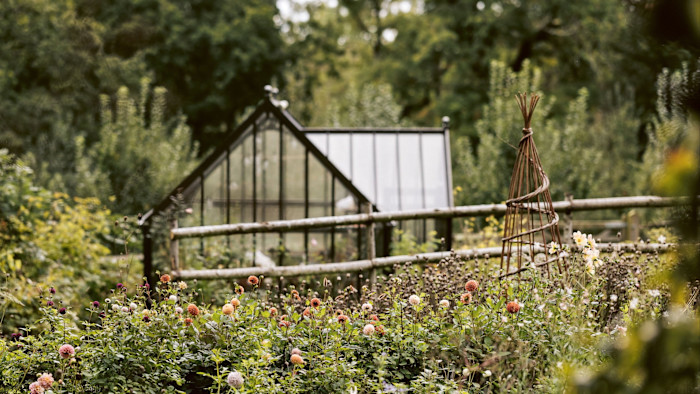
 A cutting patch of dahlias
Proust originally trained as an actor, a profession where, she says, you’re met with failure pretty much every day. But as a gardener she has embraced it, “figuring out what doesn’t work, and figuring out what does work, and then writing that down”. As a flower farmer the learning curve is fast and steep — failures are costly.
What can gardeners learn from a flower farmer? A great deal. In her book, Proust breaks down her approach to colour, which is dominated by subtle tonal shifts and tints. She grew up in London surrounded by art — her mother was an artist and Saturdays were often spent trailing around the Courtauld Gallery. “At home, colour was something we talked about a lot,” says Proust. “If someone isn’t confident with colour, they need to tap into how colours make them feel. Don’t worry about what’s trendy. Just listen to what you like, and then fill your life with it.”
 This year Proust is trialling 150 varieties of sweet peas
  Dahlia ‘Brown Sugar’ and Ammi majus (Queen Anne’s lace)
One of her most frequently asked questions is around succession and ensuring that there’s always something of interest in flower. She says it can be achieved in the most low-maintenance way by under-planting trees; in her first garden, a mini-orchard was under-planted with snowdrops, crocus, narcissi, Iris reticulata and species tulips, which were followed by camassias, Martagon lilies and Dutch iris. “Everything naturalises and expands year on year on its own. And you’ve got this incredible, biodiverse, beautiful space that means minimal maintenance.”
Starting over in her new house has brought some new challenges. “I’ve never really done hard landscaping before, it was always just me with a wheelbarrow making paths, and being really DIY about it,” says Proust. “I do know that I don’t have to get it right the first time, but I also know that it would be really nice if I did.”
 Stella waits with the seed trays ready to be planted out
Her first challenge was trying to make sense of the walled garden: “It felt like such a puzzle that I couldn’t crack open. I couldn’t envision it.” But she’s found an enthusiastic mentor and collaborator in Charlie Harpur, head gardener at the nearby Knepp Rewilding Project. Through historical research, he discovered that there had once been an orchard in the walled garden. Consequently, a magnificent pear tree then became a key focal point; a new path in cobbles and edged in flint now dissects the space, and grounds the layout.
This partnership is also impacting the way Proust is planting. A new studio garden, around four metres by eight metres, formerly a builder’s dumping ground of rubble and compacted soil, has provided an opportunity to plant a Knepp-style garden for resilient plants with a range of bumps and rainwater-capturing hollows that can support a wider variety of insects, small mammal and birds. “A garden is made beautiful if it is biodiverse,” adds Proust. “Birds swooping and bees working. I don’t think there’s anything more beautiful than walking through a garden filled with butterflies.”
 A garden is made beautiful if it is biodiverse,’ says Proust, ‘birds swooping and bees working’
  Peony ‘Germaine Bigot’, Phacelia and common foxglove
While she previously gardened on heavy clay — perfect for roses — across the site she is now faced with a triptych of different conditions from silty loam and clay to sand. She is approaching the variation as an opportunity to grow resilient plants that will thrive in dry conditions. “I’ve never had conditions to grow bearded iris and, my god, I’ve tried. I think they’re so stupidly beautiful.”
There are endless possibilities for the future too. A hay barn will one day be transformed into a cider barn for Dwane, who has his own cidery, Two Orchards, and the courtyard of stables around it is another blank canvas for another garden.
Recommended

For now, Proust is leaving the intense schedule and drama of wedding flowers and focusing on her seed business, supplying beautiful and productive flowers for cutting — this year she is trialling 150 varieties of sweet peas, and has just completed a trial of dainty violas. She produces 70 per cent of the seeds she sells (the remainder are from specialists) and each packet features her own illustrations. “We’re curious about finding interesting plants, and sharing that information and the seeds. We just love that idea of more flowers, not just here, but everywhere.”
Find out about our latest stories first — follow @ft_houseandhome on Instagram
Comments are closed.