
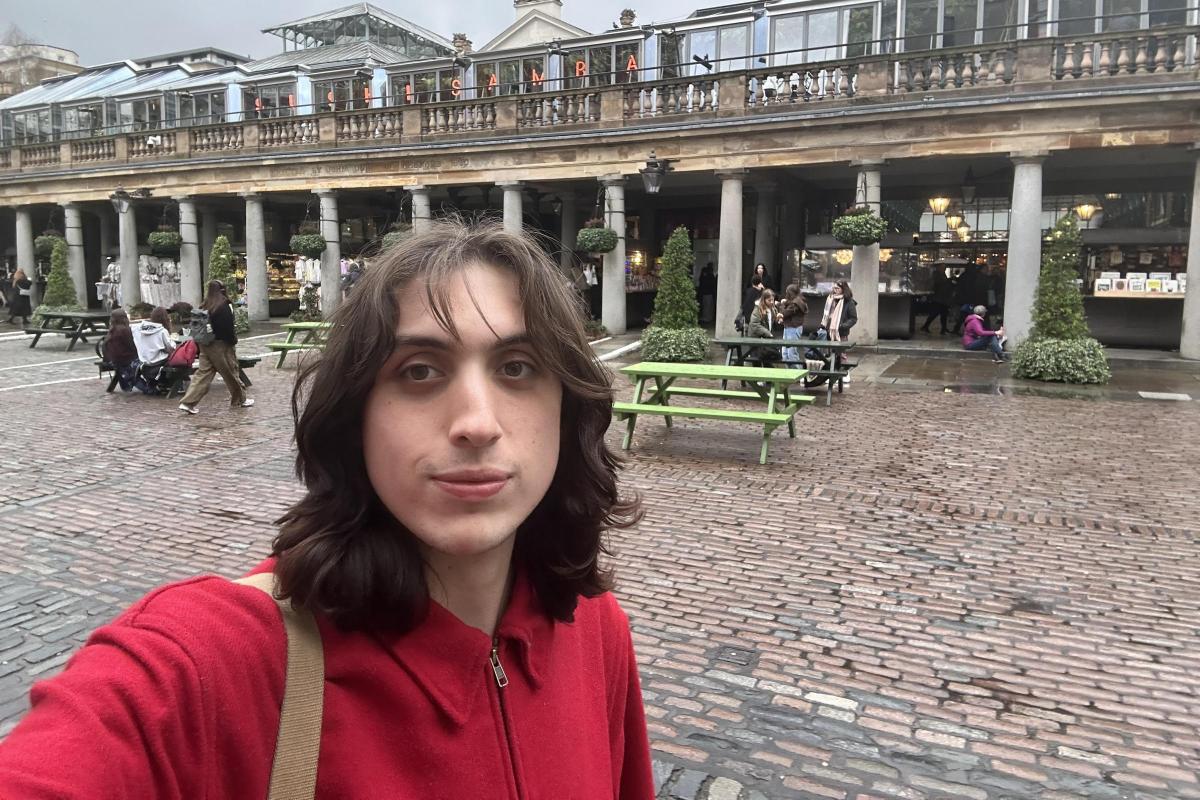
I’m Roberto, a journalism student from New York spending the spring in London. This is my first time in England, and I’ve been asking around for places to see.
One spot that kept coming up was Covent Garden—I’d never heard of it before arriving, but enough people mentioned it that I decided to go see what the fuss was about.
I arrived on the tube at Covent Garden station and quickly made a rookie mistake: I took the stairs. All 193 of them. Fifteen stories later, I staggered onto Long Acre and understood why everyone else had queued for the lift.
I walked down James Street toward the market, where a small crowd had gathered around a street magician.
James Street (Image: Roberto Carlos Thompson)
The performer was Samuel Osborne, who told me he’s been working at Covent Garden since he was 15. He picked up magic during lockdown, and a mentor pushed him to try performing live.
“One day, while visiting the market with my family, I saw a show and asked how the system worked,” he said. “Then I came along, brought my stuff, and now it’s my job.”
Street performance here dates back centuries, and Samuel and his fellow performers keep the tradition going with four or five self-managed shows a day.
He said the history gives the work a certain weight. “Its been a renowned tradition for a while, so it’s held in this kind of high esteem,” he added.
“When you say you’re a Covent Garden performer, people will go, ‘Oh! That’s you! So it’s a cool thing..”
I then made my way into the market itself, where a guitarist serenaded shoppers with Pink Floyd’s Wish You Were Here. A little on the nose, maybe—but I quite enjoyed it.
Segar & Snuff Parlour (Image: Roberto Carlos Thompson)
The first shop I walked into was the Segar & Snuff Parlour, a tobacco shop tucked inside the main market building. Inside, I spoke with a worker named Jean Paul, who told me he’s worked there for just over three years—after being a customer for 25. He said the shop has been in Covent Garden for 46 years and attracts a diverse clientele.
“Covent Garden is very diverse, so you get tourists who walk in and have a look,” Paul said. “We also have regulars and people who come specifically to this shop, especially for pipes.”
Paul also shared a bit of local history. “Covent Garden takes its name from a convent once linked to Westminster Abbey,” he said. “Before Henry VIII expelled the religious orders, monks kept a kitchen garden here.”
When I asked about Covent Garden must-sees, Paul pointed me toward Punch & Judy, a pub at the other end of the market.
Punch & Judy (Image: Roberto Carlos Thompson)
It’s named after the famed puppet show, first recorded in the Covent Garden Piazza in 1662; the pub itself has been there since 1787.
Per Paul’s recommendation, I walked over to check it out. Inside, I tried to strike up a conversation with the bartender, who wanted absolutely nothing to do with an American kid asking questions.
I’m not sure I got more than a two-word response out of him.
I reluctantly ordered an overpriced Guinness 0.0 and took it upstairs to the outdoor patio, where I watched another street performer work through a set.
After the pint, I wandered around and came across Benjamin Pollock’s Toy Shop, its windows filled with old-fashioned toy theares and puppets.
Benjamin Pollocks Toy Shop (Image: Roberto Carlos Thompson)
Inside, I spoke with a worker named Chiara. She told me it’s the oldest shop in Covent Garden—founded in the mid-1850s, though it moved to its current location in the 1980s.
I asked about the clientele. “There are a few regulars and locals, otherwise it’s mostly tourists or British families on holiday in London,” she said.
From there, I wandered through the Apple Market, where I stopped to listen to an opera singer performing in the downstairs restaurant section.
Afterward, I made my way over to Jubilee Market Hall, which felt decidedly aimed at people like me. Plenty of Union Jack merchandise to say the least.
I wasn’t particularly interested in the tourist trinkets, but one stand caught my eye: Retro Progression Records.
Retro Progression Records (Image: Roberto Carlos Thompson)
The stand sold engraved clocks made from old vinyl records. I spoke with a worker named Kieran, who told me how they were made.
“Basically, we take old mispressed records and laser cut them” he said.
He said the clientele is about 50-50 tourists and locals “depending on the season”.
After about two hours, I felt like I’d seen most of what the market had to offer.
I decided to make one last stop at St Paul’s Church. The building itself was closed, but I sat for a moment in the garden outside, alongside Londoners on lunch breaks and tourists ticking off their to-do lists.
St. Pauls Church (Image: Roberto Carlos Thompson)
Satisfied with my afternoon, I decided to walk back home. On the way, I passed Balthazar—a restaurant from my hometown. Even 3,000 miles away, some things are familiar.
Covent Garden seems to me like a quite fun place to spend an afternoon. Between the performers, shops, and history tucked into every corner, I was certainly entertained.
It’s a place I’ll revisit—maybe next time I’ll skip the stairs.
Comments are closed.