
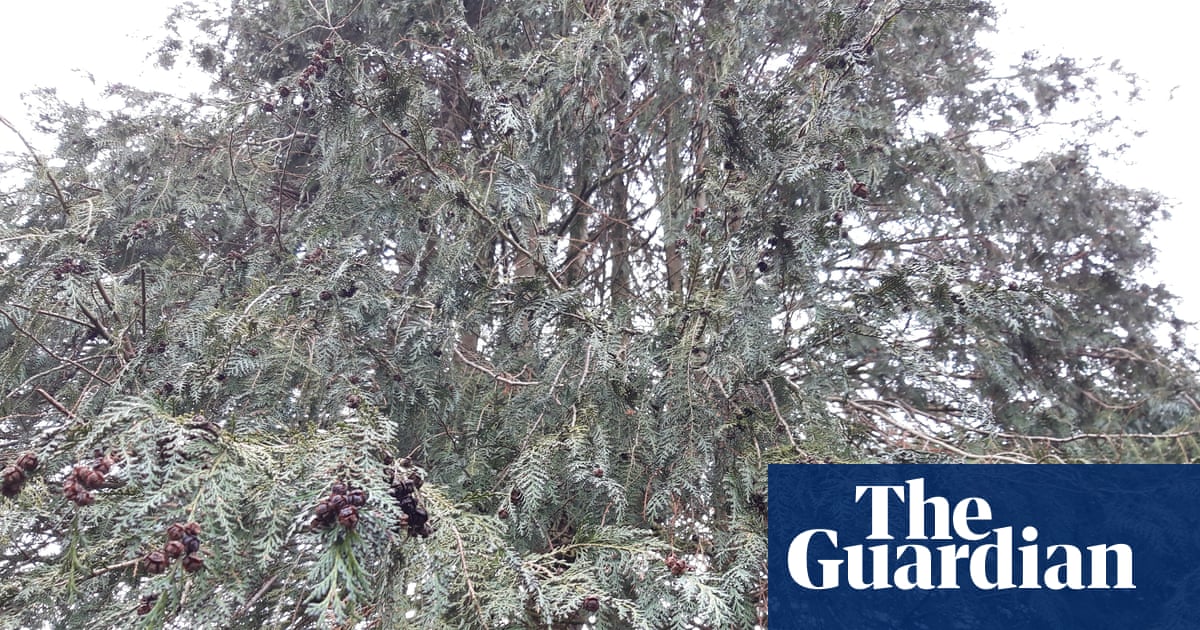
It goes against the grain for me to hate a plant, but I’ve been resenting a certain Leyland cypress for a long time. Planted by a neighbour in the 1970s to give the house we overlook privacy, it now blocks part of our panoramic view over Cardiff. When we moved in 12 years ago, I was able to lie down in bed and see only sky. In that time the solitary tree has grown four metres and now looms over my sleep. Crows, robins, pigeons and green woodpeckers use it as a lookout over the city. Magpies have attempted (unsuccessfully) to build a nest in it. Polite requests to the owner have been ignored.
Hesperotropsis leylandii is an accidental hybrid of Cupressus macrocarpa and Callitropsis nootkatensis. First noticed in 1888 in Leighton Hall near Welshpool, it was exploited commercially as a cheap, fast-growing screen. Leylandii hedges are light-stealers, tolerant of pollution and notorious for discouraging growth around their base. They often generate disputes between neighbours (including one murder). One person was convicted of criminal damage for urinating on an offending plant. So far I have resisted this, and another suggestion that I knock copper nails into its trunk.
As part of making my peace with this tree, I go to see Ben Jones, curator of Oxford University’s Harcourt arboretum. He tells me that conifers are among the most threatened species worldwide because of the usefulness of the wood and, of course, the climate crisis; the Patagonian cypress (Fitzroya cupressoides) is as endangered as the Asian elephant. We go out in soft rain with Ernest the dog, passing saplings propagated from the primordial Wollemi pine discovered in Australia.
The arboretum’s specimen leylandii looks quite different from my enemy. I show Ben photos and he identifies my monster not as a leylandii, but a western red cedar (Thuja plicata). Its fronds smell like over-stewed tea. It’s less vigorous than a hybrid but, in the wild, it can reach 60 metres. If it ever comes down, its wood can be used for outdoor furniture, cladding and roof shingles. Most pencils are made from western red cedar. Somehow, knowing that detail makes me feel kinder towards the tree.
Under the Changing Skies: The Best of the Guardian’s Country Diary, 2018-2024, is available now at guardianbookshop.com
Comments are closed.