

Your holiday gifts have all been opened and promptly returned to the store. It was the thought that counted anyway…not that Wacky Waving Inflatable Arm-Flailing Tube Guy.
For the rest of you, start planning your re-gifting list.
Actually, you can do the same with plants…return…or gift them. If you have an underperforming plant, some stores will take them back if you kept the receipt.
But gardeners don’t return stuff. We see the value in ALL plants…except Japanese knotweed, goutweed, for sure kudzu, probably hogweed, definitely poison hemlock, and maybe 18 to 30 others.
We will do EVERYTHING to bring those little fellas…at least the ones we like…back to good health. We will nurture them, talk to them, maybe even sing to them, provided you can carry a tune. If none of that works within an hour, it’s time to play the harp and get out the bagpipes.
Poinsettias, everyone has a red one, right? Wrong. Besides red, this Christmas flower can be white, pink, peach, green or bi-colored. Remove or poke holes in the foil wrap for drainage. It’s possible to get a poinsettia to rebloom next year, but it’s challenging.After attempts with two plants, mine ultimately made it to the top…of the compost pile. The colored leaves (they attract pollinators) are called bracts and are not the flowers. Its red bracts symbolize the blood of Christ, while the star-shaped flower cluster in the center represents the Star of Bethlehem. The true flowers are the tiny yellow bead-like structures (cyathia).
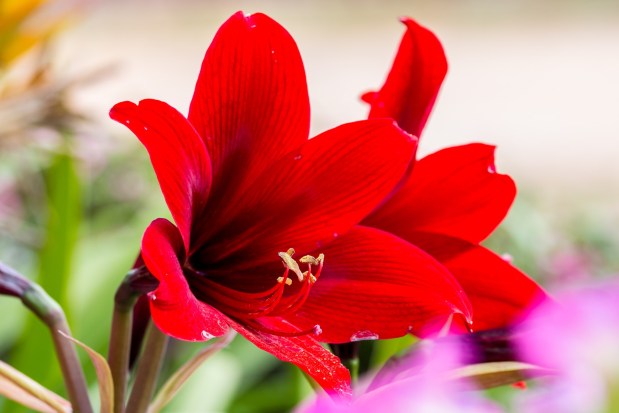 Red amaryllis flower (iStock)
Amaryllis is a Christmas classic that has tall stems and huge trumpet-shaped flowers. In summer, move the plant outdoors and continue to water and fertilize it. You can propagate amaryllis by dividing small offset bulbs (bulblets) that grow from the mother bulb after blooming, planting them so the top third is exposed. There are more advanced, and challenging techniques, like slicing or chipping for more bulbs.
Instructions are not included. In our warm USDA Zones (9a and 10b), Amaryllis will grow in the ground year-round, and will naturalize and bloom every spring without a forced dormancy.
Outdoor amaryllis bloom in late spring. They do not need a leaf-dropping dormancy. Always leave the green leaves attached after the flowers fade. These leaves are essential for photosynthesis, which recharges the bulb for next year’s flowers. Apply a water-soluble fertilizer monthly during the spring and summer.
Holiday Cacti: So why didn’t I call it a “Christmas Cactus,” like many people and stores do? Because there are actually three types of Holiday Cacti: Thanksgiving (blooms in November), Christmas (blooms in December), and Easter Cacti (blooms in April).
Most plants sold in stores as Christmas Cacti are actually Thanksgiving Cacti because they bloom earlier and are easier to ship. They’re hardy plants with pink, white and red flowers, and can continue to bloom year after year from November to January. Apply potassium fertilizer every two weeks. The Christmas cactus is said to bloom in celebration of Christ’s birth.
Christmas pepper is an ornamental chili pepper plant grown for its multi-colored fruit that resembles Christmas lights. This was the most popular festive plant in the early 20th century before being replaced by the poinsettia. They’re low maintenance, heavy producers and are grown for their looks. You’ll regret tasting them…they’re spicy and bitter.
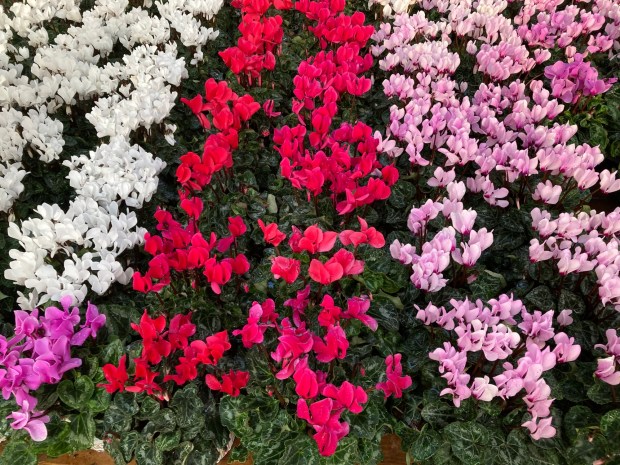 Cyclamen. (Photo by Joshua Siskin)
Cyclamen bloom in the fall, winter, and spring when the weather turns cool and damp. During the hot, dry summers, cyclamen become dormant; their foliage dies back. Cyclamen is known for its red, pink or white flowers, and heart-shaped leaves. Prefers temperatures, around 60-65°F.
Holly is low maintenance, fast growing and has sharp, dark, glossy leaves with red berries. In Christianity, its leaves represent the crown of thorns and berries Christ’s blood. It was thought to keep evil spirits from entering homes.
Kalanchoe’s soil should be kept dry for three to four weeks then resume watering and fertilizing. “They are popular because of their ease of propagation, low water requirements and wide variety of flower colors in clusters” well above the leaves. Source: plants-on-demand
Paperwhites, a type of Narcissus, are prized for their sweet fragrance and white flowers. Frankly, I find their fragrance overpowering. “If growing bulbs in water, keep the water level at the bottom of the bulbs. If growing in soil, keep the soil moist. They are not hardy outdoors and will not have the energy for blooming again. Source: escoffier.edu. Paperwhites symbolize hope and new beginnings.
Mistletoe is associated with love and friendship, hung for good luck, and symbolizes fertility and peace leading to the kissing custom. Mistletoe has white berries, grows on trees and uses specialized roots (haustoria) for its water and nutrients.
Chrysanthemums or “mums,” are the most common Thanksgiving flower. Blooming in fall and available in gold, rust, burgundy and bronze, mums symbolize abundance and gratitude. To encourage a bushier plant, trim them back in the summer.
Sunflowers are another popular Thanksgiving bloom, representing warmth and happiness. It’s harvested for its edible seeds, which are often eaten as a snack food. They are also used in making cooking oil, as food for livestock and as bird food.
Easter lilies have large, white, trumpet-shaped blooms that symbolize purity and the resurrection of Christ. According to Christian tradition, lilies sprang from the ground where Jesus’ tears fell after the crucifixion.
Tulips have cup-shaped blooms that symbolize love and renewal. They come in white, yellow, pink or red. Even after being cut from their stems, tulips can continue to grow, making them a popular choice for floral arrangements.
Daffodils are among the first flowers to bloom in spring, making them a symbol of hope and new beginnings. Their yellow petals reflect the spirit of Easter. October is the ideal time to plant the bulbs as they need 12 weeks of cold weather to get them ready to bloom.
Hyacinths represent peace and rebirth during Easter and come in white, pink, red, blue, purple (associated with Lent) and yellow. Their sweet, spicy scent is widely used in the fragrance industry.
Schmidt is a Poway resident with over 40 years of gardening experience.
Comments are closed.