
While many fruit trees can be grown indoors—including kiwis, avocados and limes—not every variety will thrive. Whether it’s a lack of sunlight, chill hours, or access to pollinators, there are a variety of reasons why a fruit tree might require an outdoor location.
Here, we spoke to experts about the fruit trees that you shouldn’t try growing inside your home.
Sour Cherry
Sour cherry trees (Prunus cerasus) need extended periods of cold temperatures—about 1,000 hours below 32 degrees Fahrenheit—to develop flower buds or fruit.
“You may have noticed that outdoor cherry trees produce very little fruit after mild winters,” says Mason Hanrahan, an ISA-certified arborist and qualified tree risk assessor with Tim-O-Tree. “Unless you keep your house incredibly cold over the winter, an indoor cherry tree will not be able to produce flowers or fruit.”
To be clear, the cherry tree will still survive indoors. “But without the tree’s most distinctive features, what would be the point?” he says. “Plant it outside where it belongs.”
Elberta Peach
Elberta peach trees (Prunus persica ‘Elberta’) do not do well indoors.
“They need cold weather to properly set for fruit production and can get too large for inside spaces,” says Levi Williams, ISA-certified arborist with Tree Scouts Tree Service. “These trees are quite picky when it comes to soil conditions and need a lot of room to grow.”
This tree does well in USDA zones 5 through 9 and needs very well-drained soil and full sunlight to thrive. “Pruning it indoors would be very difficult and labor-intensive, with low outcomes for fruit production,” he adds.
Blenheim Apricot
The Blenheim apricot tree (Prunus armeniaca ‘Blenheim’) is popular among homeowners due to its flavor. Unfortunately, the ideal climate for this tree is fairly small.
“Blenheim apricots are best suited to hardiness zones 6 through 8,” says Lisa Tadewalt, an ISA-certified arborist. “Even within that range, they can be finicky. Sometimes in warmer zone 8 winters, the trees can fail to fruit if they don’t get enough winter chilling, and in colder zone 6 winters, trees can suffer damage or die back if there is a severe cold event.”
This climate sensitivity often leads growers to plant them indoors, where temperature can be more precisely controlled.
“In reality, growing apricot trees indoors is rarely successful,” she says. “The biggest problem is that these trees still require a substantial number of chill hours where the temperature is somewhere between 32 degrees and 45 degrees Fahrenheit during their winter dormancy period in order to properly set the fruit.”
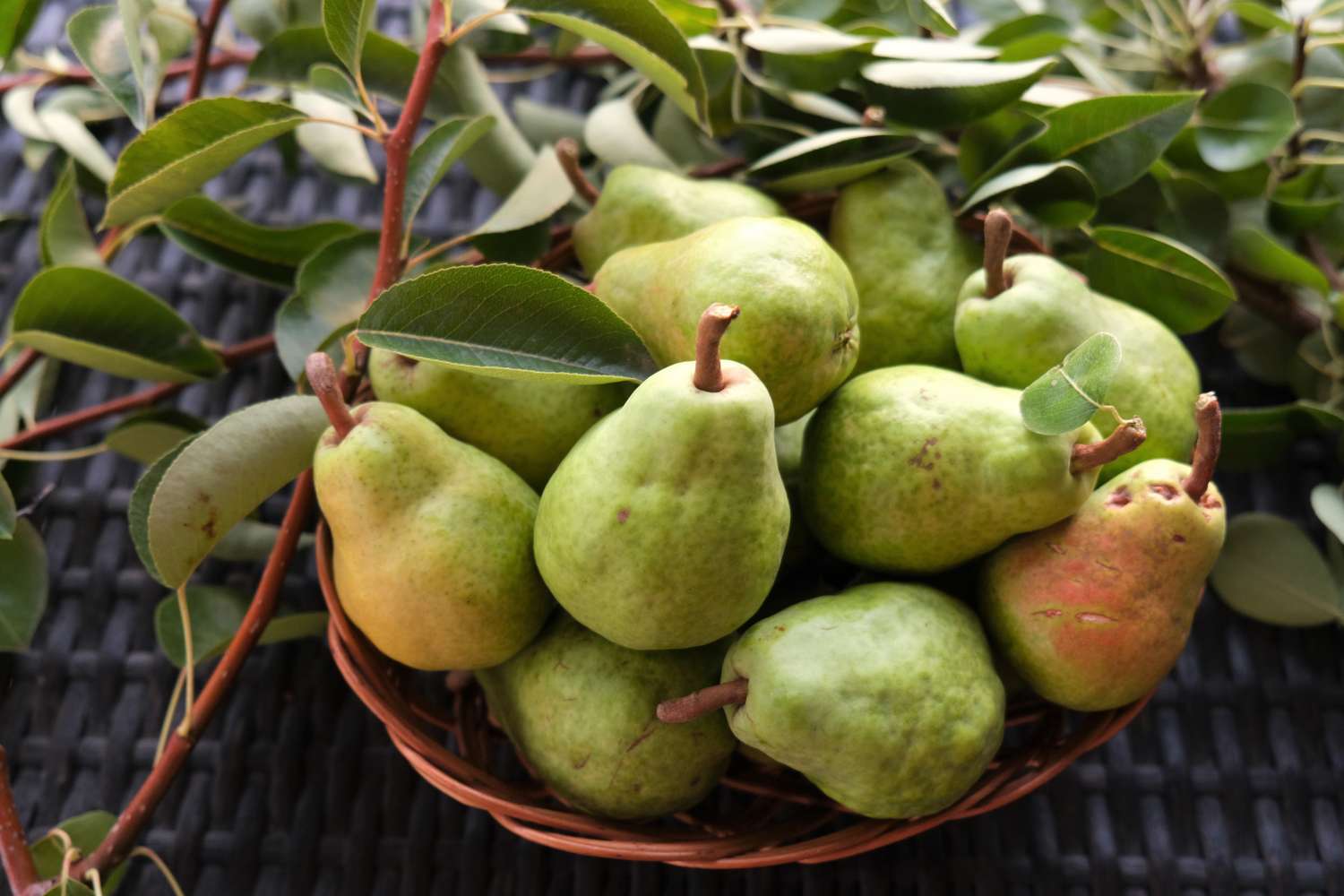
Bartlett Pear
Dwarf Bartlett pear trees shouldn’t be grown indoors.
“Many people think that any dwarf variety of any kind of fruit tree is suitable for growing indoors because of the smaller size,” says Steve Corcoran, CEO of Lawn Love. “That’s not the case for Bartlett pear trees. Virtually no pear trees will grow well indoors because they need a cold winter season for their growth cycle, which indoor conditions don’t provide.”
In addition, even though dwarf Bartlett trees are semi-self-pollinating, they still do much better with another tree growing nearby. “You don’t want to have to worry about [that] when growing a tree indoors,” he says.
Honeycrisp Apple
This is a classic apple tree cultivar for outdoor gardens (Malus pumila ‘Honeycrisp’).
“Growing it indoors can be challenging, as the tree needs about eight hours of direct sunlight daily and a cool rest period—800 to 1,000 chill hours—in winter,” says Julia Omelchenko, resident botany expert at Plantum. “Replicating [these conditions] is hardly possible in an indoor setting, even in very bright rooms.”
Without sufficient light and true winter dormancy, the tree will grow weak and may flower irregularly. “In addition, Honeycrisp requires another apple tree nearby to cross-pollinate and set fruit,” she says.
Bing Cherry
The Bing cherry (Prunus avium ‘Bing’) is another prime example of a fruit tree that doesn’t belong indoors.
“It requires a proper winter dormancy period and plenty of bright sunlight—conditions that are nearly impossible to replicate inside,” says Omelchenko. “Without them, the tree becomes weak and fails to flower or produce fruit.”
Moreover, this cultivar isn’t self-fertile, meaning it needs a second, compatible cherry tree for successful pollination.
“It also depends on insects such as bees to transfer pollen, and once pollinated, it needs ample sunlight for the fruit to ripen,” she says. “While hand-pollination is technically possible, it’s generally impractical, and rarely successful.”
Plum
Plums (Prunus domestica) need cross-pollination for good fruit set and require significant seasonal temperature variation.
“Indoors, there are no pollinators, and the light and temperature fluctuations are inadequate, leading to poor flowering and fruiting,” says Ivanov. “Instead, outdoor temperate zones with well-drained soil are ideal.”
Red Mulberry
The red mulberry (Morus rubra) grows two to three feet per year and reaches up to 70 feet at maturity.
“So if you don’t want to let it crash through your roof, you’ll have to take on the equivalent of a part-time job trimming it down,” says Hanrahan. “It is also not self-fertile, so it won’t produce fruit unless it is pollinated by another tree.”
Comments are closed.