
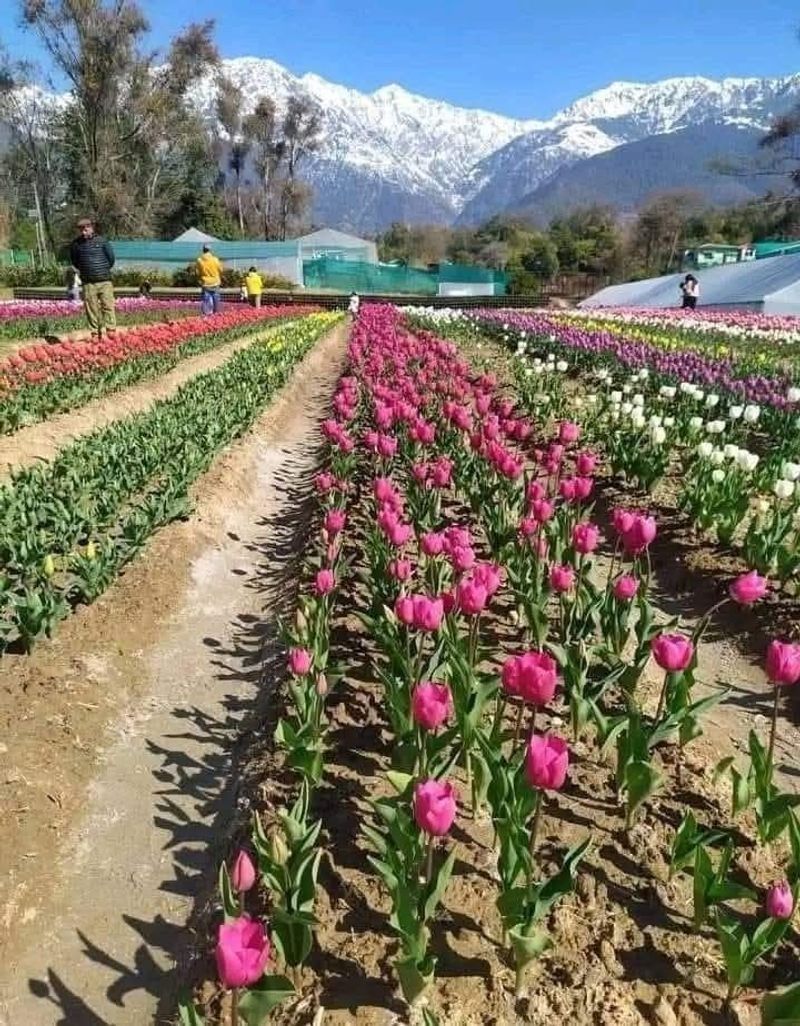
Tulip Garden developed at the CSIR complex, located about 2 km from Palampur along the Pathankot-Mandi National Highway, will be thrown open to the public on Tuesday, February 10. The garden presents a colourful display of red, yellow, white and multi-coloured tulips, with the CSIR-Institute of Himalayan Bioresource Technology (IHBT) introducing several new flower varieties this year.
CSIR-IHBT Director Dr Sanjay Yadav said that the tulip, which originated in Persia (present-day Iran), was introduced to Europe in the 17th century and subsequently developed into numerous varieties. “At present, the Netherlands is the world’s largest producer of tulips,” he said.
Dr Yadav added that tulip is a tuberous cut flower with significant international and domestic demand and ranks third globally in the cut-flower trade. “Under this initiative, the institute has been planting tulips on its campus for the past three years. This year, nearly 50,000 tulip bulbs of various vibrant varieties have been planted,” he said.
The garden is expected to attract a large number of visitors from within Himachal and other states, thereby promoting scientific and eco-tourism in the region. He noted that the flowers have bloomed earlier than usual this year due to comparatively warmer climatic conditions.
Last year, over 1 lakh visitors from across the country visited the tulip garden, and an even higher footfall is anticipated this season. This is the first tulip garden of its kind in Himachal Pradesh.
In addition, CSIR-IHBT has initiated experimental trials on tulip flower and bulb production in the Lahaul valley to promote its commercial cultivation. In the initial phase, farmers from cooperative societies such as Yaani Mahadev Floriculture Society (Madagran), Pattan Valley Floriculture Society Limited (Shansha), and Tinan White Mountain Floriculture Society Limited (Jangla) were trained and empowered to take up tulip cultivation.
These farmers are now actively engaged in tulip flower and bulb production and are benefiting economically from the initiative. The institute aims to create new income-generation opportunities for farmers and entrepreneurs while making India self-reliant in tulip bulb production to meet the country’s domestic demand over the next seven to eight years.
Comments are closed.