
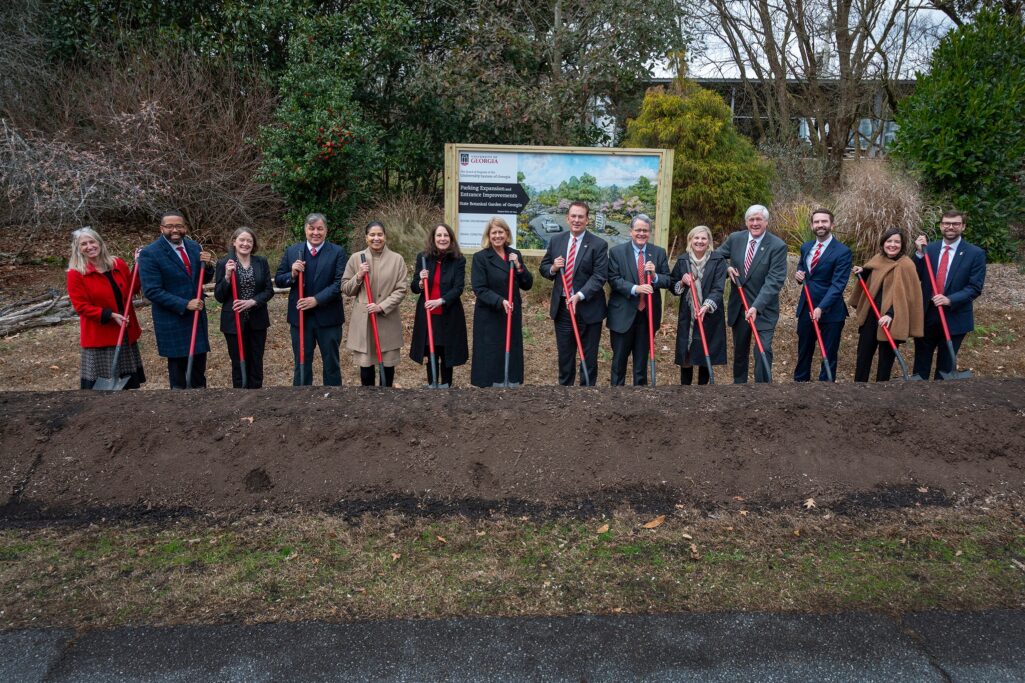
 Leaders from the University of Georgia and key supporters join for groundbreaking ceremony for the Gateway to the Garden entrance and parking expansion project on Jan. 23, 2026. (Photo by Wingate Downs)
ATHENS, Ga. — The State Botanical Garden of Georgia recently broke ground on its long-planned Gateway to the Garden entrance project, a major upgrade designed to meet soaring visitor demand.
State legislators, UGA administrators, donors and garden staff gathered for the ceremony on Jan. 23. It marked the start of a multiphase project that will relocate and expand the garden’s entrance, add parking, and improve trail and pedestrian access.
When the botanical garden opened in 1968, its entrance was built to serve about 50,000 visitors a year. Last year, more than 470,000 people explored its gardens and trails — nearly 10 times the original projection.
“The garden is a perfect representation of the significant impact the University of Georgia can have through its teaching, research and service missions, and I am incredibly grateful to everyone who continues to elevate this special place on campus,” said UGA President Jere Morehead.
The new entrance will be relocated further south on Milledge Avenue and designed to better accommodate larger vehicles, including school buses that bring more than 4,000 children to the garden each year for field trips. The project also includes expanded parking, improved trail access and enhanced pedestrian infrastructure.
“We are thrilled to be breaking ground on the Gateway to the Garden project, which will provide necessary improvements to our entrance, providing greater accessibility for the thousands of visitors we welcome each year,” said garden director Jenny Cruse-Sanders. “We could not have reached this milestone without the support of many individuals, organizations and especially our board of advisors for helping us bring this project to fruition.”
The $5 million project is being funded through private donations and a $2.35 million state appropriation.
Athens-based Koons Environmental Design is designing the project in partnership with the Office of University Architects, and Grahl Construction is overseeing construction, which is expected to be completed in late 2026. Garden operations will not be impacted during the project.
Print Article
Comments are closed.