
My backyard garden is asleep. With the cold and the snow we’ve recently had in Newton, the garden looks quiet. The branches of the black locust and the Japanese maple trees are gray and bare, but the evergreens in my yard, a Norwegian spruce and a blue spruce, provide some greenery in an otherwise colorless landscape.
The only activity is at my bird feeders, where sparrows, finches, bluejays and juncos reach in for a quick snack. There are also black-capped chickadees and an occasional nuthatch, tufted titmouse, a pair of stunning cardinals, and woodpeckers. Most fly away in a huff when the gray squirrels arrive and take over.
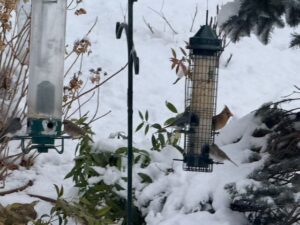
Visitors to feeders on a recent January morning. Photo: Marian Prokop
I enjoy observing the wildlife through my kitchen window. The native trees and shrubs, especially the magnificent oak that hovers in the corner over my yard and that of my neighbors, provide some food and protection for the birds, but it is not enough. The insects that birds eat in the spring and summer are gone or dormant, so birds rely on seeds and fruits from native plants for survival in the cold weather months.
But with loss of habitat and the prevalence of non-native plants in our suburban yards, there is little food for the birds to eat. Those non-native boxwoods, honeysuckle, and pachysandra are pretty, but they do nothing to provide nourishment to wildlife. So I try to do my part to supplement their diets with my two feeders and a wire cage of suet. I’m also excited to set up a new feeder with a wi-fi camera that my daughters gave me for Christmas so I can watch the birds up close.
The winter garden
In January, there’s not much to do in the winter garden but watch, think, and dream. It’s important to look ahead but also to look back on last year’s garden. Which plants did well, which failed, and which poor things never had a chance thanks to hungry rabbits and other critters? (That’s another reminder to get out the Plantskyyd or Rabbit Scram and use it regularly.) As I glance over the landscape, I find another bare spot. What plant can I put right there to fill in? What new plants are there to try and which can I start from seed?
It’s time to plan for spring!
I’ve been perusing gardening magazines, including Horticulture and Fine Gardening, and websites for inspiration. I browse seed catalogues for the latest vegetable varieties. The choices are so tempting and the marketing pitches so enticing (best tomato flavor! gorgeous color!) that I always buy more seed than I need for my two 4-foot by 8-foot raised beds. That’s good for my gardening friends to whom I pass on the extra seed or seedling plants that get started. Leftover seed packets get stored in a container in the refrigerator for next year.
I also watch gardening webinars to learn more from experts and from other gardeners. We gardeners are an optimistic bunch and there is always enthusiasm to spare as we learn from our mistakes and plot our goals for next spring. (This year I will get that soil test! I will really truly get a jump on pruning! I will finally get around to transplanting those wild geraniums!)
In Newton, we are fortunate to live close to many outstanding garden resources, including the Native Plant Trust in Framingham, the Massachusetts Horticultural Society in Wellesley, the Arnold Arboretum in Jamaica Plain, and the New England Botanic Garden at Tower Hill in Boylston. While most have limited hours this time of year, they still offer a variety of gardening courses, online or in-person, where you can get lots of useful information and learn with other gardeners.
In upcoming columns, fellow gardener Lisa Gianelly and I will alternate writing assignments to offer information, ideas, and inspiration to help Newton residents succeed in their gardening goals. We care about our environment and worry about climate change and so we will encourage the use of native plants and discourage the use of pesticides. We will provide information and suggest plants that grow in our USDA plant hardiness zones (in Newton it’s zones 6a and 6b) and we hope to be a resource for finding local gardening events.
While it’s too early to start digging in the soil, there’s plenty to do to prepare for gardening this spring. May you have happy garden dreams!
Marian Prokop and Lisa Gianelly are Newton residents and certified master gardeners. They welcome your suggestions for column ideas and news to share of gardening-related events throughout the city. They can be reached at beacongardeners@gmail.com.
Comments are closed.