
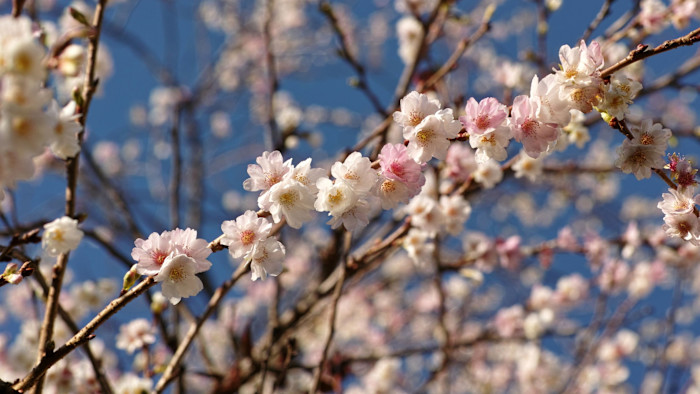
Gardeners have just finished their post-Christmas month for reflection, a time for asking themselves why they garden and how might they change what they do. They have a pre-spring month for planning what to plant and how not to kill it off. Micromanaging the future is impossible, but I have one principle as we start to think of the year ahead. It is as follows: Things Never Quite Work Out. If you are newish to gardening, I urge you to remember it.
The past six weeks have confirmed it. Two days after Christmas I checked my plantings in Oxford and could hardly believe what I found in flower. It was not just that there was a mass of flowers on the bushes of scented wintersweet and blossoms galore on winter-flowering cherry trees, my number one choices among trees that are easily grown. An unprecedented mass of fruit was still hanging on the crab apple trees, whether big red fruits on Malus robusta ‘Red Sentinel’ or thousands of small yellow berries on Malus transitoria. The birds have still not stripped them: I never remember such a marvellous display for so long.
You too will have had surprises, but I doubt if they exceed mine. I was amazed, two days after Christmas, to find blue flowers on Ceanothus ‘Dignity’, on evergreen rosemary and on silvery-leaved Teucrium fruticans, each of which should flower from May onwards. There were even some half-opened rosebuds, not just on China roses, the ones which used to be called “monthly roses” because they flowered in almost every month of the year. Buds were unfurling on yellow floribunda roses, still in green leaf.
When autumn colours appear early on trees, the effect is known as “false autumn”. It is usually a response to summer drought and stress. We saw it in September after six months with next to no rain, but then at Christmas unseasonal flowers from spring and summer were showing too. Are they a sign that our gardening calendars must change and that we should bet on “false spring” from now on?
 Teucrium fruticans ‘Azurea’: ‘I was amazed to find, two days after Christmas, blue flowers’; this plant normally flowers in May © GAP Photos/John Glover
 Viburnum bodnantense: ‘I rely on one and the same family, the viburnums, shrubs that have never succumbed in winter’ © GAP Photos/Pernilla Bergdahl
In a false, springy mood I left sheltered Oxford and began to wonder if I should risk evergreen grevilleas and griselinias at home in the country and be less sceptical about pittosporums, those quick-growing buttresses of green. A day later, frost and snow blew in and erased all thoughts that winter might never be cold. If I had acted on those choices I would have lost them all. Things, indeed, would not have worked out.
From March to October, last year’s vicissitudes had already conveyed this lesson. First, we had the longest dry spell of my lifetime, one which crippled most of the bedding plants and shrivelled phloxes and monardas in borders. Then we had a heavenly autumn which reversed the summer by sending days of rain. Lawns became green and returned to vivid freshness, their current state. Autumn’s border plants flowered magnificently in as good an autumn for gardens as I remember. Dahlias had a late run into early November and Michaelmas daisies were spectacular. I had to struggle to remember that I had been married to a hosepipe in May and June until an official ban divorced us in early July.
Do not fall for the soundbite that Britain is developing a Mediterranean climate. Dark skies and pouring rain are not Mediterranean at all
In the record books 2025 will go down as a dry year, but month by month that label did not always fit it. The way forward is not to follow the record book and go over to nothing but drought-proof grasses and spiky phormiums. My hunch is that we are moving into years with blocks of weather, dry following months of wet, frost following weeks of false spring. Strategies therefore should be many-sided. Balance your choices, as wise investors learn to do: hedge your bets to cover the times when one side of the balance lives up to my principle and does not quite work out.
I am not hedging wet against dry. Long runs of dry weather kill off plants for damp soils before rains return to rescue them. Instead I am hedging marginally hardy plants against ones that never freeze to death. Averages are all very well, but I plan from the bottom up, not the top down, remembering that one outlying week or night can damage plants which an average of the weather and temperatures implies to be safe. Do not fall for the soundbite that Britain is developing a Mediterranean climate. Dark skies and pouring rain are not Mediterranean at all. If you pick plants from lists of plants for Mediterranean zones, you are on the wrong track, inviting things not to go right.
 Philadelphus ‘Belle Étoile’: ‘especially lovely’ © GAP Photos/Heather Edwards
Marginal hardiness varies between cities and country, between south and north, coast and inland. I have to plan for an inland rural slope where snow and frost lay for 10 days after Christmas, revealing wildlife’s footprints on their surface. Foxes, it seemed, had been dancing in a circle while rabbits engaged in six-legged activity. For once they kept off the flower beds: what survived there unscathed?
Even after the brutal cold spells in winter 2022-23, I still risk a few evergreen agapanthus and some broad-leaved hebes, shrubs now classified as veronicas. Against a sunny wall they sometimes defy low temperatures, so they are worth a gamble. In open ground some of the less hardy penstemons pull through, whereas others give up. If they survive, well and good, but by balancing the plantings round them I am covered if they do not.
While starting out, you may wonder where to begin in catalogues and plant centres of bewildering variety. For a bigger country garden on alkaline soil here are six of my rock hardy bets, survivors of far harder winters than our last two.
In spring I bank on ribes, or flowering currant, valuing its ability to grow in dry places, even in light shade beneath the canopy of tall trees. In May I feel safe with lilacs, which I have never lost to cold weather: they balance the risks of quick-growing silvery teucriums or grey-green olearias.
In June I bank on scented philadelphus, the so-called beauty bush Kolkwitzia amabilis, and several of the deutzias, a most beguiling family. I have never lost any of them, though philadelphus, especially lovely ‘Belle Étoile’, is best in soil which is not too dry. In May, June and winter to spring I rely on one and the same family, the viburnums, shrubs that have never succumbed in winter. The scented ones for May are a joy but so are the yellow-flowered Viburnum x hillieri ‘Winton’ in June to July and the pink and the white scented viburnums which flower sweetly from November to March. If in doubt try a viburnum, truly a family for all seasons.
Like markets, meanwhile, most other plants are unpredictable. Do not confuse them with carpets and curtains. Things seldom turn out predictably: accept that basic principle, balance your choices and love gardening for its inevitable ups and downs.
Find out about our latest stories first — follow @ft_houseandhome on Instagram
Comments are closed.