
Try to direct the water at the soil where the roots are rather than over the whole plant.
Mulching is a good gardening practice to conserve moisture as well. This has the added benefit of adding organic matter to the soil.
Plants such as our NZ natives, azaleas, rhododendrons, camellias, daphne, kalmias, magnolia, clematis and liliums are just a few of the plants that enjoy a cool root run and good organic mulch or compost around the base.
There are a number of options of products available to mulch with; ‘Tui Mulch & Feed’ is a popular choice and highly recommended, it is formulated to fertilise, hold moisture and improve soil structure.
Purchasing pea straw bales and spreading this over the garden is an economical option. Bark chip spread over the garden is very successful for moisture retention and weed suppression. It looks attractive too.
Mulch from arborists chippers is good too, particularly once it has broken down a bit and is not so fresh. (Fresh mulch can cause a nitrogen drawdown from the plants)
Growing from cuttings
January is a good month to take cuttings of many plants including hydrangeas, buxus, houseplants and carnations. If you are successful it can be most rewarding.
It is not difficult and if you have never taken cuttings before you may like to have a go.
Here are some how to do it tips:
Choose strong healthy shoots.
The cutting should have about two-four pairs of fully developed leaves and should be severed from the plant with a sharp knife or secateurs.
Do not pull off as this may damage the stem of the plant on which it was growing.
The bottom of the cutting should be trimmed so it is just below a leaf or leaf scar and always with a very sharp knife.
The lower leaf or leaves should be removed and if the foliage is excessive some of it can be trimmed off or back by up to one-half along the length of the leaf to prevent excessive loss of moisture.
To increase the area where cell division and root development can take place a wound should be cut along the side of the cutting near its base and of approximately 1cm in length.
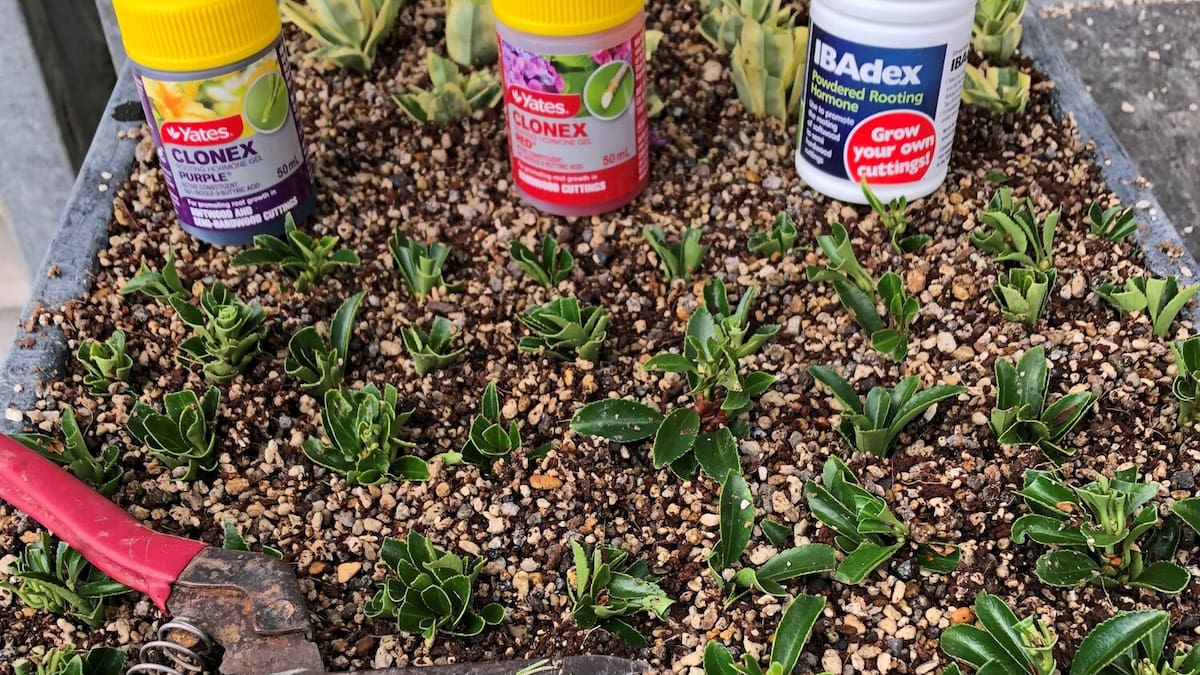
Dip the cuttings into a rooting hormone.
There are a couple of different types according to the type of plant, these will help stimulate cell division and root development.
Keep your cutting material moist at all times. There are gel type rooting hormones ‘Yates Clonex Red’ for hardwood cuttings, ‘Yates Clonex Purple’ for softwood and semi hardwood cuttings or ‘IBAdex Powdered Rooting Hormone’.
Insert the cuttings into a ‘sharp’ media such as propagation sand or even better is a specialist ‘cutting mix’.
Daltons Premium Cutting Mix is a well-proven commercial mix used for the fast establishment of cuttings.
It contains clean, screened 3mm pumice and fine grade coco fibre and balances moisture retention, soil aeration and drainage properties.
The free-draining properties reduce risk of soil-borne diseases.
Set the cuttings in a tray or a pot with mix approximately 10cm deep, make a hole with a pencil or similar and space the cuttings about 5cm apart.
Gently water to settle in cuttings and place in a shady spot.
Place under a plastic cover that is sealed to prevent moisture loss but allows good light.
Check watering requirements daily. After about four weeks the cuttings should start to root.
When the roots can be seen coming out the pot’s drainage holes then it is time to transplant them to a bigger pot using a potting mix with fertiliser added such as Ican Premium Potting Mix.
Many houseplants can be multiplied by trimming just below a leaf node as described above and then sitting in a jar or glass of water inside for two to three weeks.
Changing the water weekly will stop you having a green stagnant swamp in your house.
Some houseplants such as rex begonias will produce roots just from a section of their leaf set into cutting mix.
Once roots have started to appear the new plants can be carefully potted into individual pots with a suitable potting mix such as ‘Yates Thrive Indoor Potting Mix’.
It is very satisfying growing new plants from cuttings so why not experiment and have a go.
Gareth Carter is the general manager of Springvale Garden Centre in Whanganui.
Comments are closed.