
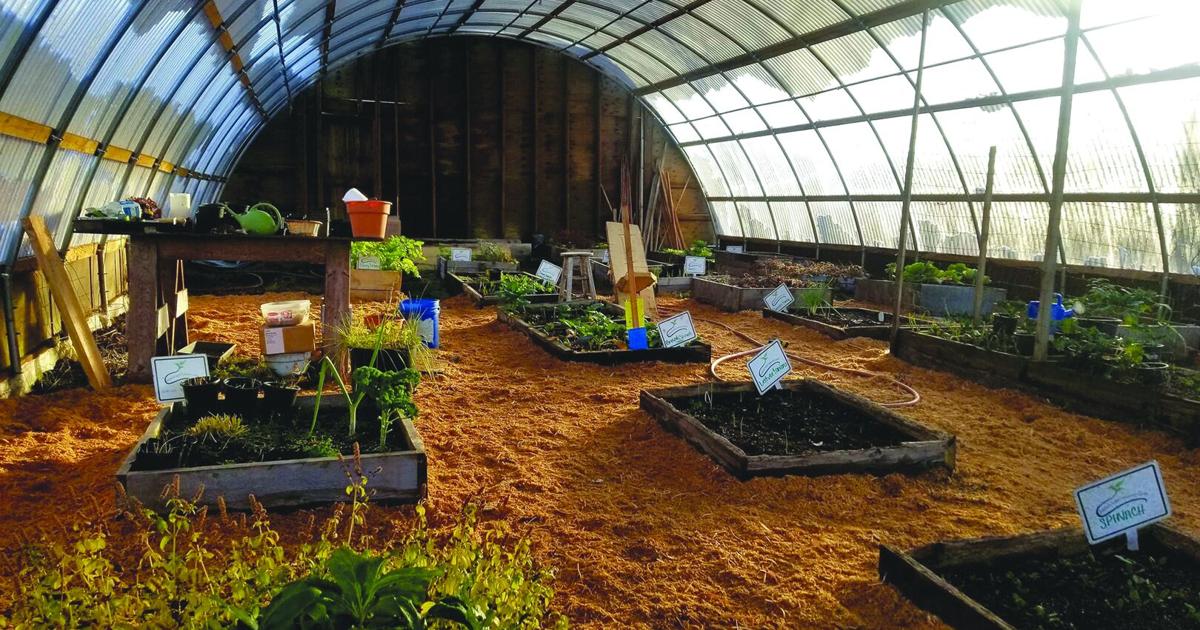
Gatgyeda Haayk, the Metlakatla S’ndooyntgm Galts’ap Community Garden “champion,” has transformed the way that locals access and grow fresh produce, bolstering the community’s food security.
During a phone conversation with the Daily News on Monday, Haayk said that she has been the full-time Metlakatla Indian Community manager of the S’ndooyntgm Galts’ap Community Garden for more than 10 years.
Haayk, who said she is a Haida/Tsimshian/Cuban born and raised in Metlakatla, described her work with the community garden.

Gatgyeda Haayk prunes raspberry bushes at the S’ndooyntgm Galts’ap Community Garden in this undated image. Photo by Gabe Derrick, owner of Biclops Productions
Haayk said that when she first began her work with the garden, it had been sitting mostly untended for several years.
“There were a few teachers here and there who used some of the beds and tried to make it a traditional-style community garden,” she said.
MIC Grant Coordinator Genelle Winter hired her using grant funding at first as a part-time employee, Haayk said.
Winter gave her the title of garden “champion” when she was hired, Haayk said.
When she first assessed the garden, there were more than 20 beds that were filled with peat moss rather than nutrient-rich soil.
“I didn’t know that when I first started,” she said. “I was ambitious and was like, ‘Ok, let’s start growing things’ and it wasn’t very successful that first year because it was just peat moss.”
Haayk said that, “I went around to local businesses and started collecting their food scraps and just building up a compost pile, and that was able to sustain and amend the high tunnel (beds.)”
Another challenge in the first year was that the beds were protected only by a plastic fabric cover that would blow away every winter, as the beds are located in a windy area.
Attendees participate in the “Reconnecting with the Land” garden workshop put on by the GROW Program with RurAL CAP and hosted by the S’ndooyntgm Galts’ap Community Garden in Metlakatla. Photo by Brandi Patterson
Using a federal grant secured by Winter through the Natural Resources Conservation Service, Haayk was able to purchase a more robust high tunnel to serve as a permanent structure to protect the garden.
Through funds from that grant, Haayk also covered the high tunnel with Lexan corrugated plastic, which helped to retain the heat for the garden and to create a more wind-proof structure, she said.
One advantage Haayk said that she’s had is working under the umbrella of MIC, which has made securing grant funds easier.
She said that her main goal has been “growing fresh, locally grown produce and half of it usually goes to the elders in the food distribution program and then I make some of it available for donation to the community. It doesn’t always have to be a cash donation, it can be their time. If I’m ever out of town and need somebody to come water, that would be considered a donation.”
Attendees participate in the “Reconnecting with the Land” garden workshop put on by the GROW Program with RurAL CAP and hosted by the S’ndooyntgm Galts’ap Community Garden in Metlakatla. Photo by Brandi Patterson
Haayk said that the garden offers to the community seed starter kits, seeds, and volunteer opportunities in addition to the produce.
One produce item that Haayk said she was particularly interested in growing were Tlingit potatoes that have been grown locally by families for multiple generations and that have been dubbed “Metlakatla potatoes” for many years.
“I was very excited to get that established in the garden and back into the stomachs of our local people,” Haayk said, adding that the potato starts also are made available to local gardeners.
Another Indigenous food that Haayk said she has been growing include stinging nettles, which she said used to be widely available in Metlakatla, but as more land has been cleared over the years, they are more difficult to find.
She also has been growing Haida potatoes as well as the more widely regional Tlingit potatoes.
Attendees participate in the “Reconnecting with the Land” garden workshop put on by the GROW Program with RurAL CAP and hosted by the S’ndooyntgm Galts’ap Community Garden in Metlakatla. Photo by Brandi Patterson
In the wartime years, Haayk said that “victory gardens” were popular in the Metlakatla area, with a focus on growing favorite staples. Those included crops such as rhubarb, gooseberries, currants and raspberries that flourish in Southeast Alaska and she is growing now.
Last year, Haayk said that she purchased some grapes that she is hoping will grow well and produce fruit as they mature. She also is growing Arctic kiwi, garlic, spinach, a wide variety of potatoes, lettuces, chives, herbs and kohlrabi.
Some of the lesser known produce such as kohlrabi, which is a root vegetable created by crossing turnips with cabbage, will also offer the chance for locals to learn about edibles they possibly haven’t tried before, Haayk said.
Haayk said that she also is the program director of the Indigenous-Led Agriculture program in Fairbanks for the Calypso Farms.
Part of the he S’ndooyntgm Galts’ap Community Garden in Metlakatla is seen at rest in the winter a couple of years ago. Photo by Gatgyeda Haayk
“That helps me a lot with the educational tools, that I can come back here and help teach my local folks on gardening, and how to cook with whatever produce that I’ve decided to grow that year,” she said.
A crop that has done well that has surprised many locals are sunflowers, she said.
“It’s been pretty cool because every year I grow sunflowers, and then when they bloom I just go around town just giving them to people, and that’s always the greatest part of my day because they just light up,” she said.
The sunflowers are not only beautiful, but they produce edible seeds as well, Haayk said.
She said it also has been gratifying to show people that more exotic produce species can successfully be grown locally.
Haayk said that she also tries to be mindful and to carefully plan when adding one more type of crop to the garden so that it doesn’t become overwhelming.
“I want the community members to be able to come up, and elders to come up and be able to harvest and access the site,” she said.
“It’s just been interesting because year after year this program has grown so much since I first started and now we have a greenhouse from a grant with NDN Collective. It’s not fully hooked up yet, but it’s climate controlled, and with grant partnership with (Rural Alaska Community Action Program) we were able to get supplies for grow lights and signage for letting the community know what type of produce we have available,” Haayk said.
She said that, more recently, her aim has been to make the beds under the high tunnel available to community members as a space where they can grow their chosen produce items.
The greenhouse is being used for commercially grown produce that Haayk manages and makes available to the community, she said.
Once she established those two areas, Haayk said that the egg shortage in late 2024 and early 2025 inspired her to pursue a Food Security Grant from the Newman’s Own Foundation to purchase 18 chickens that she established in the gardens.
“The whole purpose of that, too, is an educational piece,” Haayk said. “After that egg shortage everybody was like, ‘I want to get chickens!’ and I wanted to have a space to tell people, ‘Hey, if you really want chickens, this is what you’re going to have to do, this is how you care for them, and it’s not as cheap as you would think it is.’”
Haayk said that she has established a compost program that has grown each year. Her experience with having to build up the poor soil in the original beds made her realize how critical nutrient-rich compost is to successful gardening.
“A big goal of mine is I don’t want just the community garden to be the sole food security for the community, I want to help support local growers as well as divert food waste that could be used from the landfill,” she said.
Two years ago Haayk noted that she decided to open up the compost project to become a community-wide program.
Haayk also works with the Metlakatla School District in a variety of ways.
“I think that (with where) our health and wellness is, and the political climate of today, I think it’s so important for our youth to really understand where our food comes from; … to really make an impact and show the kids that we can show the kids that we can support ourselves locally and minimize our global footprint and emissions that is not good for the environment,” Haayk said. “I have really been trying to focus heavily this past year in moving forward on education.”
She said that she recently has been awarded a grant from the Native Americans in Philanthropy Indigenous Tomorrows Fund that will allow her to hire up to five youth interns to work with her. That will allow the youths to be educated in the agricultural world.
“The school district has one climate-controlled greenhouse and one makeshift experimental greenhouse,” Haayk said.
“I’d like to get those up and running, and also in doing that, I applied for the (federal) Farm to School grant to help sustain that program and really get it developed as well as getting Indigenous foods onto our menu a lot more,” she said.
That grant also would fund a paid assistant for her, Haayk said.
She said that she envisions that position as being the “school garden champion, so they would basically be in charge. I would help them get established and work with them but they would be the one that would maintain the school gardens as well as working with the administrators and any teachers that want to be a part of those experimental growing activities.”
Hyaak said that she always has been interested in gardening, so managing the S’ndooyntgm Galts’ap Community garden has been a natural role for her.
She said that her grandma and two of her aunties used to garden, and even though she didn’t garden alongside them, she’d always admired their gardens.
“It wasn’t until probably about seven years after my daughter died and I went through my healing journey that my boss, who’s married to my cousin, she knows about my journey and she kind of thought that this job would help me with that, and it totally has,” Hyaak said. “It’s been very healing to work with the land and be able to provide this type of environment for my community, and the youth, as well as providing them with fresh produce. It’s been quite an amazing journey for me, to be on.”
Hyaak said that the garden now spans across about an acre of land, which includes a roadway which allows locals to easily drop off compost material at the garden.
Haayk said that currently she is looking for someone to fill the role as her successor, as she doesn’t want to be the sole garden manager in perpetuity, as she doesn’t see that as ideal.
More information about the garden can be found on Facebook by searching for the “MIC S’ndooyntgm Galts’ap Community Garden (garden).”
Hyaak’s advice for people interested in building a community project similar to Metlakatla’s and in seeking funding was to build a network of supporters.
Sharing the garden’s story and the goals of the project is important as well, she said.
Hyaak said that she would like to partner with the Ketchikan Garden Club to collaborate on projects and to share ideas.
Creating and managing a successful community garden is “a lot of work, but when you have a passion for it and really have a good story to share it becomes easy,” Hyaak said. “I just never give up on the dream.”
Comments are closed.