
Some gardeners get their kicks by growing flowers and vegetables that hardly anybody else knows or grows.
These are the non-mainstream varieties that come with unusual traits, old-fashioned scent, taste, or charm, and especially stories behind how they came to be.
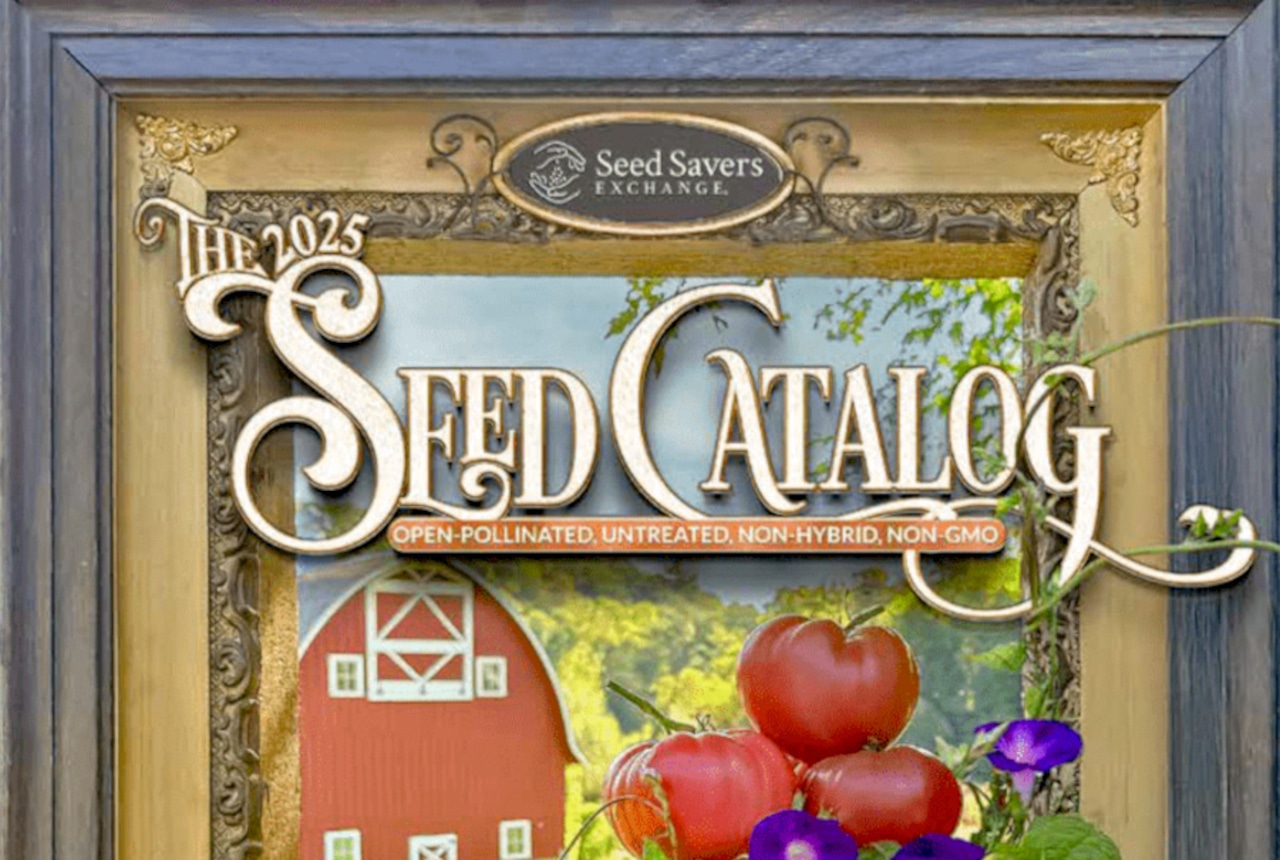
If that’s your style, meet Seed Savers Exchange.
SSE is a nonprofit based on an 890-acre farm six miles from Decorah, Iowa. It’s one of the largest non-governmental seed banks in the world, and its mission is to preserve plant varieties that otherwise might disappear.
That’s become an even bigger issue now than when Kent and Diane Ott Whealy founded SSE in 1975 with a six-page typed seed list and 29 customers.
As seed producers get bigger and fewer and increasingly move toward genetically engineered, patented, and/or unsavable hybrid seed varieties, seed diversity is shrinking. In other words, relative few seed varieties are in fewer hands.
The idea of SSE is to preserve as many older vegetable and flower varieties as possible by encouraging the kind of saving and sharing that gardeners and farmers did for generations.
SSE grows more than 20,000 varieties of rare fruit, vegetable, and plant varieties at its Iowa farm, which also has its own sub-freezing underground seed vault to keep seed viable for years or even decades.
Seed is also shared with and stored at the Svalbard Global Seed Vault in Norway.
But the other main part of the operation is encouraging people to keep these varieties alive by growing them in the ground year after year.
SSE has both a traditional seed catalog where gardeners can order selected varieties (mostly at $4.25 a packet) or go onto its online Seed Savers Exchange, in which gardeners and larger-scale “listers,” as well as SSE itself, offer some 16,000 varieties for about $3 a packet (technically to cover shipping, not charge for the seeds themselves).
If you’re a gardener who appreciates the unusual, this is where you’ll go down a vole hole reading each variety’s description and history.
All of the seed varieties are “non-GMO” (not genetically modified), and all are open-pollinated (meaning you can save them yourself and get something close to the parent year after year).
Some of the varieties are somewhat familiar heirlooms, but most are ones you’ve never heard of and can only find on the Exchange … veggies such as the ‘Pound Giant’ tomato, ‘Aunt Foss’s’ looseleaf lettuce, ‘Willing’s Barbados’ pepper, and a German cabbage called ‘Filderkraut.’
You’ll find some interesting and completely offbeat crops, too, such as Chinese garlic, miner’s lettuce, a root vegetable called skirret, and a tuber from the Andes called yacon.
In the flower section, you’ll find seeds of the hollyhocks that prairie settlers planted around their outhouses (known as ‘Outhouse’ hollyhocks), an orange-blooming nasturtium called ‘Empress of India,’ and ‘Harvey’s Honor’ marigold, a scarlet three-footer that the Juhre family in Washington has been handing down for more than three generations.
A lot of varieties in The Exchange have no names at all. They’re just listed as generic tomatoes or peas.
You’ll also find the two varieties that started it all. The Whealys were motivated to begin protecting heirloom varieties after they were given seeds of ‘Grandpa Ott’s’ morning glory vine and ‘German Pink’ tomatoes – plants that Diane’s great-grandfather brought to the U.S. when he emigrated from Bavaria in 1870.
SSE has grown from its humble beginnings to a movement that numbers 13,000 members worldwide.
The Exchange can be searched by plant type or by states and regions to zero in on varieties that are most locally adapted.
The descriptions also tell sizes, bloom times, light needs, harvest times, dry/wet tolerances, and other characteristics that best suit the intended garden site.
And when you’re eyeing something offered by a fellow gardener, you can message directly to see how it performed or what other intricacies the variety prefers.
By design, buyers often become savers who become listers to increase the availability of the collection.
SSE’s website is also a gold mine for detailed information on how to save seeds and get them to sprout and thrive.
SSE says its seed preservation work is important because the world has lost about 75 percent of its edible plant varieties in the last century.
“A system that depends so heavily on so few crops is extremely fragile,” SSE says in a website post. “When seed diversity is strong, our food system is protected. Diversity increases the likelihood of having crop varieties that can adapt to different climate conditions and become resistant to certain diseases.”
SSE adds that genetically engineered plant varieties “have had a devastating impact on biodiversity,” resulting in about half of U.S. cropland now being planted with engineered varieties.
“These patented seeds cannot be saved and planted again in the years that follow,” SSE says.
The Milennium Seed Bank in the United Kingdom is the largest seed bank in the world. Large ones also are in India, Russia, Ukraine, France, and Australia in addition to Norway’s Svalbard Global Seed Vault.
The largest seed bank in the U.S. is the USDA’s National Laboratory for Genetic Resources in Fort Collins, Colo.
Comments are closed.