
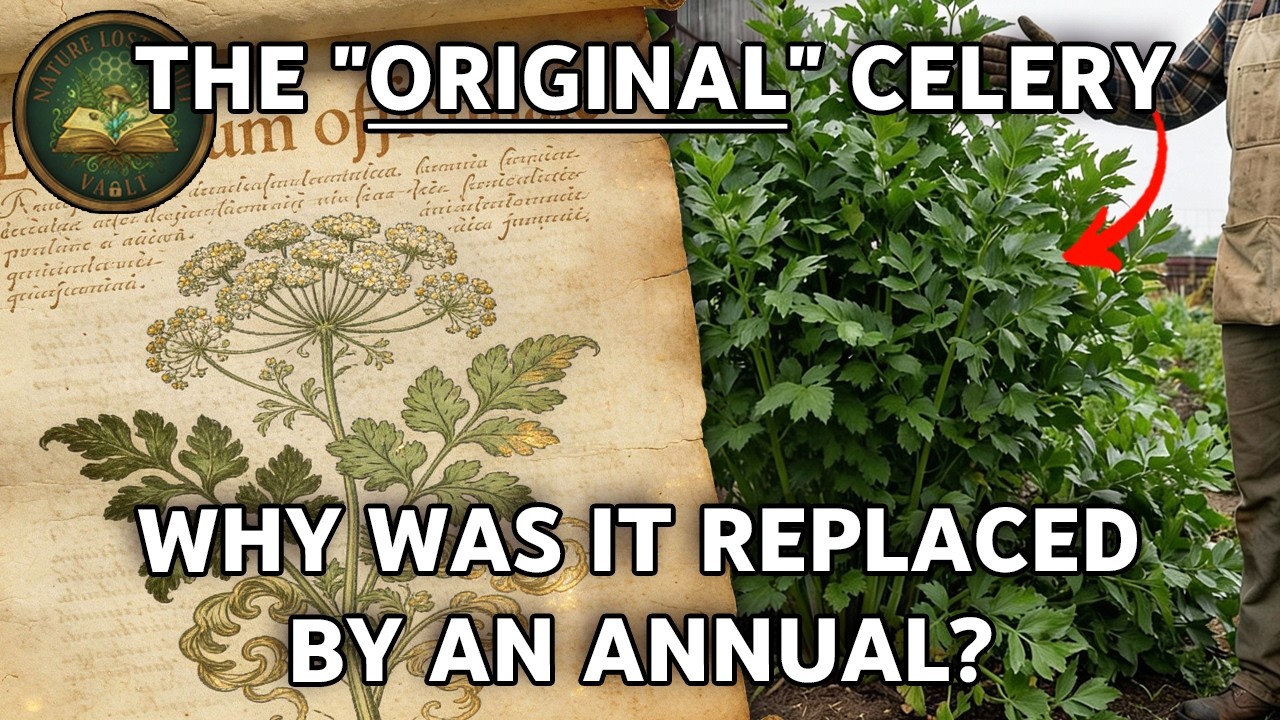
This vegetable produces food continuously for 15 to 20 years from a single planting, with almost no water, once established.
In 800 AD, Charlemagne issued an edict requiring 94 plants in every Imperial garden. One plant appeared on the “compulsory list”—essential for any estate. For 1,500 years, it defined European cuisine, appearing in Roman recipes more than garlic or onion. Then in the 1950s, it vanished from American seed catalogs. Not from disease. It was systematically replaced by an annual vegetable that requires purchasing seeds every year.
This is lovage (Levisticum officinale), the perennial celery that grows for 15-20 years from a single planting. One plant produces continuously from April through October, surviving to -30°F and requiring almost no maintenance once established. Every part is edible—leaves, stems, roots, and seeds. Nutritionally, it surpasses modern celery in minerals, vitamins, and flavor intensity.
So why did the $2.7 billion celery industry need you to forget it?
In 1919, botanist Ulysses Prentiss Hedrick wrote that lovage’s flavor was “too pronounced for modern American tastes.” Not poisonous. Not inferior. Too flavorful. American food was being redesigned for industrial production, and lovage’s greatest strength—its intensity—became its death sentence.
By the 1950s, Pascal celery had become the industry standard. Mild, uniform, compliant with mechanization. But most importantly: annual. Farmers had to buy new seeds every single year. Lovage’s 15-year lifespan made it worthless to seed companies who profit from dependency.
The replacement worked. For them. The global celery market hit $2.69 billion in 2024, with the celery seed market projected to reach $2.6 billion by 2030. That’s nearly $5 billion in combined annual revenue from a vegetable that requires constant repurchasing.
Lovage appears in the Capitulare de villis (800 AD) as compulsory for Imperial estates. The Apicius cookbook (circa 400 AD) lists it more than any other herb in ancient Roman cuisine. Medieval monasteries from Ireland to Jerusalem grew it as a staple. For over a millennium, European food was built on lovage.
The plant reaches 6 feet tall with hollow stems and dark green leaves that smell like concentrated celery. It grows in zones 3-9, tolerates drought once established, and produces continuously for 15-20 years. Young leaves go fresh in salads. Mature leaves dry for winter. Hollow stems can be candied or used in soups. Seeds work as a spice (often sold as “celery seed”). Even the roots are edible.
Nutritionally, lovage contains significantly more potassium, calcium, magnesium, and iron than celery. The flavor is more intense—what celery wishes it could be.
Lovage never disappeared completely. Heirloom seed companies still carry it. European gardens never stopped growing it. And now, slowly, it’s returning.
📚 SOURCES:
– Charlemagne (800 AD). “Capitulare de villis vel curtis imperii” (Of Imperial Lands and Courts), Chapter 70.
– Apicius (circa 400 AD). “De re coquinaria” (On Culinary Matters). Ancient Roman cookbook referencing lovage extensively.
– Hedrick, U.P. (1919). “Sturtevant’s Edible Plants of the World.” New York Agricultural Experiment Station. Macmillan Company.
– Bailey, L.H. (1914). “The Standard Cyclopedia of Horticulture.” Macmillan Company. Historical cultivation practices.
– Virtue Market Research (2024). “Global Celery and Coriander Produce Market Report.” Market analysis showing $2.69 billion celery industry.
– Future Market Report (2024). “Celery Seeds Market Size, Share & Industry Analysis.” Projected $2.6 billion market by 2030.
– Spence, C. (2023). “Lovage: A Neglected Culinary Herb.” International Journal of Gastronomy and Food Science.
– Mother Earth News (1979). “Lovage Plant: The Perennial Celery.” May/June issue on cultivation.
– Denver Public Library (2020). “Trenched Celery, Blanched Celery and Pascal Celery: The Forgotten Story of Colorado’s Once Mighty Celery Industry.”
– Pimenov, M.G. & Leonov, M.V. (1993). “The Genera of the Umbelliferae: A Nomenclator.” Royal Botanic Gardens, Kew.
🔔 Subscribe to Nature’s Lost Vault to rediscover what industrial agriculture tried to erase
##homesteading #PerennialVegetables #FoodSovereignty #ancientwisdom #HeirloomSeeds #SustainableGardening #permaculture
41 Comments
This perennial vegetable can feed you for 15 to 20 years from a single planting. It flavored European food for over a millennium, then vanished when annual celery became more profitable to sell.
If you want to grow it yourself, learn how it’s used, or find seeds and root divisions today, start here: https://naturelostvault.com/episodes/episode-47-lovage.html
Does it grow in the wet tropics, in well drained soil???
This is lovage (Levisticum officinale), the perennial celery that grows for 15-20 years from a single planting
I grow loveage. Its a fantastic plant. Only drawback is no ants on a log. Other tha that its a great substitute to celery. Its easy to grow.
As a person who plant trees and vegetables, I feel like crying when I saw standing dead trees in my village therefore it's extremely torturing to know how people had done to the plants that God had created for us.
😢😢
bruh this can't be planted in a tropical climate
Probably tastes terrible
I had a packet of parsley seeds that grew lovage. Lovage is POTENT. I like to pop fresh parsley in my mouth and chew…I simply cannot do it with the lovage. The seeds look very similar…the plants identical when sprouting, the flavor, Wow! Not so alike. Guess I will try to cook with it and see. A little has to go a long way.
….✨For The Last Few Years, Celery Has Been Dry, Stringy And Tough ~ Going To Try To Grow Lovage ~ Thanks For This Information✨….
Gee it wasn't removed by big pharma.
Its usually a "plant once, forget, harvest for ages" herb… but some caterpillar has been obliterating our lovage plant for the past 2 years!
I wish there was a way to signal the chickadees to go check it out. They do a wonderful job with pest control in the grape vines and fruit trees/bushes, but never seem to notice the lovage (alone in its corner).
You keep saying that it's so strong that it takes one plant to season an entire pot and it grows so fast what are you going to do with all of it
Too strong for modern American tastes?? Whoa there, tiger. This change was initiated by corporate. Not "Americans".
Interesting, I still use dryed lovage leaves
I miss the real celery from my country.
I thought Come Free (Comfrey) was a cool name. Lovage takes the cake. I LOVE Your channel! I am not exaggerating when I say it is my #1 favorite YouTube channel.
I've ordered Purslane seeds and Comfrey – specifically the Bocking 14 variety so I can grow them in my yard. Thinking of growing the Jerusalem Artichokes (sunchokes). My soul feels uplifted already.
I am excited to try Lovage; however, Celery is not totally an "Annual" plant.
If you take the bottom end of a celery head you bought at the grocery store, you can replant it — and it will grow. How successful this is over 20 years I cannot say; but in a pinch you could do this.
Ugh thrives in zones 3-9. I'm in zone 11b. Sounds like another struggle to grow plant here then! 😢🇦🇺
many different plants have been eliminated, erradicated, and or deemed a nuisance. Saldy many of these are extremely high in nutrients and some have more protein than beef which is making the planet sick.
Great 5 minute video please make it more concise in the future
Campbell's soups used tons of this perennial!
What is the name of the pretty pot with the holes that I saw in the graphic describing lovage in colonial US?
got my lovage seeds from baker creek too…i don't really see the similarity to celery except in how it looks…it tastes and smells way different from celery to me…lovage is as aromatic as a flower or a strong herb like sage or lavender…just walk past it and get a huge whiff…it smells divine!! i wish i could get that smell in my laundry and my house…it is true that it's potent…i wrecked a pot of soup with a few leaves…i understand that you should put a stalk in the pot at the end and after 15mins fish it out like a bay leaf
Uau… gonna plant it in my garden this week. Never heard of it before! ❤
❤
Thank you for featuring one of my favourite herbs/vegetables.
It's the must have for everyone seeking the true umami flavour.
Don't be scared of It's intensity, it blends very well.
I believe the common name 'Lovage ' derives from 'Love Ache ' being thought of as an aphrodisiac many moons ago ……
It's also an important plant when in flower for many beneficial insects.
When my Lovage reappears in spring I greet it like a true loyal friend and know that warmer days are ahead.
Can you send me the seeds… And also please share process to use it and replace onion.
Looks like celeriac
Modern celery is basically water and crunch.
Lovage is celery concentrate.
No wonder one survived for 1,500 years and the other needs to be replanted every season.
bottled water pretending to be a vegetable! nice one!
Heh, nice to see a Townsends clip in there.
Do you have a full listing of these plants you are featuring and where they can be acquired
Lovage has a very strong flavour, much stronger than celery (×1000). It's too pungent to eat fresh. In short, it's great, but it's not a perfect celery substitute.
Things used to be cheap because things didn't need to be replaced every year.
Thank you, this is such a channel of knowledge! I’ve already purchased some lovage seeds, and now can hardly wait for planting season! 😊
I can't plant it outside bc it's invasive, I can't plant it inside bc it's massive. If I ever realize my dream of having a greenhouse, Maybe then. Celery will have to do. Good thing it's cheap! (Celery for soup can be frozen. Leaves can be used on sandwiches if you like the taste or are pining away for a substitute for lettuce texture.)
My seeds came in last week. So looking forward to growing this!
Lovage (Levisticum Officinale) is out in the wild here in IRL and it is also available in pots! I'm going to get one of these in a pot and plant it as I NEVER liked the taste of 'pascal celery' – maybe this plant is the reason of what I should be eating! Thank you for this upload!
I had the plant in my garden, never used it. It’s absolutely not the same as celery. Lavas is bitter, and quickly dominates every other taste.
The different types of celery are way more sophisticated. And yes, there are different types of leaf celery. With fine leaves, with larger leaves, Italian celery. There are local varieties. Like Amsterdam celery, and westland celery.
But it’s a nice perennial.
In dutch it’s called the Maggi plant, because it has the same aroma.
No one replace celery with lovage…we Grew them separatly because they are diferent plants and totaly diferent aromas.
In Germany 50 years Go we called it 'Maggikraut' Maggi is a chemical brew.