

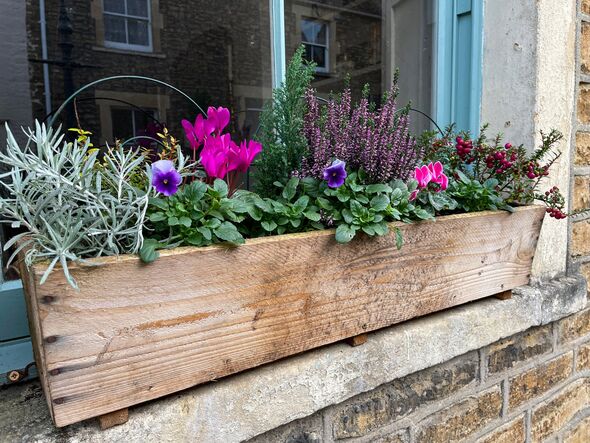
A well-planted window box puts winter flowers and evergreen foliage at eye level (Image: Getty/iStockphoto)
January has plenty of potential for adding colour to the garden. A well-planted window box puts winter flowers and evergreen foliage right at eye level, so you enjoy it every time you pass the window. It’s also a tidy way to garden in small spaces, from balconies to narrow ledges.
Choose your window box and position
If you already have a window box, empty it completely and give it a good wash. Fresh peat free compost makes a big difference to drainage and plant health, even in winter. When buying new, measure the window carefully and choose a sturdy trough with proper drainage holes. If you’re fixing it in place, use strong angle brackets and suitable wall plugs and screws. If your window opens outwards, keep plants low or hang the box slightly below the opening line.
Plants that look good in January
Pick a mix of structure, colour, and trailing edges. Aim for plants in bud, flower, or with interesting foliage so the display looks good instantly.
· Erica carnea ‘Myretoun Ruby’ for flowers from winter into spring.
· Viola x wittrockiana ‘Cool Wave Blueberry Swirl’ for spreading, trailing colour in cool seasons.
· Skimmia japonica ‘Rubella’ for red buds and glossy evergreen leaves.
· Heuchera ‘Obsidian’ for strong foliage in a small space
· Ornamental kale ‘Nagoya Red’ for frilled texture and bold winter colour.
Read more: Here are my 5 tips to spark a lifelong love of nature in kids this Xmas
Read more: Winter’s here – these are my 4 tips to stop it killing your garden

Evergreens are the perfect winter window box ingredient (Image: Getty/iStockphoto) THREE STEPS TO WINTER WINDOW WONDERLAND

Use peat-free compost when replanting your window box (Image: Getty)
Step 1 – Clear and Plan
Remove old compost and debris, then check the drainage holes are clear. Stand your plants in the empty box while still in their pots. Put taller plants towards the back or middle, and trailers near the front and edges. Step back and check the balance of colour and height.
Step 2 – Fix then Fill
Put the box into position before filling, as it will be heavy afterwards. If you line the box first, pierce plenty of holes for drainage. Add peat free compost and fill to about 2-3 cm below the rim, then firm lightly.
Step 3 – Plant, Water, Finish
Dig planting holes to match each rootball. Ease plants from their pots by gently squeezing the sides and tipping them out, keeping the compost intact. Plant at the same depth as before, then firm compost around each plant to remove air gaps. Water them in well, wiping the outside clean, and check that water can drain freely.
Herbs in January
For outdoor winter window boxes, stick to hardy herbs like thyme ‘Doone Valley’ or sage ‘Berggarten’ in a sheltered spot. In very exposed positions, frost and wind can damage growth. In that case, use a sunny windowsill indoors for herbs you want to pick often, and keep the window box focused on ornamentals.
Winter aftercare
Water only when the compost feels dry. Deadhead violas to keep flowers coming and remove damaged leaves after windy weather. With that little routine, your window box will stay colourful and fresh through January and beyond. Learn more about making a DIY window box on my YouTube channel, @daviddomoney.

Hamamelis mollis (witch hazel) is hard to beat as a winter spring flowering shrub (Image: Getty/iStockphoto)Focus Plant – Witch hazel
When winter borders need a lift, witch hazel, Hamamelis, is hard to beat. It grows into an elegant, open shrub with a naturally arching shape, earning its place as a standout feature in the colder months.
From January into early spring, its bare branches carry fine, ribbon-like flowers that catch the light on dull days. Many are also scented, the perfume often being strongest when the air is still. Later in the year, the foliage can turn buttery yellow, orange, or copper, so the plant offers interest through all the seasons.
January is a great time to plant a container-grown witch hazel, provided the soil is not frozen or waterlogged. Give it a bright, sheltered position with moist but well-drained ground, as flowers hold for longer away from cold, drying winds.
Improve the planting area first by working in plenty of peat-free garden compost, then set the shrub at the same depth it grew in the pot. Firm it in gently and water it well. For containers, use a loam-based, peat-free compost and make sure the drainage holes are clear so winter rain can escape. Once established, witch hazel is generally low maintenance, only needing extra watering during prolonged dry spells.
If space is limited, choose a variety with a reliable habit and colour, such as Hamamelis x intermedia ‘Arnold Promise’ or ‘Jelena’, which give a strong winter impact without dominating the garden. Witch hazel resents heavy pruning, so after flowering, simply remove dead, damaged, or crossing stems to keep the framework tidy. Head to my YouTube channel to learn more about growing and caring for witch hazel, @daviddomoney.
Fun fact: The ‘witch’ in witch hazel is not about witchcraft. It comes from Middle English wych (from Old English wice), meaning pliant or bendy. This describes the flexible stems traditionally used for dowsing rods.
Top 5 Gardening Jobs
1. As the new year gets going, rotate indoor citrus pots a quarter turn weekly so growth stays even and the canopy doesn’t lean towards the light. Keep plants in the brightest spot you have, avoiding cold draughts from open windows at night. Check compost moisture too, as central heating can dry pots quickly.
2. After winter winds, look up into tree canopies for hanging, split, or torn branches. Remove damage promptly with clean, sharp cuts back to a suitable side branch or bud, taking off any loose bark so the wound edges are neat. Work safely and leave major limbs to a qualified tree surgeon if access is difficult.
3. On mild, still days, ventilate cold frames to reduce condensation and discourage grey mould. Prop the lid open slightly for an hour or two to let damp air escape, then close it again before late afternoon, especially if frost is forecast.
4. Inspect pond edges for liners lifted by frost heave or shifting soil. Ease the liner back into place, repositioning stones or edging, and top up water levels if needed. Rainwater is ideal because it’s untreated and usually gentler for pond life. Tap water can alter hardness and pH, and may contain chlorine, so add it slowly if you must.
5. Clean algae and grime from solar light panels and lenses so they charge well during short January days. Use a soft cloth and warm water, then adjust the angle to face the brightest part of the sky. Clear nearby leaves, moss, or stems that cast shade, and check the panel isn’t tilted away after wind.
Facebook – https://www.facebook.com/DavidDomoneyTV
Instagram – https://www.instagram.com/daviddomoney/
Pinterest – https://www.pinterest.co.uk/daviddomoney/overview/
TikTok – https://www.tiktok.com/@daviddomoney

Topiary has been popular since Roman times (Image: Getty)Did you know?
Topiary, the clipping of evergreens into shapes, has been recorded since Roman times; Pliny the Elder even noted clipped cypress, and it later returned to fashion in Renaissance formal gardens.
After Christmas, recycle your real tree for wildlife: cut thick trunk sections into logs, drill smooth nesting holes of mixed diameters, and fix them in a sunny, sheltered spot for solitary bees; stack the branches as a quiet log or brush pile to shelter overwintering insects, amphibians and small mammals. Leave it undisturbed until spring so residents can settle safely.
Blackthorn (Prunus spinosa) produces dark purple fruits called sloes, traditionally steeped in gin with sugar to make sloe gin, a classic British winter liqueur; many people freeze the fruit first to soften it.
Britain’s native black poplar (Populus nigra subsp. betulifolia) is now scarce, once common on floodplains and riverbanks, and conservation projects are working to safeguard and replant it.
Comments are closed.