
Pauline McLeanScotland arts correspondent
 Shutterstock

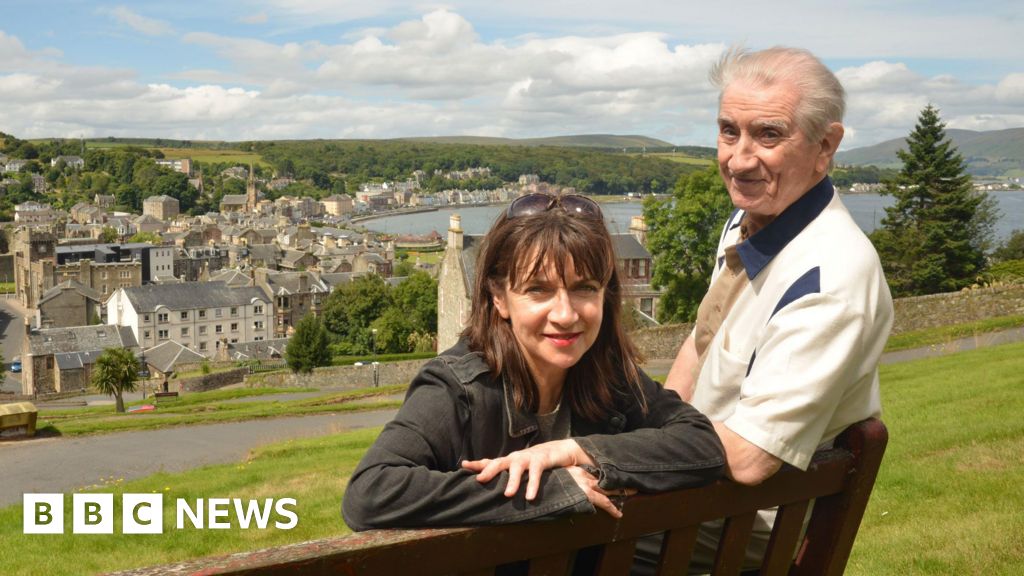
Maureen Beattie is continuing the family support for the campaign to save Rothesay Winter Gardens after her father Johnny Beattie stopped its demolition in 1982
Rothesay’s A-listed Winter Gardens are the ultimate survival story.
And actress Maureen Beattie has the badge to prove it.
In 1982, her father, Scottish showbusiness legend Johnny Beattie led a campaign to prevent the demolition of the building by the local council.
Despite being revamped as part of the wider townscape of the seaside town, it faced closure again in 1997 and survived only because it was bought by Visit Scotland and reopened as a tourist information centre.
Two years ago, Visit Scotland announced it was closing all of its visitor centres – including Rothesay. And at that point, Maureen whose father died in 2020, joined the reactivated campaign.
 Getty Images
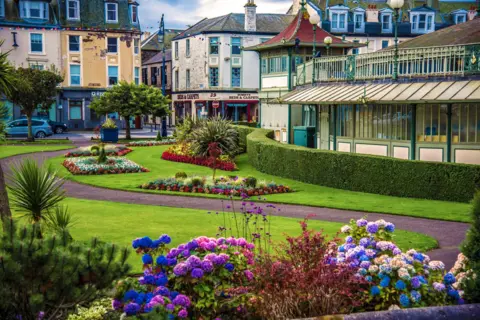
The Winter Gardens building was bought by Visit Scotland and reopened as a tourist information centre
She points to the badge from the 1982 campaign.
“There’s something about the magic of that building and its history, which once you get involved, it’s got its hooks in you and you can’t get away.”
“This is where the Rothesay Entertainers were famous for keeping up the morale of the troops, during the Second World War. It was a major entertainment hub and my father performed here many times, along with every Scottish star.”
This time round the community has bought the building from Visit Scotland, thanks to a grant of £120,500 from the Scottish Land Fund.
Richard Whitcomb heads the Bute Community Land Company which was set up in 2009 to take charge of the community forest.
“Our constitution allows us to take ownership of other community assets and this seemed like the perfect opportunity,” he says.
“It has survived 100 years so it’s seen a lot and come close to being lost to the community before and we just couldn’t let that happen.”
At the heart of the new centre is the island’s only cinema, an 86-seat affair which was part of the visitor centre, and has been run by the community since October.
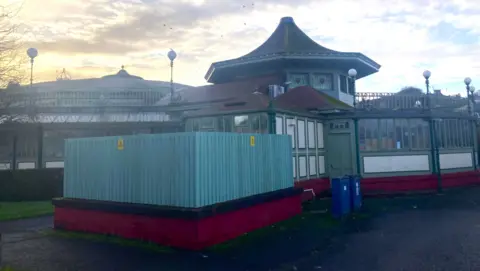
The Winter Gardens are now in a process of rejuvenation after being bought by the community
Zeraya MacGillivray is one of four staff who work there.
“It was crucial to keep it going,” she says.
“Once you lose something like this you never get it back again.
People make alternative plans and they go off the island.”
She says the fact that it’s a small community makes it easy to remember preferences whether that’s choice of seat, film or ice cream.
“People will also come and ask for particular films which is good because we’re a community cinema so that’s what we’re here for. The more people ask for films, the more they’ll come to the cinema.”
But it’s not just about films. She says local groups have realised the venue can be used for all sorts of events, like nativity plays, pantomimes, and dance shows.
Dorothy MacDonald is a member of the Winter Gardens Steering Group and hopes that the cinema is just the start of the latest chapter in the Winter Gardens history.
“It’s such an unusual, flamboyant building and the first thing you see when you get off the ferry.
It’s also right in the middle of the town and it’s so important to people who live on the island. It’s been a wedding venue, it’s been a place where the jazz festival was held, it’s had parties, it’s had everything in it.”
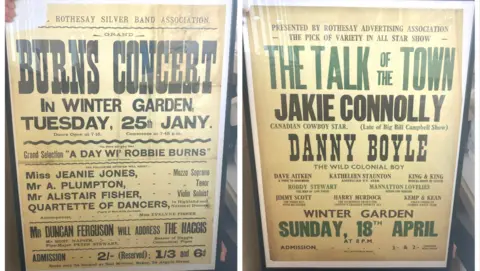
The Pavilion hosted live orchestras and dance hall acts and the Winter Gardens had more formal shows, with professional acts like Sir Harry Lauder and Tommy Morgan in the summer season
The original winter garden was a simple stage in an open air bandstand on the waterfront lawns.
The steel ribbed dome was made to fit over it, and one of the last to be made by the Saracen Foundry in Govan. In 1924, it was shipped to Rothesay to be reconstructed. The entire cost was £1,500.
The art nouveau building was joined more than a decade later by the Art Deco Pavilion, and between the two buildings, the town was a mecca for entertainment.
While the Pavilion offered live orchestra and dance hall, the Winter Gardens had more formal shows, with professional acts like Sir Harry Lauder and Tommy Morgan in the summer season, and amateur companies in the winter.
The island became an important naval base during the World War Two with the seventh submarine flotilla based there. The third Submarine Squadron which followed them was based there until 1957.
For a short time, the winter gardens were used as a mess for personnel but they soon returned to their original purpose of entertainment with morale boosting shows from the Rothesay Entertainers.
The group was established by Glasgow painter and decorator Robert Fyfe, who first painted sets there and then began to put on shows to cater for holidaymakers. The shows ran for over 25 years.
But as the appeal of the Scottish seaside town waned in the 60s and 70s, both the Winter Gardens and the Pavilion fell out of fashion. Both struggled to find a new and viable use and both were derelict for a period.
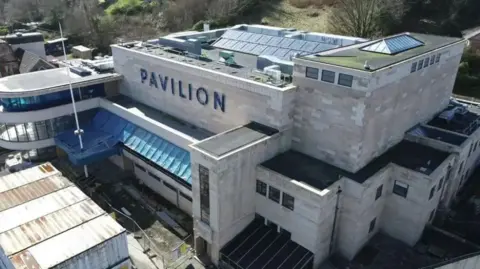 Argyll and Bute Council
The Rothesay Pavilion is being refurbished and is due to reopen in 2027
The Pavilion – which closed for refurbishment in 2015 – was due to reopen in 2019 but the pandemic, inflation and the cost of living have pushed costs up and caused long delays. Now in the final stages of the project, it’s due to reopen in early 2027.
The Winter Gardens project still has further work to do, and estimate they need to raise £700,000 to upgrade the heating system and add a café bar.
“It’s an important moment,” says Dorothy.
“It means that we, the local people that live here, have control over what happens to it.
“I think people just feel we don’t want to lose it, and there’s so much we can do.”
The main message is that the cinema is the lifeline which is keeping the Winter Gardens afloat and locals need to use it or lose it.
As well as screening films, the cinema hopes to collaborate with local schools where film production is being piloted as part of the curriculum.
They also hope to establish a small film festival.
“We want it to be intergenerational, says Dorothy.
“You look at the history of the building and a lot has happened here in the past, but there’s so much that can happen in the future, and we really want it to be a space that young people on the island will take to their hearts as well as older people looking back. That way, we keep it going for another 100 years.”
Maureen Beattie agrees.
“Time moves on. People want different things and the heyday of the Rothesay Entertainers is not coming back.
So we’ve got to find a way of making this a building where people want to go whenever they come to Bute.”
Comments are closed.