
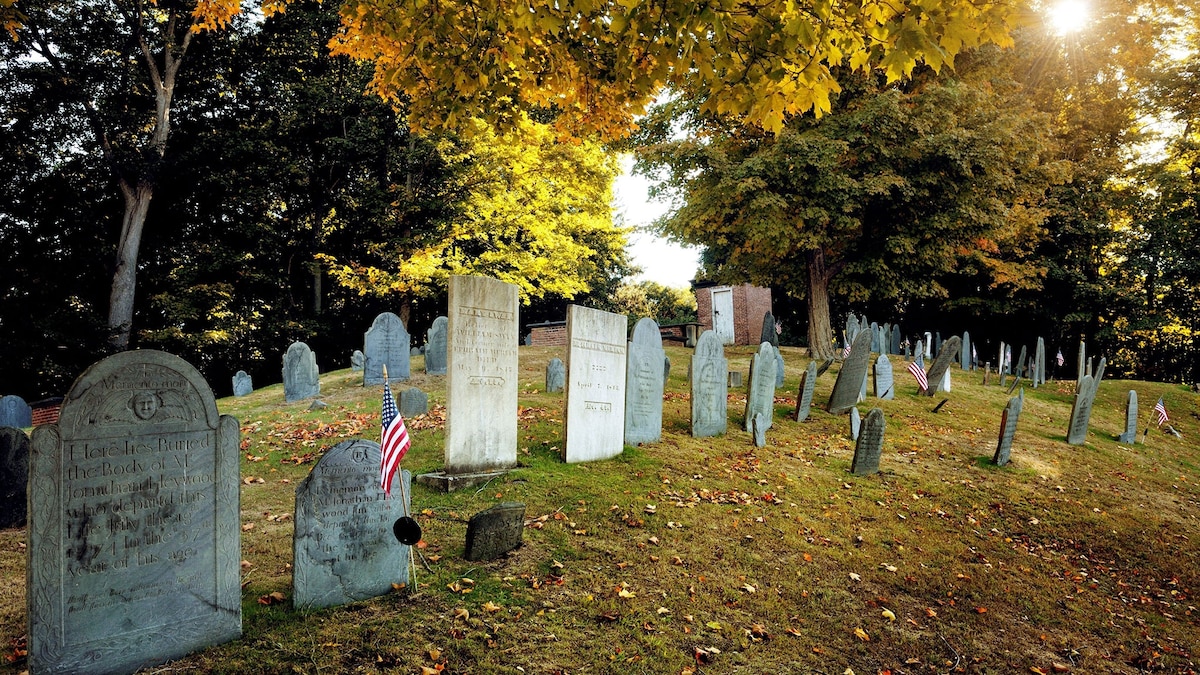
Historic cemeteries are among New England’s most surprising cultural landscapes. Far from the macabre, these sites were “designed as a tranquil, natural setting … to inspire and comfort the living,” wrote Blanche Linden-Ward in her seminal work Silent City on a Hill about the 19th-century landscape movement that sought to reimagine graveyards as rural gardens.
Today, that original vision is evident across the region in burial grounds that feel like arboretums, wildlife refuges, and outdoor art museums. From coastal hillsides to wooded ridges, these seven sites invite travelers to slow down and see New England through a different lens.
Forest Hills Cemetery, Boston, Massachusetts
Founded in 1848, Forest Hills is one of New England’s most sculpturally rich Victorian cemeteries. Instead of a single monumental center, artwork by contemporary artists, such as Fern Cunningham and George Sherwood, dots the hillsides and around ponds, giving the landscape a theatrical quality. Veiled figures appear at different turns in the path, angels stand poised on high slopes, and elaborate family tombs catch late-day sun.
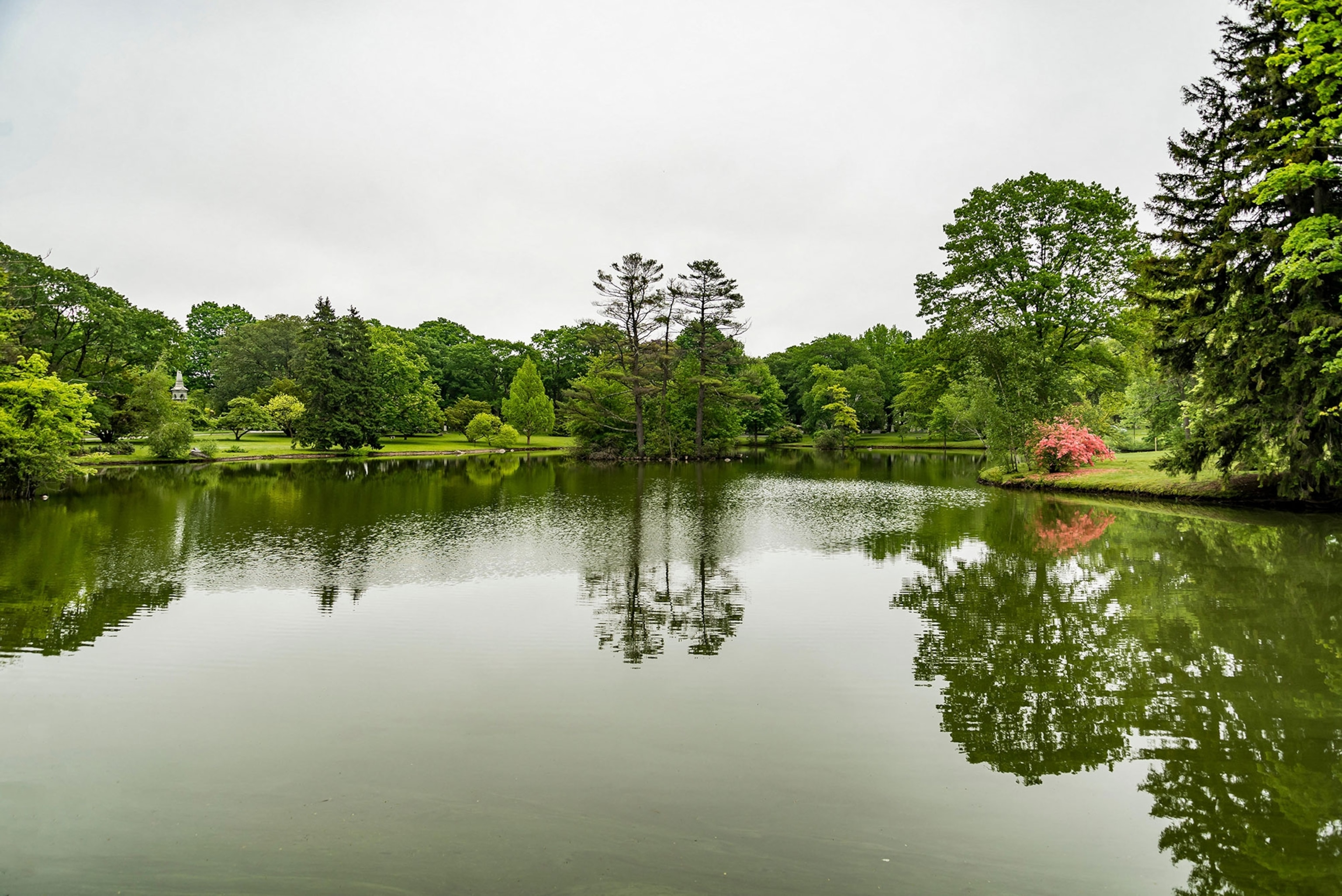
Forest Hills Cemetery, in Boston, Massachusetts, feels like an arboretum, with its sloping hills and diverse plant life.
Enrico Della Pietra, Alamy
The cemetery reflects Boston’s cultural life too. Buried beneath the oaks and beeches are abolitionist William Cooper Nell who wrote for the anti-slavery newspaper, The Liberator; poets Anne Sexton and E.E. Cummings; suffragist Lucy Stone; and playwright Eugene O’Neill.
Visitors can walk to Lake Hibiscus for one of the cemetery’s quietest views or explore the grand Gothic Revival gateway that replaced its Egyptian-style predecessor in 1871.
(What is ‘Gothic’? It’s more complicated than you think.)
Cedar Hill Cemetery, Hartford, Connecticut
Designed in 1863 by landscape architect Jacob Weidenmann and built the following year, Cedar Hill opens into broad lawns, quiet lakes, and shaded knolls where monuments rise among copper beeches and maples.
Cedar Hill is known for a variety of funerary architecture, from classical mausoleums to family stones carved in intricate decorations. A simple boulder marks the grave of actor Katherine Hepburn, a popular site with visitors.
Some of the cemetery’s most rewarding sections are its quieter ones, where Weidenmann’s compositions of water, woodland, and sculptures can be appreciated in full. The Broadway producer Charles B. Dillingham and artists William Glackens and George Wright are buried in these areas.
Sleepy Hollow Cemetery, Concord, Massachusetts
Sleepy Hollow was founded in 1855 and reflects the transcendentalist belief that nature should guide thought and spiritual renewal. Rather than imposing strict geometry, the cemetery’s designers allowed it to unfold around slopes, biting ridges, and shaded hollows.
The best-known section, Authors Ridge, holds the graves of Henry David Thoreau, Ralph Waldo Emerson, Louisa May Alcott, and Nathaniel Hawthorne—leaders of the literary transcendentalism movement. Visitors leave notes, pencils, and stones at their markers, creating an informal pilgrimage site for lovers of American literature.
(Discover Buenos Aires through these 5 dazzling bookstores)
Also in Author’s Ridge, Daniel Chester French’s Melvin Memorial, created for three brothers who fought in the American Civil War, stands as one of New England’s most moving pieces of funerary sculpture. The famed sculptor of Washington, D.C.’s seated Abe Lincoln for the Lincoln Memorial is buried nearby.
Old Burial Hill, Marblehead, Massachusetts
Established in 1638, Old Burial Hill is one of New England’s oldest colonial graveyards and one of its most dramatically sited. Perched high above Marblehead Harbor, it offers views of fishing boats, rocky coastlines, and, beyond them, the Atlantic.
The cemetery includes the graves of Revolutionary War soldiers as well as residents with ties to the Salem witch trials. Many of the slate headstones featuring winged skulls, hourglasses, and other stark symbols of mortality were carved in the early 18th century by members of the Lamson family, whose distinctive style is a hallmark of early New England funerary art.
Weathered inscriptions and lichen-covered surfaces hint at the site’s age, while granite outcrops shaped by frigid forces create a craggy setting. The cemetery is one of the clearest windows into the region’s earliest spiritual and maritime history.
(Salem casts a spell—even without the witchcraft)
Mount Auburn Cemetery, Cambridge, Massachusetts
Mount Auburn, founded in 1831 and listed on the National Register of Historic Places in 1975, is widely credited with reshaping American ideas about burial grounds. The country’s first large-scale landscape cemetery features winding roads and curated sight lines inspired by English landscape gardens, with a diverse plant collection predating the rise of arboretums. Egyptian Revival gates, Gothic-style chapels, and obelisks reveal how tastes shifted across generations.
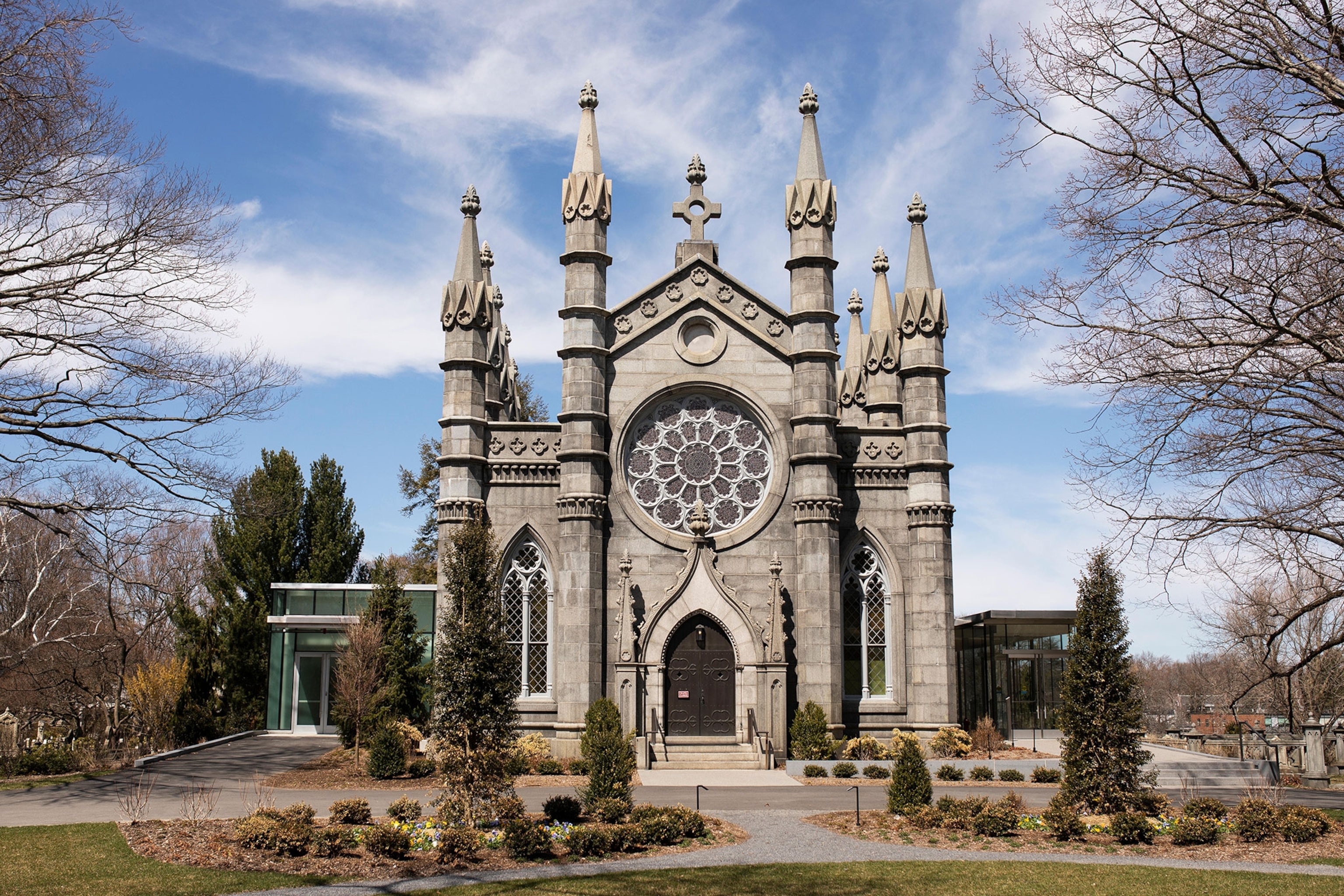
The Gothic-style Bigelow Chapel at Mount Auburn Cemetery, in Cambridge, Massachusetts, makes a dramatic backdrop for public events like Solstice, a dramatic nighttime light and music show held every winter.
Everyday Artistry Photography, Alamy
Today, visitors climb Washington Tower for sweeping views of Boston, attend events like the annual Solstice art and light show, or stop by the graves of members of the Sons of Liberty, famous for dumping tea into Boston Harbor during the Boston Tea Party protest against British taxation.
Swan Point Cemetery, Providence, Rhode Island
Set along a sweeping bend of the Seekonk River, Swan Point feels more like an arboretum than a final resting place. More than 150 species of birds stop here, making the cemetery a quiet sanctuary for birders year-round. Sunrise and sunsets are especially striking, when warm light filters through beech and maple canopies and the river reflects the sky’s changing color.
Among the 19th-century sculptures, including the Channing Memorial, visitors find the graves of Civil War veterans, political leaders, artists including controversial author H.P. Lovecraft, and Engelhart Cornelius Ostby who perished on the Titanic.
Swan Point’s combination of cultural history and ecology makes it one of New England’s most serene burial grounds.
Evergreen Cemetery, Portland, Maine
Founded in 1854, Evergreen Cemetery is one of Maine’s most expansive and offers a distinctly northern expression of the rural cemetery movement. Its character comes from the interplay of woodland and meadow: Victorian monuments emerge among pines and birches, while ponds draw herons and migrating ducks.
(These are the most beautiful cemeteries in Europe)
Evergreen reflects Portland’s civic history as well. Granite tombs and Gothic-style mausoleums showcase Maine’s stone working traditions, and many of the city’s prominent artists and leaders are buried here. Among them are abolitionists Alexander and Louisa Jones Stephenson, who were connected to Portland’s Underground Railroad; and Helen Augusta Blanchard, inventor of the zigzag-stitch sewing machine.
Walk near Houchens Ponds, one of the cemetery’s most active wildlife areas and explore the older Victorian sections, where ornamental plantings still follow 19th-century design ideals.
Comments are closed.