
From Frida Escobedo’s reimagined patios to the rise of edible gardens, architects and designers are turning our built environments into spaces for reconnection.
There is no question that in the last decade, we’ve become increasingly attached to our screens. While our phones make daily life more efficient, they also pull us inward, farther away from the outside world–and ultimately, other people. In response, architects and designers are rethinking how spaces can restore a sense of human connection, using architecture as a bridge.
During Art Basel Paris, for example, architect Frida Escobedo described her redesign of the Centre Pompidou as a “living culture machine,” a civic space open to participation and belonging. Her vision extends beyond museum walls: it embodies a larger shift in how design can foster the shared experiences of a community.
That same idea of architecture as a living organism is now reshaping the landscapes around us. From public courtyards to private patios, designers are crafting environments that invite people to gather, reflect, and reconnect with nature. Around the world, landscape designers are turning to edible planting not just to grow food, but to cultivate connection.
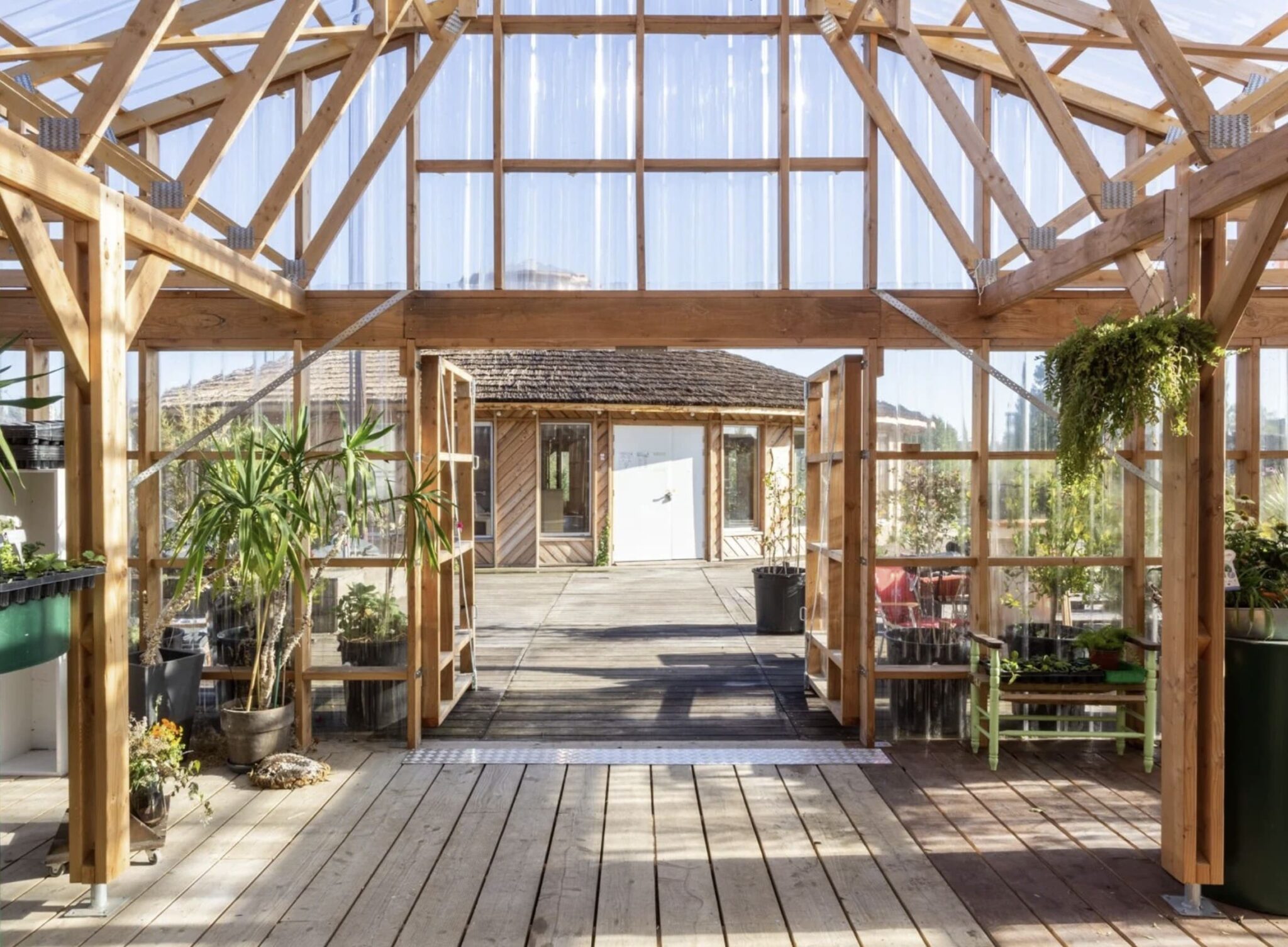
 Bercy Charenton by Pépins Production. Courtesy of Atelier UOA.
 Bercy Charenton by Pépins Production. Courtesy of Atelier UOA.
The Patio: Feeling Part of Something Larger
During the conversations at Art Basel Paris, architect Frida Escobedo reflected on how her upcoming project for the Centre Pompidou has prompted her to reconsider the architect’s role in contemporary culture.
“I asked myself, ‘What is the role of the architect today?’ For me, it’s about sustainability and its social aspect,” she reflected. “It’s about how architecture can create spaces for people to come together and feel part of something larger.”
For the Mexican architect, the patio holds a special place in that vision, highlighting that it is also an important fixture in Latin America.
“The patio is a space for people to gather, but also one where you can be reflective and react to the environment,” she said.
Her interest in this subject can be traced back to her earlier works. Civic Stage, which she designed for the Lisbon Architecture Triennale in 2013, was a slanted circular metal structure with a smooth wooden surface. It beautifully evolved into a living, breathing patio that was used by the city’s inhabitants.
“People were having meetings, skating, meeting up, making out… it became a place where life unfolded naturally,” she recalled.
At home, patios serve the same purpose on a more intimate scale. They offer a place not only to gather but also to slow down. It’s a quiet reminder that architecture, at its best, doesn’t isolate us from nature, but brings us closer to it.
The Rise of Edible Gardens
Research shows that when the economy is uncertain, homeowners tend to focus on things they can control, with one of these things being gardening. While tending a garden is hardly a new pastime, edible gardens have become one of the most promising trends for the coming year, and this shift marks an evolution in how people are using their outdoor spaces. At the same time, they can ease stress while encouraging healthier eating habits and a closer relationship with nature.
This practice goes beyond the idea of a traditional vegetable garden–something not everyone is up for, as it can potentially take up a lot of space. Instead, think about it as weaving food-producing plants into ornamental garden spaces. Designers and homeowners alike are experimenting with microgreens, edible flowers, and small fruit trees in their spaces.
In urban environments such as Paris, in particular, where residents are no stranger to problems such as poor insulation and rising temperatures, companies like Terrasse & Jardin de Paris are creating sustainable solutions to bring nature into smaller apartments. Specializing in plant design, their team of architects, gardeners, and plant experts craft personalized green spaces that feel both restorative and refined.
“Our goal is to transform each project into a personalized, green oasis, whether it’s a fully vegetated pergola, a terrace with a view, or a vertical garden that brings nature into the urban space,” founder and architect César Saint-Ouen previously shared to ArchiExpo.
Merci Raymond, founded in 2015 by Hugo Meunier, is another key player in the rise of urban edible landscapes. One of their standout projects is the rooftop garden at Hôtel des Grands Boulevards, which supplies the hotel’s bar and kitchen and serves as a sensory experience for guests. It also aligns with the hotel’s commitment to reduce its environmental impact.
Another initiative reshaping Paris’s edible landscape is Pepins production, a network of shared nurseries designed to support urban gardeners. One of their projects in Bercy Charenton was created with a clear goal in mind: to make fruit and vegetables more affordable and accessible in urban neighborhoods. In addition to their Bercy location, their edible gardens, which include a diverse range of edible plants and medicinal herbs grown using recycled materials, also appear in unexpected corners of the city, such as behind the Belleville cemetery.
These projects demonstrate how communities can grow and thrive alongside these gardens.


Comments are closed.