
Breadcrumb Trail Links
OpinionColumn
Picking a tree is not like picking a couch. You will outlive a couch, but a tree will outlive you.
Published Dec 05, 2025 • Last updated 1 hour ago • 2 minute read
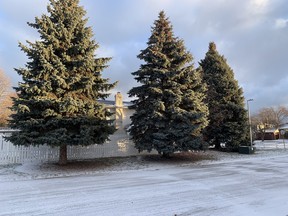 Three Colorado spruce trees are shown. (John Degroot photo) HandoutArticle content
Picking a tree is not like picking a couch. You will outlive a couch, but a tree will outlive you.
Advertisement 2
This advertisement has not loaded yet, but your article continues below.
Article content
A tree’s growth likely will continue during several decades, perhaps even centuries, so it is important to choose trees with care, taking several factors into consideration.
Article content
Recommended Videos
Article content
Size matters. If you have enough space, you may not care how big a tree eventually will become. But if your tree is to be planted close to the house, you will want a smaller-growing ornamental tree. Evergreens are tricky because at planting, they may look innocent, but in a decade or two, an evergreen such as spruce or pine can easily become six to nine metres (20 to 30 feet) wide, taking up too much of the yard.
Variety matters. The climatic hardiness zone map puts southwestern Ontario in Zone 6B. Paper birch, one of Canada’s hardiest trees, will grow in the range of Zone 2 to 7, making it possible to grow from Temiskaming to Windsor, but it doesn’t want to grow where it is warmer. Sycamore grows in the range of Zone 4 to 9, allowing it to grow from Sudbury and North Bay down to the north half of Florida.
Advertisement 3
This advertisement has not loaded yet, but your article continues below.
Article content
If you want a fast-growing tree, poplar, silver maple and willow would be good choices, but are weak wooded and not long living.
Shape matters. Trees such as sycamore and many oak varieties can reach widths that are almost equal to their own heights. Sugar maple, poplar and white pine are among Ontario’s tallest growing trees, with less width. For today’s home landscapes with smaller lots, trees such as pyramidal sweet gum, columnar beech and columnar oak are popular choices that grow tall and narrow.
Soil condition matters. Make sure you know your soil before selecting trees. Maples and pines do not want to grow in heavy clay soil with poor drainage. They will perform well in sandy soil. Oaks, birch and cedars will do fine in heavy soil, but good planting techniques will help them become established, especially in the first few years after planting.
Trees are resilient and have a strong will to grow. But care should be taken when planting trees in disturbed or compacted soil. Native trees will grow readily in native soil, but may be reluctant to perform in non-native city conditions.
The right tree in the right place is a good motto when making choices for your home landscape.
Read More
GARDEN CLIPPINGS: Protecting evergreens in winter
GARDEN CLIPPINGS: Good care will help poinsettias stay colourful
Article content
Share this article in your social network
Comments are closed.