
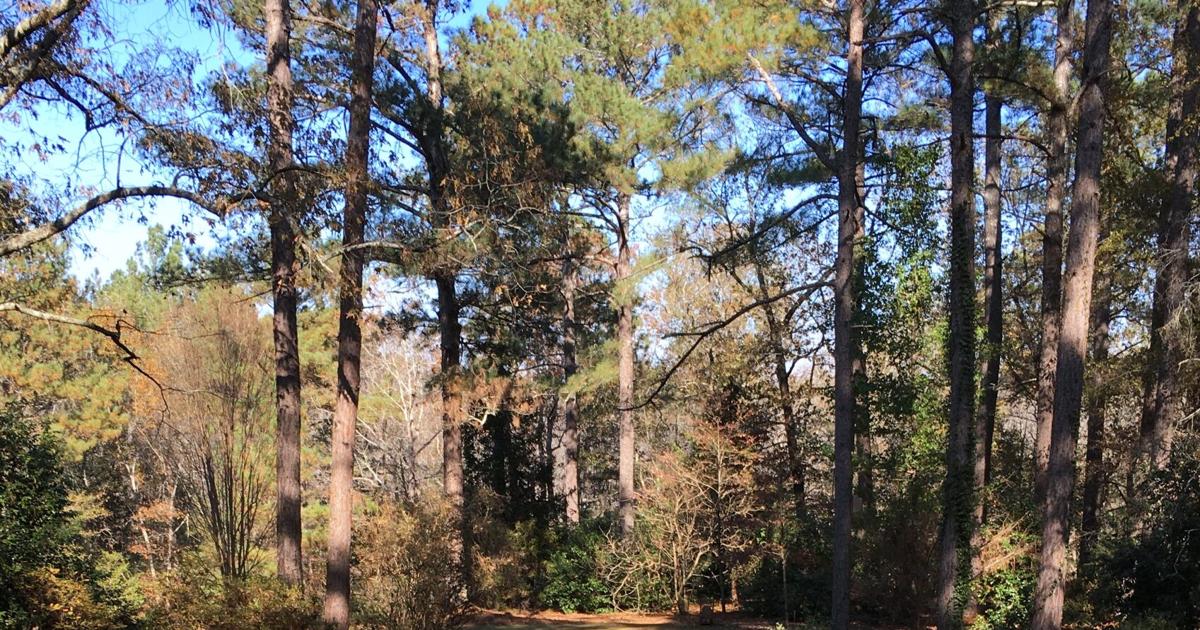
Now that leaves have fallen from the oaks, hickories and yellow popular, I can better view a distant ridge line to the north. Canopies of pines etch this extended view of the skyline from my kitchen window, especially at dawn and dusk when fall’s colors extend across the horizon. I enjoy taking the long view as winter approaches. Master gardeners, and all gardeners, can value the long view. Whether establishing permanent beds for asparagus, garlic, daffodils or roses, or maybe selecting a site to plant a new oak for Arbor Day, many decisions made by the home gardener involve long term planning.
My asparagus beds have involved weeding and mulching over these past few weeks. Years ago, we selected a border in our vegetable garden to establish asparagus, and after waiting a few years, we now enjoy delicious spears throughout early spring. If you wish to establish a new bed, preparation is best done in the fall. Enrich the soil with additions of compost or leaf mold, take a soil sample to determine whether lime is needed and place crowns between Feb. 1 and March 15. For complete guidelines, visit hgic.clemson.edu to find a factsheet for asparagus. Spring’s asparagus bounty in a few years will be a sweet reward.
This fall, I also started a garlic bed, having finally decided on the perfect spot next to my compost bins. Garlic must be planted in the fall to permit full development. Two basic types of garlic are soft-necks and hard-necks. Soft-neck garlic varieties (subspecies sativum) do not make a seed stalk. They are good for braiding and tend to keep longer than hard-neck types. Large and mild, artichoke garlics are most commonly seen in supermarkets, with between 12 and 20 small cloves per bulb. They are easy to grow and store well. More strongly flavored, silverskin garlics are generally the longest storing of all garlics and have soft, pliable necks. Silverskins have many cloves per bulb but are not as large as artichoke varieties. Hard-neck types (subspecies ophioscorodon) produce a seed stalk and peel easier than soft-neck garlic. After turning compost and spreading it over the selected space, I planted a batch of hard-neck cloves. While I still need to mulch with weed-free straw, over time, this year’s planting will become a permanent bed situated between my compost bins and wildflower bed.
The wildflower bed received extensive weeding in October. Now it’s ready for a handful of poppy seeds to be broadcast over the (currently weed free) space. I’m sure that weeds seeded too, so I’ll monitor and pull winter weeds on mild sunny winter days. I have spread pine straw around my roses, so their grafts are protected from winter freezes; otherwise, I’ll wait for Valentine’s Day to prune roses in anticipation of next spring’s rose flush. I’ll also leave dried salvia stalks on the back hillside until early spring. As perennials always do, they’ll persist over the years, becoming more beautiful with the passage of time. I still plan to plant more daffodil bulbs (as if I didn’t already have enough).
Last summer, my husband brought home many bunches of bulbs dug from an abandoned homesite. I’ve been saving them in a dry spot, waiting for early December to arrive. After debating over where to plant the bulbs so that they get enough sunlight but not too much water, a few days ago, walking around the yard, we decided where to plant the next permanent bed of daffodils next to azaleas and forsythia. Dreams of spring’s gold blossoms are always essential to my long term gardening visions. I’ll take another soil sample, of course, and once I know whether lime is needed, I can put these bulbs out before Christmas.
One more long term project approaches. I like to plant a tree for Arbor Day, which arrives in South Carolina on the first Friday of December. Dec. 5 is the date for this year’s Arbor Day. This early winter date assures that newly placed trees can take advantage of the dormant season for root growth. I will plant a Sonderegger pine this Arbor Day.
Sonderegger is a naturally occurring hybrid pine, a cross between loblolly pine and longleaf pine. This pine usually occurs singly or in small groups where both loblolly and longleaf pines overlap in range, and I happen to have one growing in a pot that needs to be transplanted into the ground. If you have space and inclination to plant a tree, consider selecting an oak sapling. Doug Tallamy, in The Nature of Oaks, states that even though each of us lives our lives “in a brief instant of ecological time,” even though each individual may not live to see the long term vision of an ancient oak tree’s life, we can — “indeed we must — start the process.” Tallamy asserts that “in a blink of time, these trees will be large enough and old enough to assume their keystone positions.”
To be assured of success when planting a tree, consult Clemon’s HGIC, to find the perfect factsheet. Trees can be planted to attract pollinators, to provide shade, to provide year round beauty, and to make a difference in the future of our planet. Taking the long view can and will assure our well-being both now, and for those who will follow.
Comments are closed.