
As winter takes hold, the garden changes. Only a few leaves remain on the almost bare trees, the rest are forming a blanket on the ground. Evergreens now dominant, conifers once hidden away take centre stage, some their foliage becoming brighter; Pinus radiata ‘Aurea’ the largest tree in our Winter Garden turns from its summer blue green to a golden yellow as the temperatures drop, lighting up like a beacon over the Formal Garden.
Surprisingly, many plants flower during this time – our gardens are important food sources for pollinators throughout the year. One of my all-time favourites is Daphne bholua ‘Jacqueline Postill’ just coming to its peak, the scent is intoxicating, the purplish-pink and white flowers seem never ending, resilient against the winter cold; several big plants are within the garden – the best are next to our shelter in the Winter Garden.
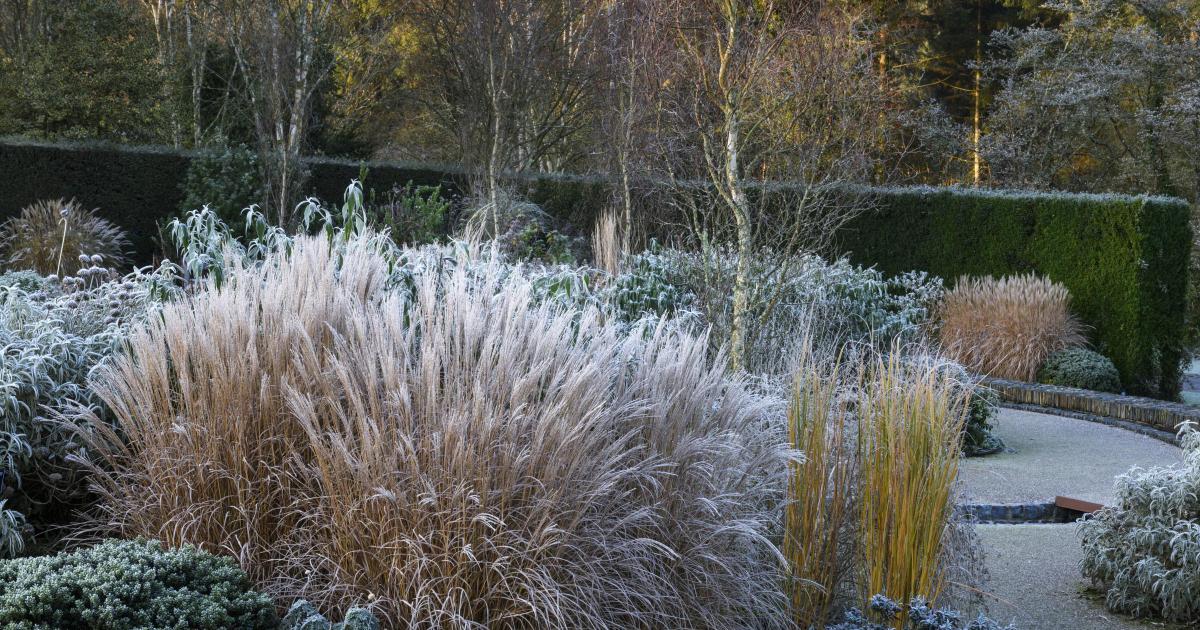
Now the mammoth job of cutting all the gardens hedges is nearing completion. The clean sharp lines add so much to how the garden looks over the winter months, giving a sense of structure and both providing shelter and a backdrop for other plants to be seen. The Cool Garden is a great example, here the many grasses have now turned to bronze, a lovely contrast to the dark green yew hedges which encircle the garden, adding a different tone to the borders but still providing texture and movement in the wind. Panicum virgatum ‘Northwind’ grows very upright and Hakonechloa macra is lower and loose and fluffy in appearance often overhanging the water rills.
Cool Garden December (Image: Jason Ingram)
Evergreens definitely are a must for the winter in any garden, they help provide shelter for wildlife, offer protection from the winds and just give us something nice and often bright to enjoy. At Rosemoor we have seven Plant Heritage National Plant Collections. Ilex – or hollies as they are commonly known – have been part of the evolution of the gardens since Lady Anne Berry, who gifted the garden to the RHS, started her gardening journey. I am always fascinated in the stories behind the plants and especially when planted by Lady Anne as so many well-known gardeners of the time were often the source, with some fascinating stories of how she acquired them.
Back in 2015 Lady Anne told me the story of how she became so interested in these often-prickly plants,. Then living in New Zealand she sent me one of her regular emails explaining all.
‘It must have been in the early 1980’s that Harold Hillier, of Hilliers Nursery in Hampshire, telephoned one evening asking me to entertain an American from South Korea and take him round my garden. I was a little apprehensive but agreed and Carl Ferris Miller duly arrived and stayed with me for a few days, and we hardly stopped talking and I found him most entertaining and an enthusiastic plantsman.
‘He told me how he had fallen in love with South Korea when serving in the US Navy and his ship called at Seoul. Later as a successful banker he decided to make his home there and develop an arboretum at a place called Chollipo in the south, with a special interest in growing hollies together with a wide range of other plants in what was to prove an ideal climate.
It did not take him long to stimulate my interest in the genus Ilex, and I soon began collecting them!’
Ilex × altaclerensis ‘Golden King’ (Image: Lee Charlton)
The holly collection was one of the very first when Plant Heritage began its work to help safeguard cultivated plants, and now we have over 185 different species and cultivars, a collection we continually add to, honouring its long association with the garden.
Diversity is apparent, the plants vary so much in size, leaf shape, berry colour and gender. Hollies are called dioecious which means separate plants have male or female flowers, this is important to know if you want berries. Looking online or in good gardening books it will tell you which sex certain varieties are but do check and don’t rely on names as many can confuse you! Ilex × altaclerensis ‘Golden King’ is in fact female and will produce red berries which standout against its green foliage with a bright yellow margin.
Ilex crenata ‘Dwarf Pagoda’ (Image: Oliver Kite)
On the border at the bottom of our Formal Garden grows Ilex aquifolium ‘Ferox Argentea’, a selected form of our native holly with variegated leaves was first recorded in England in 1662, commonly called the hedgehog holly due to its very spiny and distorted foliage, a showstopper over winter. Now to something smaller from Japan, Ilex crenata ‘Dwarf Pagoda’ commonly called the Japanese holly as the name suggests is small, reaching 50cm in around 10 years if you are lucky, ours each year is smothered in very small black berries.
With so many different hollies to choose from I am certain you will find one to suit your taste and garden! .
Jon Webster is curator at RHS Garden Rosemoor near Great Torrington.
Daphne bholua ‘Jacqueline Postill’ (Image: Neil Hepworth)
Comments are closed.