
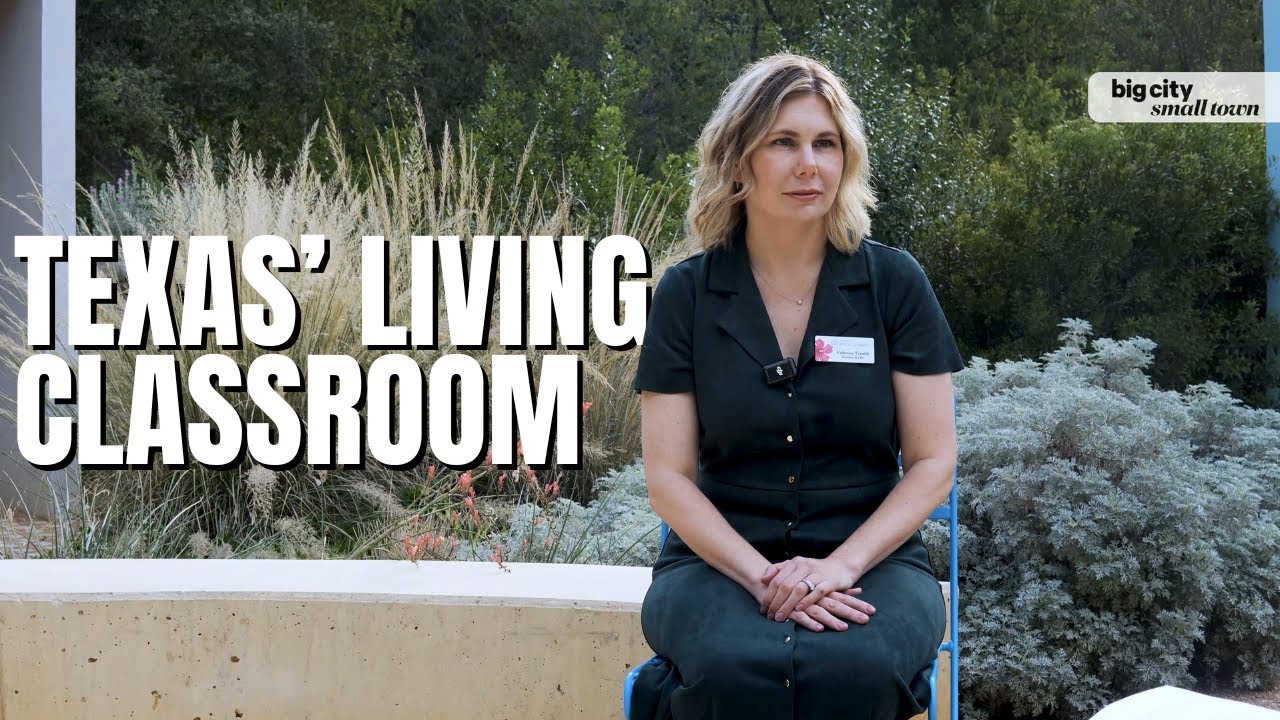
This episode of bigcitysmalltown asks a simple question with big implications:
What can a botanical garden teach Texas about water, climate, and community?
Host Cory Ames sits down with Katherine Trumble, President & CEO of the San Antonio Botanical Garden, to explore how a “living museum” can help Texans rethink their relationship with nature, yard by yard, neighborhood by neighborhood.
Now in its 45th year, the garden is launching a bold 10-year master plan centered on two big ideas: plant conservation and access. Katherine shares how that vision shows up in everything from drought-tough demonstration gardens and school tours to a new pollinator meadow, statewide seed bank, and the Trees Initiative restoring flood-damaged stretches of the Guadalupe River Valley.
They talk about the garden as:
– A living classroom for water-wise gardening and native plants
– A place where kids roll down Tumble Hill and families feel at home in nature
– A behind-the-scenes conservation hub protecting Texas’s rare and hyperlocal plants
– A cultural and economic engine for San Antonio through tourism, memberships, and events
—
📚 CHAPTERS
00:00 Introduction and Background
00:28 Journey to Leadership
02:24 San Antonio Botanical Garden’s Community Impact
04:27 45th Anniversary and Future Plans
08:03 Conservation and Education Initiatives
17:31 Membership and Community Engagement
19:26 Exciting Upcoming Events and Features
23:47 Fundraising and Community Involvement
27:45 Conclusion and Final Thoughts
— —
RECOMMENDED NEXT EPISODE
▶ #143 Will San Antonio Become America’s Next Manufacturing Hub? https://youtu.be/TZq4jLJknQM
— —
✉ Subscribe to Bob’s Newsletter – https://bigcitysmalltown.kit.com/3116febd0c
📝 Resources & Show Notes – https://www.bigcitysmalltown.com/146
CONNECT
📸 Instagram: https://www.instagram.com/bigcity.smalltown/
🔗 LinkedIn: https://www.linkedin.com/in/robertjrivard/
🎥 Subscribe on YouTube: https://www.youtube.com/@UCNqjZ5_KqYMsHfwOWNlsp2g
SPONSORS
🙌 Support the show & see our sponsors
THANK YOU
⭐ Leave a review on Apple Podcasts
⭐ Rate us on Spotify
#SanAntonioBotanicalGarden #sanantonio #texasnature #nativeplants #waterwise #plantconservation #bigcitysmalltown #CoryAmes #SustainableTexas #urbannature
[Music] Katherine, thank you again for for taking the time to speak with me. I know that you’ve worked with a number of important cultural institutions here in San Antonio, as well as uh maybe one elsewhere, but I’d love to know for those who might not be familiar. Uh how do you find yourself here in the leadership position at the the San Antonio Botanical Garden? Give us that background of experience that that led you to this work. Of course. And first off, thank you so much for interviewing me today, Corey. I really appreciate this opportunity. I am very fortunate to be sitting in this role as president and CEO of the San Antonio Botanical Garden. I have been CEO at the botanical garden for about for almost two years now and it’s been an incredible opportunity. It’s it is a really a joy to come to work every day with 156 really committed individuals uh to help fulfill our mission and hundreds of really active volunteers. My personal background, I came up through art museums and I’ve worked in three different um art museums in San Antonio serving as head of development of the McNe and the Brisco uh before coming to the botanical garden six years ago as director of development. Ran those programs for several years to expand our contributed revenue and also our membership program and then and then eventually events and rentals as well. And then when our previous CEO moved on to another institution, I became interim and then CEO. And so it’s been a wonderful journey. I feel very fortunate to have had the opportunities that I’ve had, especially in a city like San Antonio that is so culturally vibrant and it’s really special being in a living museum every day. Well, say more about that. like the the experience of working in these institutions here in San Antonio, people don’t necessarily see the background of it. You know, the maybe they, you know, visit these places on occasion or maybe they can feel that they’re oriented more so for for tourists or visitors. I’m happy to say that that’s not the experience for my family with botanical garden. Our our toddlers love this space, but especially, you know, contrasting that with art museums, the Brisco and the MCN. What’s your perspective of living in San Antonio but but working in these important cultural institutions? What do you feel like is their relationship to the city, the citizens and the residents? Maybe some things that people may not always think about. Well, at the botanical garden, part of the reason why we have almost a thousand programs a year is because we want you to come back again and again. And that’s why our membership is so robust as well because we have all these offerings that engage people at different points in their life with different interests. Our goal is to be at the heart of community and public gardens in general when we’re doing our work best are at the heart of community. I like to think about it many you may have been uh with your family to Tumble Hill. So, Tumble Hill is in our family adventure garden, and my girls love Tumble Hill. I mean, they’re they’re getting a little bit old for it now, but but they will still run up the hill, roll down the hill, run up the hill, run down the hill. And why I think that is so special is that it really embodies that sense of being free and feeling at home and comfortable and that sense of uh of belonging that we want every child to feel. And I think that that is something that goes beyond the San Antonio Botanical Garden and extends to our other cultural institutions in San Antonio is this feeling that the incredibly passionate people that work at those institutions as well are all committed to helping San Antonians feel like these are their resources to enjoy and love and be a part of. And then because San Antonio has uh is such a tourist destination, we also have a responsibility as cultural institutions to our city that we are offering the very best to help drive tourism revenue and be an economic driver for the community. And so it really all comes back to community and how we are all a part of that. Well, some folks may may see these banners uh around Broadway with the the big 45 on them. It’s the 45th anniversary, the San Antonio Botanical Garden. Tell us a little bit about the significance of that milestone for the garden and things continue to to rapidly evolve and change, which we’ll talk about more so, but what’s the significance of the 45th year? Yes. So, 45 years of enriching lives through plants and nature. This year, we launched our new 10-year master plan. And and at the heart of that plan are two main themes, plant conservation and access. And really, that’s our focus. That’s our guiding light for the next 10 years. How do we activate on that plan in in many ways? And so the the uh the 45th anniversary is really a celebration and a rally call uh for our community, celebrating our legacy and just really getting excited about what’s coming next. Well, help paint that picture for us 10 years down the line. What’s that vision look like? What’s the experience of the garden going to be for for San Antonio? Yeah, so we spent the summer doing a programming study on phase one projects for the news master plan. And really at the those projects include a new horiculture campus which that fuels our mission, a public facing conservation and education building with a living roof. Uh that will help us to more than triple our our education programs and also really expand our conservation programs with a seed bankank that will serve the entire southwest research spa research space and a small herbarian and library. a 2 and a half acre sprawling pollinator meadow that will champion our milkweeds collection and also our Texas oak collection which is up for accreditation this year. And then revitalizing the Texas native trails which are one of the things about the garden that makes it so special and unique and by adding a vineyard and a West Texas garden. So much of what we’re collecting through our conservation programs comes out of West Texas. About 54% of rare endangered plants come from West Texas in our state. And then really one of the program projects we’ve been working on that that’s coming ahead of these other larger projects is the new Napier family orchid pavilion. And that is something that we are very excited about. We’ve been spending the summer designing it. We’ve just finished the design uh uh in earlier this month and we are going to break ground on that project after the new year. So, what kind of feeling do you hope visitors have walking into the San Antonio Botanical Garden 10 years from now? The garden is a place where people can come refresh their soul. It’s also a place of joy. Sometimes it can be a place of quiet reflection. uh when your heart is hurting about something, the garden can be whatever the community needs in that moment and that’s part of what makes it so special. So, we want to make sure that with these transformations that we have down the line, the heart of it all, we remain uniquely San Antonio. You could never pick up our garden and put it anywhere else in the country. And uh that’s something we’re really proud about and want to continue. and we just want to make sure that we’ve opened our doors as wide as possible so that everyone feels welcome here. Well, maybe along those lines, we we’ve talked a little bit about the structural and economic significance of of the garden and those other cultural institutions in San Antonio. The garden can be considered a living museum, right? As as we’ve as well seen it mentioned before, but what do you think it teaches us about our city and teaches us as as frequent visitors about living with nature right here? One of the best examples of that is the garden that we’re in right now. This is our water saver community garden. And this is a teaching garden that teaches people about best practices in water retention and water- wise planting. And in San Antonio, as you know, we’re enduring one of the worst uh droughts in recent history. And so, it’s very important that we as a community are making every effort to preserve our water. And that includes how do you experience beauty? How do you create beauty and harmony with nature in a responsible way? And so all of the plants that you see in this garden are handwatered. They are there’s no irrigation in this garden. And so they’re native and adaptive plants that provide really year round color without the use of a lot of sod. I I love this space and I do think that since it is kind of currently at the edge of the garden, it’s a little bit tucked away. Yes. Um, but it is also I feel like it’s a feature for for kids and families. My kids like to play pretend in some of these uh house facads here as well and and make up their own games. Yeah, it’s about discovery, right? And and and we use this space a lot in our school tour programs, but it is also something that you can come and explore. We have planting plans that are sponsored by HB so that people can um that can uh you know take the those planting plans home and recreate the uh some of these spaces in their own homes and the plants can all be purchased here at the garden and they’re all plants that are on the saws water wise list for San Antonio and a lot of those are eligible for even for saws coupons. That’s Yep. tearing up some grass something I’ve done and earned myself a couple hundred to go to Vance. Exactly. It’s a great perk not enough people know about. Uh so touching back to to the planet, it’s maybe the most ambitious in the garden’s history uh 10 years down the line. What was the significance of this moment that that seemed uh for that plant or that plan to uh uh make sense now? Like why now for for building this this decade long plan? So coming out of our current strategic plan which started back in 2021, building out our conservation programs was an um a facet of that plan. And so we we have we are incredibly fortunate to have Michael Een as our VP of of conservation. He is a nationally respected botist. He is leading that charge in collaboration with our chief mission officer Andrew Leay who’s also incredibly talented too. Our focus has been about protecting the native ecosystems of Texas. And one of the ways that we’re able to do that right now is through our new trees initiative. And what that is is that is a coalition of more than 20 different nonprofits, state agencies, Shriner universities also involved, and conservation-minded individuals. and we are leading the charge to collect native seed, grow and outplant 50,000 trees to help restore some of the Guadalupe River Valley areas that were most adversely affected by the July 4th floods this year. And this is an example of our mission in action. So it’s we have the expertise that we can go and collect this native seed within 15 miles of of where the new trees will be planted and by doing that you’re protecting the bio the specific biodiversity of that region. So those trees, those new trees will be more resilient than say if you were to bring in a bald cyprus from, you know, East Texas or Louisiana and they will be better suited to withstand the drought. Well, maybe talk to me more about the importance of that that conservation, ecosystem preservation. We are facing an abundance of challenges of which we already discussed. there’s drought uh that’s sustained and prolonged and um it seems as if that that might only continue. We also seem to have uh not necessarily less rain but more rain all at once, right? Causing that that challenge of the both the drought cycle and those severe floods. How important is that that cornerstone pillar of uh preservation uh and as well ecosystem expansion part of uh this 10-year plan for the garden? Right. So, our goal is that we become the statewide leader in plant conservation over the the course of the next 10 years. And so, you know, and we’re about to go into to strategic planning again. And we’re doing so using the lens of conservation uh and how to run an effective business model as as the as kind of uh the guiding light for that strategic plan. So trees is just one example of how we’re building on our um on our conservation programs in the coming years, but we see this as a jumping off point, right? Because it’s not going to be the last natural disaster that we have. Uh but we are very committed to helping Texas stay Texas, right? We have we are blessed with these incredibly beautiful and diverse landscapes, many of which we showcase here at the garden through our Texas native trails and we need to make sure that we are preserving those for future generations. Well, and and how does that also get connected? I I love the the expertise um these very perhaps you know complicated uh projects of you know aggregating and collecting this this specifically native seed and not just native to Texas native to the particular region um hyper local and those things are so critically important for the the success and resilience of whatever does get planted and established there for the future. And so at at one level we can have with a botanical garden like ours this really high level expertise and understanding. And what I do love about our the San Antonio Botanical Garden is the accessibility uh at a at a very basic entry level. Like you said, the garden can be a lot of different things uh depending on, you know, when you visit it or what perhaps the individual needs. Um and so you don’t necessarily have to know everything in the world about Texas native plants. you can kind of learn it through osmosis uh by being in a place like this. But talk to me more about some of the activations, some of the educational program programming now and perhaps perhaps what’s to change to not just have the expertise but you know as we’re here in the the water saver garden something to give you know practical application of how to integrate Texas native plants in the home landscape things like this where else can we bring that expertise to the general San Antonian who who might be interested in you know using their landscape a little bit more productively or with their kids, you know, learning about the importance of Texas native ecosystems and plants. Yes. And and that has been part of uh growing our our school tours program. We now serve about 31,000 kids through our school tours program and growing. And we have two different tours that are dedicated to well, excuse me, three different tours that are dedicated to uh water and plant conservation based on the age of the ch child moving from K through 12. Uh, and that is a project that has been built out over the last several years very intentionally by our programs team in partnership with the Elma Elma Dill Russell Spencer Foundation. And so we’re very grateful uh for that support as well. And then you know from a in adult learning as our conservation team grows we will continue to uh provide you know lectures and engaging opportunities to meet people where they’re at. People like to learn in different ways. One recent example that um that we have is we had a during cactus weekend a couple a few weeks ago, we had a a botonist come in from Desert Botanic in Phoenix and talk about how they’re using dogs that are usually used for, you know, search and rescue to u help find rare plants in the wild and just by tracking that scent. Anytime that we can take some something like plant conservation that’s kind of a big nebulous term and and relate it to something that people understand uh you know like you know like a like a dog a search and rescue dog or in the case of trees that’s that that initiative is this is why it matters to us right now. This is why plant conservation matters to Texas right now to help us heal and help um and help heal that um repairarian area. And so that’s what we’re focused on more moving forward. Well, and uh you mentioned there’s a healthy and and vibrant membership as part of the botanical garden. I think, you know, it’s it’s more or less I picked up 400,000 annual visitors. Uh I’m sure that spans locals and folks from out of town. What do you attribute to the the health and vibrancy of that membership? What do you see maybe most increases the growth of it? Uh sustaining that over time. What do you hope the garden does more of that has worked really well thus far? Well, our membership is growing. We’re about 13,000 member households and we’re really one of the things that we do is an annual membership survey. We want to hear from you. What’s going well? what do we need to stop, start, and continue to make your experience at the botanical garden the best possible? And so we really do a lot of listening from our members to tailor that experience. And we also make an effort to connect um our membership to the garden through storytelling, right? some of uh our conservation team members on the road and you know doing a blog about that or you know while they’re out doing field work or following a member of our horiculture team um around the garden you know a day in the life of a horiculturist and then through the very engaging and diverse programs we have one of the things that I am very excited about is our new director of culinary programs Mark Weaver and and bringing him to the garden in August. He came on board and he’s in the process of revamping our culinary programs because people in San Antonio love good food and it’s a great way to connect people with nature and where their food comes from and healthy eating and those sorts of things. And so this year he’s really doing a deep dive into how to scale our culinary programs to engage more visitors with nature in that way. And we’re really glad to have him on board. Well, that’s really exciting. I think uh and and not something that that everyone has maybe gotten the news of or or knows about. So maybe more along those lines. What are some things that you feel most excited about with the garden personally or maybe existing features or or routine installations that you think are kind of the greatest hits that the garden has to offer that that maybe folks here in town or or visiting may not otherwise know about. Right. October is my favorite month in the garden because everything is blooming, the weather is is more tolerable. This year, our horiculture team did an incredible job with our marolds display. We now have a 14,000 marold living mural uh anchored with pumpkins on concert lawn. It’s absolutely beautiful and celebrates uh diadillos muertos, the monarch migration and just really just the rhythm of nature. We are also adding a 16 foot tall Katrina with a living skirt and she will be on view and help to usher in all of the Dia de los Muertos festivities and celebrate that um as a part of the San Antonio community which has one of the largest deodos Muertos celebrations outside of Mexico. And then we have the return of of our light show. Illuminate opens on November 21st and runs through I believe January 10th, January 11th and that will be back this year with beautiful botanical displays and uh just it’s it it’ll be different this year but just as spectacular and so we look forward to welcoming probably 70,000 people to the gardens over that um from the end of November through early January um in the evenings to c um as part of their holiday tradition. And then moving forward into 2026, I think what I’m really most excited about is the orchid pavilion because this is an opportunity for our garden with this new orchid pavilion. We are expanding our collection from 150 to more than 600 species and varieties of orchids. And then we will get that collection accredited and have the first accredited orchid collection in Texas with a focus a conservation focus on celebrating native Texas orchids uh as well as rare orchids from all over the world. It’s a really vibrant design uh by Reed Hildebrand, a nationally respected landscape architecture firm. It’s got an incredible new water fa feature that’s going to be called the Kakuna Naylor uh water uh waterfall wall and we just can’t wait to c um share that with everyone uh towards the end of 2026 when it opens. Excellent. Well, we’ll look forward to those programs and events to come here in the the near term and as well what seems like a a major development here next year. Oh, and I forgot um I um I failed to mention as well Other Wild. That’s our spring exhibition that’s coming next year by artist Patrick Shern and a group of artisans called Poetic Kinetics. And that will include 10 different kinetic trees, but also a incredibly beautiful skynet that’s called Flora Borealis and it’s in this incredible it’s a kinetic sculpture that’s that’s in the air and it will be above the pond in the conservatory. incredibly colorful and just to celebrate the completion of the construction that we’ve uh had in the conservatory over the last two years where we replaced all the glass in the conservatory. So, it’s a celebration of that and uh for our community. What What’s a kinetic tree? Oh, it’s so pretty. Uh there are these there these sculptures that are very colorful and there’s 10 different ones. They’re going to be all over the garden. And there are these each of the of the leaves are these acrylic leaves that move uh with with the wind. Yeah. Wow. Well, I’ll look forward to that. And and to to round out our our conversation about the the master plan, Katherine, uh I saw that the the totals on what that that type of development uh and growth for the garden would cost wasn’t clear, but I saw one figure of up to 100 million. Sure. How do you foresee the the garden meeting that that fundraising challenge over these next few years? And we’re anticipating that our our construction costs will be between 65 and 75 million. The reason that you heard that $100 million number is because there’s an endowment component that we’re also focused on building and increasing our endowment and that will be largely through plan giving. And then the capital expenses is will be a combination of public and private funds focusing on um the city which is always an incredible partner to the garden um and the county um and then individual philanthropy as well. Yeah. And so uh further along those lines, you know, what’s an invitation um to San Antonians? How can they play a role in this growth and development of the garden uh over these next years? you know both at the individual level but entities and organizations public or private uh what what sort of invitation would you extend? So come one come all you know everybody everybody has a place at the botanical garden I think the easiest way to get connected is to become a member and you can do that on our website.org or at the kiosk when you come and visit the garden. And because members really get constant communication about what’s happening, you know, is there a plant sale coming up, what kinds of programs are coming down the line, when they when can they get illuminate tickets, those those sorts of things, or what what new and exciting exhibitions are we opening? Um those kinds of things. Our members are always the first to know. We really want them to be our ambassadors in the community as well. Come to Illuminate. It’s a great entry point for a lot of people. Uh they’ll come to the garden and you know the kind of the gathering area for that is in our culinary garden and people are like oh my gosh y’all have culinary programs and we’re like yes please come enjoy and uh you know come for a date night you know come for a family workshop. It leads to these really beautiful conversations about what is the interest of that particular individual and how can we as a garden help make that happen because really our mission is enriching lives through plants and nature. It’s about people, right? We’re here for the people first and uh and and then we’re connecting the people to the plants and conserving the plants. On a corporate or business level, uh we do sponsorships. Um we this is an incredible place uh for private rentals. Um we we have the our new uh our car the Sullivan carriage house uh which used to have a restaurant in it has been converted into a new venue opportunity. And so that has been had a had an incredible refresh. It looks stunning inside. A great place to book for your holiday parties. Um as well as our uh beautiful Betty Kelso Center or a place for a retreat, right? Uh this is a wonderful place to come and rent the cla one of the classrooms for an off-site work event. We love hosting those types of types of events for the community. And we also partner with hundreds of nonprofits throughout the community. That’s how we’re able to achieve our access goals is because we are strategic about partnering with, you know, for example, like PreKSA or disability SA because then we know that instead of just having a free day where you don’t really know if you’re targeting the right groups, when we partner with these nonprofits, we know that we’re reaching the underserved audiences that we really want to make sure can come and experience the garden. So, if you are a part of another nonprofit that you don’t know, uh um may or may not have an existing relationship with us, we love new partnerships. So, a just ask, you know, we um or it could be an opportunity to enhance a partnership as well. Wonderful. Well, Katherine, so much uh it seems is is happening here at the garden and we’ll be excited to see things grow and change. Uh so, thank you so much for for spending the time with me. I really appreciate it. Thank you. This is a wonderful opportunity. I appreciate it very much. [Music]
Comments are closed.