
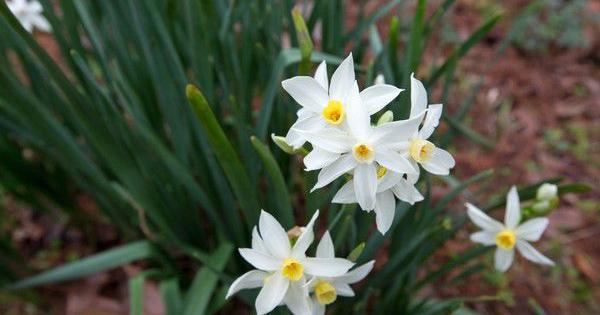
Have you ever heard of forcing paperwhites with alcohol (the kind we drink)? I heard this from a friend recently and immediately thought it was bogus. What do you think? — Caroline
A common problem when forcing paperwhites indoors is that they grow too tall, and the leaves and flower stalks tend to be floppy and bend over. The alcohol makes them grow shorter and reduces floppiness.
I must admit, I’ve heard lots of off-the-wall gardening recommendations over the years, and my initial reaction to using alcohol (ethanol) when forcing paperwhites was quite skeptical. However, I found research conducted at Cornell University that supports this finding. Here’s how to do it.
Plant the bulbs in containers of pebbles with water. Wait until the roots are growing, and the green shoots are about 1 to 2 inches tall. At this point, pour off the water and replace it with a solution of 4% to 6% ethanol, made from just about any hard liquor.
To get a 5% solution using a 40% distilled spirit (gin, vodka, whiskey, rum, tequila — do not use beer or wine), you add one part of the booze to seven parts of water. If plants are given more than 10% alcohol, it will adversely affect growth, and 25% alcohol is dramatically toxic. So, moderation is the key.
From that point on, simply use this solution whenever you need to add water to maintain the proper level. It’s as simple as that. The result will be a plant that is one-third shorter, but with flowers just as large, fragrant, and long-lasting as usual.
The plants will be nicely proportioned and won’t need support stakes to keep them upright. It’s still important to provide abundant light and cool temperatures when forcing these bulbs, but the use of ethanol helps ensure success when the growing conditions are not ideal.

Persimmon trees are prone to dropping fruit.
STAFF file PHOTO BY DAVID GRUNFELD
My sister who lives in Eunice has a large persimmon tree in her backyard. Every year we enjoy many beautiful persimmons. This year, after the last freeze, the top of the tree turned yellow and brown, and the leaves fell off. The worst part: The tree did not yield a single persimmon this year. She is worried that the tree may have died. Do you have any suggestions? — Lyndon
It’s a shame the tree did not produce this year. I can’t give you a specific reason. It could be weather-related, or sometimes fruit trees skip a year and produce a bumper crop the next year. I would not be overly concerned about the lack of fruit this year. See how it does next year.
As to the foliage, if the tree was green and relatively healthy looking through the summer, I would not be worried about seeing the leaves dying now (turning yellow, brown and dropping off).
Persimmons are deciduous. They naturally drop their leaves in the fall and are leafless over the winter. Your sister must have seen the leaves change color, die and drop off every fall since she has had the tree. Early freezes can encourage this, and that is why your sister saw a change in the foliage after the recent light freezes. So, this is normal and nothing to be concerned about.
From what I read in your email, the tree is likely fine other than not producing fruit this year. I don’t see anything that indicates the tree may have died.
There is a sticky black area on the trunk of my tree. Help. What do I do? Sherlyn
It is likely that this is caused by sap bleeding from the trunk. This may indicate an internal infection. I don’t know of any effective treatment for this. You might want to contact a local licensed arborist to come out and look over the situation and provide a more accurate diagnosis.
Garden tips
GARDEN CALENDAR: The LSU AgCenter’s 2026 Get It Growing Lawn and Garden calendar is now available online at www.lsuagcenter.com and you may also find them at some local nurseries. Featuring monthly gardening tips, beautiful photographs by Louisiana gardeners, and lots of useful gardening information, it’s a wonderful gift for you or your gardening friends. The calendar costs $13.95 and proceeds support horticulture scholarships and research.
IT’S GO TIME FOR BULBS: Finish planting spring-flowering bulbs such as daffodils, Dutch irises, narcissus, lilies, and others by early December. This is your last chance to buy tulips and hyacinths, which must be refrigerated for at least six weeks before planting. Bulbs purchased and refrigerated now should be planted in the second week of January.
LOCAL COLOR: Late November through early December is usually peak season for the leaves of our deciduous trees and shrubs to show their best color in south Louisiana. Some of the trees that are most reliable about producing fall color here include green ash, sweet gum, crape myrtle, ginkgo, Southern sugar maple, Shumard oak, red maple, Japanese maple, flowering pear and Chinese pistachio. Shrubs such as sumac, Virginia willow and deciduous viburnums also have good fall color.
A NEW LEAF: Do not rake up and throw away leaves that fall from your deciduous trees over the next few weeks. Use fallen leaves as mulch around shrubs, flowers and vegetables. Pile up the fallen leaves and allow them to decay into valuable compost. Adding compost or other forms of organic matter is a key part of bed preparation. Why throw away perfectly good organic matter generated by your landscape and then go and spend money buying mulch or organic matter?
Comments are closed.