
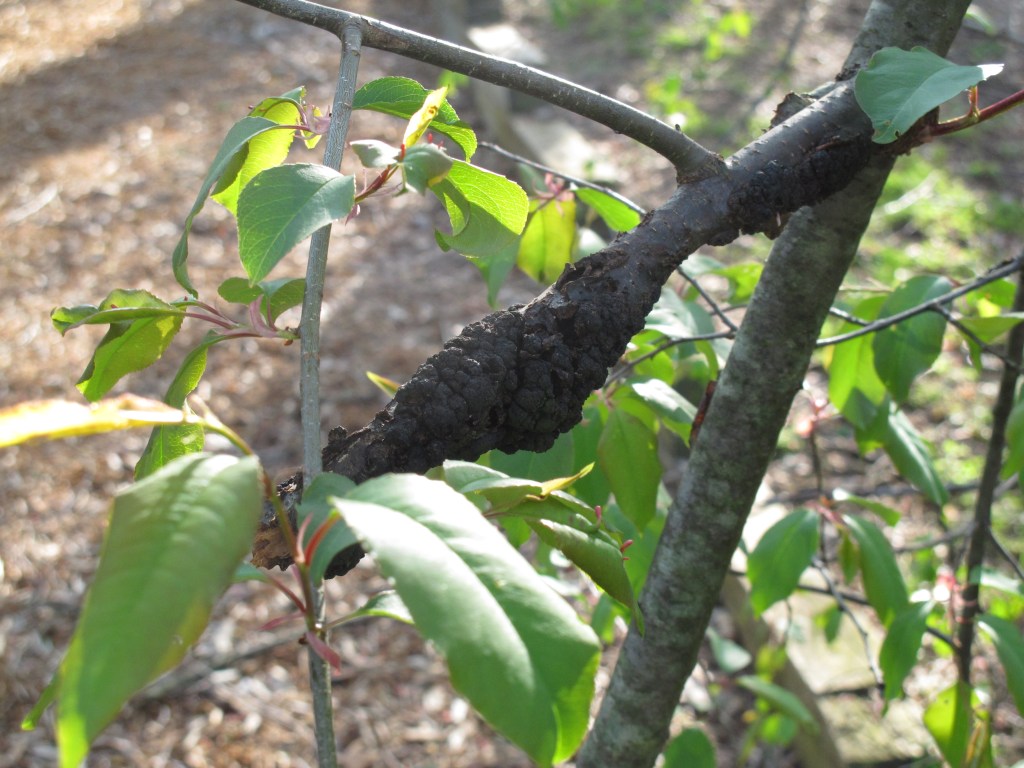
Q: My young serviceberry tree has lumpy, dark swellings on the twigs. When I checked my flowering plum tree, it looked worse, with the same symptoms. Is this a spreading disease, and how do I control it?
They are diseases, but two different infections that happen to look similar. This is a good example of how knowing the plant ID helps narrow down a diagnosis when symptoms overlap greatly. The serviceberry has a rust gall, and the plum has black knot disease. Both are caused by fungi, but they are not spreading between these two trees; serviceberries don’t get black knot and plums don’t get rust.
Gardeners who have encountered cedar-apple rust on their serviceberry foliage or fruits may be surprised to learn that this twig gall symptom is caused by the same group of fungi (cedar-quince rust in this case). Instead of the familiar bright rusty-orange spores on infected fruits and leaves, the fungus creates galls (abnormal tissue swelling) on the twigs, where spores emerge.
Black knot is aptly named because it causes knobby-looking black galls on the plum twigs, which spread the fungal spores. It does not create leaf symptoms.
Both diseases will kill the affected twig beyond the gall, so when found, they need to be trimmed off and the debris thrown away or hot-composted. Neither disease can be cured with fungicides. Wild plum and cherry (Prunus americana, P. serotina, and a few others) are sources for spore spread for black knot, and several other native plants are sources for spores of this type of rust, which alternates between host plants to complete its life cycle.
Our native Prunus, Juniperus, and Amelanchier have great wildlife value and are worth having in the landscape; vulnerability to these two diseases is just a fact of life for them. Variations in weather and individual plant genetics influence the extent to which each disease is rampant or limited from year to year.
Q: I’m adding more native plants to my landscape, but this process is still new to me, and there are tons to learn about how to choose which plant to use where. Is there a plant list that will help me make species selections?
There are many local and regional plant guides online and in books, with varying levels of detail. I’ll focus on two new digital resources that are pretty in-depth. The Maryland Native Plants Program (MNPP), a partnership between UMD Extension, the Maryland Department of Natural Resources, MD Dept. of Agriculture, and the Maryland Native Plant Society (MNPS), is working on compiling references for both home gardeners and nursery growers.
Hot off the presses is the Maryland Native Plant Guide for the Piedmont region. (Guides for the Coastal Plain and Mountain ecoregions are in the works.) A free PDF file is accessible online (http://go.umd.edu/MDPiedmontGuide), and a purchasable 180-page print version will be available through the MNPS.
Overlapping somewhat with the above, the Commercial Native Plant List is a spreadsheet available online of approximately 650 plants native to Maryland’s three main ecoregions (Mountains, Piedmont, and Coastal Plain). It’s not an exhaustive list, as roughly two thousand species of native plants occur in Maryland. The MNPP web page hosting the list provides an explanation of what qualified species for inclusion, including the fact that all of them are commercially available from regional nurseries. The data in the spreadsheet includes what region each species is native to, its sunlight and soil requirements, growth type (aggressive spreader or not), approximate mature size, seasonal aesthetic and wildlife value, and tolerance to stress (including deer palatability). Access it at https://go.umd.edu/native-plant-list.
Both are great resources to browse and compare against other plant lists that provide less detail. Aside from choosing plants based on their cultivation needs or tolerances, selection can also take into account aesthetics, like bloom season, fall color, and mature size.
As interest in adding native plants to home landscapes increases, more landscaping companies specializing in native plant design are available to hire. You can also get garden layout and plant combination inspiration from public gardens like Mt. Cuba Center in Delaware (located in the state’s small portion of Piedmont habitat), the U.S. Botanic Garden in D.C., and various other sites in the mid-Atlantic, including Extension Master Gardener demonstration gardens. (Ecoregion designations are habitat-based and don’t end at the state border, after all.)
University of Maryland Extension’s Home and Garden Information Center offers free gardening and pest information at extension.umd.edu/hgic. Click “Ask Extension” to send questions and photos.
Comments are closed.