
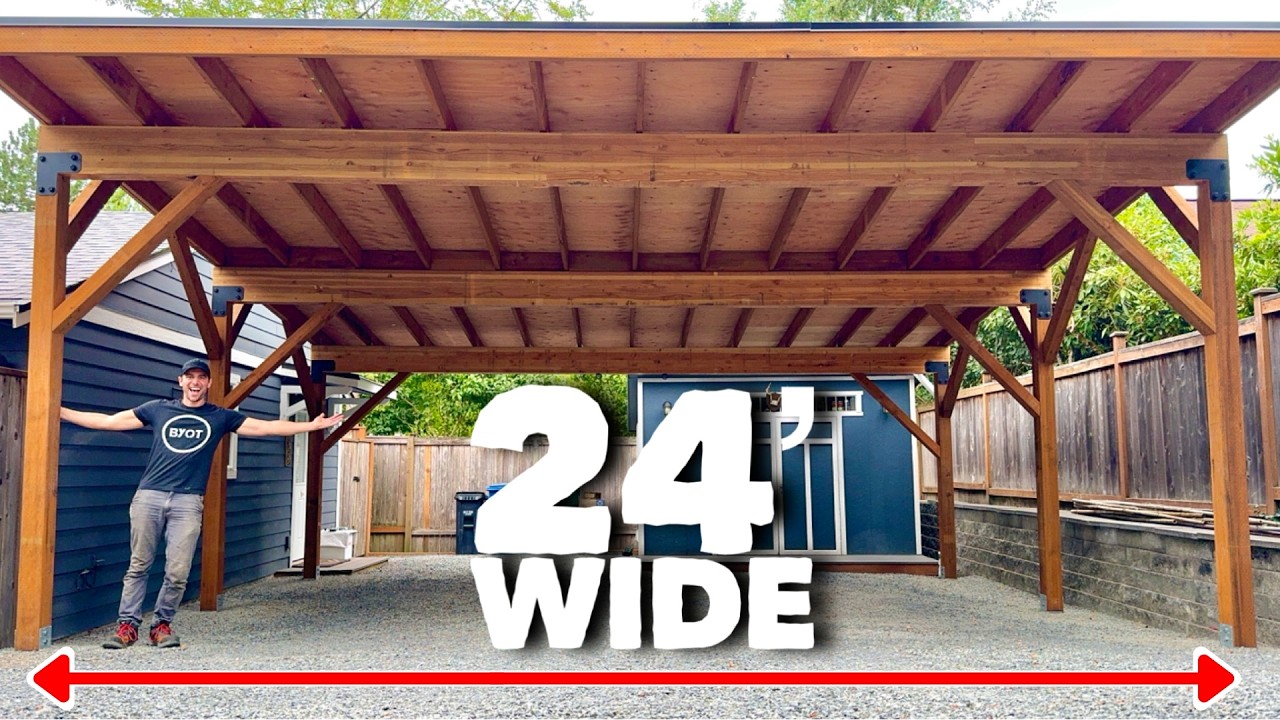
This DIY building a carport project is all about how to build a lean to carport from start to finish. This DIY carport tutorial shows the step by step process of pouring concrete footers, to layout and framing a carport in complete detail. Bring Your Own Tools (#BYOTools 223).
PART 2 can be found HERE: https://youtu.be/7PIjtazNUBY
Interested in plans? 16 page set available NOW: http://byotools.me/shop/lean-to-carport-plans-24-x185
Apparel List:
-Georgia Boot (20% off with “BYOT”): https://bit.ly/395WxO6
-Tool Apron Chest Rig: https://amzn.to/4fehSBZ
-BYOT Shirt: https://bit.ly/2T6l8dE
-Knee Pads: https://amzn.to/3Y7dXRx
Tool List:
-String Line: https://amzn.to/4g098Qg
-Framing Hammer https://amzn.to/2XmNErF
-Chop Saw https://amzn.to/3k5GCCC
-Framing Nailer: https://amzn.to/3oEb9Mx
-Metal Connection Framing Nailer: https://amzn.to/3ACJEIE
-Tape Measure https://amzn.to/3hrUYeG
-Chalk Line https://amzn.to/3yNOa0T
-Speed Square https://amzn.to/2FrIuQK
-6′ Level https://amzn.to/3ANX6Fd
-Laser Level: https://amzn.to/4bZiGbm
Materials:
-Concrete Sonotube: https://creatoriq.cc/4dAdA6G
-Adjustable Post Base Bracket: https://amzn.to/4dW6ABa
-Concrete Anchor Bolt: https://creatoriq.cc/3WSJDI2
-Metal L Strap: https://creatoriq.cc/3X1ThrQ
-Metal L Strap Screws: https://creatoriq.cc/3WXh2Bh
-Hurricane Tie: https://creatoriq.cc/3AKWcO2
-Hurricane Tie Strap: https://creatoriq.cc/3T0NrWA
-Metal Connection Nails: https://amzn.to/3ACAb4a
-3″ Galvanized Nails: https://creatoriq.cc/471bTwO
-2-1/2″ Galvanized Screws: https://amzn.to/3Mnl9Sc
-7″ Galvanized Hex Bolt: https://amzn.to/4cUkrah
-Pressure Treated 6″x6″x8′ Post (Qty: 2): https://creatoriq.cc/4fWNdJM
-Pressure Treated 6″x6″x10′ Post (Qty: 4): https://creatoriq.cc/4dAfd4u
-Pressure Treated Gluelam 6″x12″x24′ Beam (Qty: 3): Custom Order
-Pressure Treated 2″x8″x24′ Joists (Qty: 18): Custom Order
-Pressure Treated 4″x6″x8′ Knee Brace (Qty: 4): https://creatoriq.cc/4g15Ts7
-Pressure Treated 4″x6″x10′ Knee Brace (Qty: 3): https://creatoriq.cc/3yOF8Gw
-Scrail Nailable Screws: https://bit.ly/4dAoKIS
-15/32 Plywood: https://creatoriq.cc/3Z0POMP
CHAPTERS:
0:00 – Intro
0:36 – How To Pour Concrete Footers
10:30 – How To Frame A Lean To Carport
23:39 – How To Install Sheathing On A Roof
29:03 – Finish Shots
MUSIC from https://www.endlessnoise.com/ & https://www.chernebeats.com
I just put in the final screw of this massive 24t X 24t carport if you want to know how to build it keep on watching let’s get [Music] started for this massive carport project we’re headed back to this particular driveway and if you watched this channel in the past you might recognize this driveway from the fall of last year where I installed this permeable grid system with a gravel base however before we even installed that we had to drill out some footings for this carport as you can imagine when building a sizable carport like this we are going to need some substantial Footers and on this project based upon the size we are going with 16in Sono tubes we’re going to have a total of six of them to account for the overall weight as well as potential snow load and just as a general reference point I did have drawings made up for this build cuz they was so much that went into it and I had them approved by a structural engineer so I knew it was structurally sound and up to code as for the Footers themselves alignment is extremely key because everything in regards to the carport itself is going to be working off of these Footers our carport is going to be 24 ft wide but I do have to burn 3 in because this is going to be the dead center of our post base that means from Stak to stake we are 23′ 6 in because I have to burn 3 in for each post bace now that our perimeter is completely staked out and our string line is taut we can double check our cross-dimensional measurement which is fairly easy all you have to do is take a long tape measure and measure to the opposite side of the perimeter if those two dimensions are the same then you have a perfectly Square structure which is exactly what we want before we start drilling at this point in time in the project we’re just looking for a good reference point on where we need to dig and in order to do so I just line up the Stak in close proximity to the center of our Sono tube then use some striping tape to stripe off the perimeter of the hole as you can see we are extremely close to the side of the house which is what the client wanted in this application but you’ll see soon enough why that might not be the best idea on your particular project if you are trying to build a carport right next to your house our stand behind Track Loader just arrived in the nick of time because we did our layout now it’s time to actually use our augur bit this is an8 18in diameter augur bit which is quite large but needed because our footings are going to be 16 in in diameter this is be a little bit bigger which is perfect for this type of application so let’s get them over there and start drilling if you’re digging deep polles on your property and in the United States just make sure you call 811 Before You Dig I did on this project and they will come out for free to determine exactly where your sewer lines are Plumbing electrical gas just so you know you don’t have to have the headache of worrying whether or not you’re going to hit something once you break ground and one unique caveat to this mix is that they don’t account for other miscellaneous lines like a gutter runoff that is the white pipe that you see right there and due to that pipe we pushed all the Footers approximately 6 in further away from the house which just gave us a little bit more wiggle room and I didn’t damage that pipe but that’s why you go very slowly your very first hole even if you call 811 ahead of time the overall depth of your hole is actually extremely important because of your frost line especially in areas where gets cold here in the Pacific Northwest we actually don’t really have severe cold compared to the east coast so our depth only has to be approximately 18 in which means that we need to make sure that this footing is at least 18 in deep from the top of the surface all that to say is to make sure you’re checking your local code requirements because if you are in a colder climate make sure your Footers are deep or wider as needed on this particular project we are going to be digging approximately 30 in down which means we’re going to have a footer that’s 24 in deep but we’re also going to have some crushed drainage rock below the footer for proper drainage at each individual footer these Sono tubes come 4T long and that’s why I’m going to be cutting each one of them in half and I find the easiest way to do so is just take your reciprocating saw and make as accurate a cut as possible just remember that the cut side will be going in the hole on the very bottom so you have a nice clean side at the very top with our Sono tubes placed in their respective holes I am just looking to make sure they have the proper overall height as well as alignment against the house and the house is an important aspect in this application because we’re so close and I want to make sure that alignment against the house is very even the dirt at the very bottom of this hole is quite compacted as you can imagine because majority of it has been there for decades and decades but it is always good practice to give a bit of compaction before you get to your drainage Rock I pour in approximately 3 to 4 Ines of drainage rock at the very bottom of our footer then place our sonit tube back into the hole and make sure that is perfectly level on all sides once I’m happy with the levelness I then back fill our hole and compact the surrounding dirt so I know that the son tube is not going to be moving on US during the concrete pouring portion of our project I quickly drill the remaining holes needed on the opposite side of the yard and once those holes are taken care of I can move on to leveling the adjacent footer I find that the easiest way of doing this is to take your laser level determine what the measurement is based upon the height of your first footer then go back to the opposite side of the yard and figure out how high or how low that footer needs to be in order to be perfectly aligned with the one across the yard from it once you get that foot to the proper height I then level out the Sono tube making sure that everything is aligned properly and then back fill the Sono tube as needed once the back fill is complete I do double check my levelness once more as well as making sure that we’re still in alignment with our laser level in the original footer that we went off of I do the same exact procedure two more times because we have two more rows and as a general side note I do have different measurements for each row with our laser level because the fact that this area is sloped if it was all flat then I’d have one continuous measurement across the entire area but because we have different elevations on this project we do have three sets of measurements for our laser level with all of our sonel tubes fully installed we can finally move on to concrete and if you do want to check out how we finished off this amazing driveway I will make sure that there’s a link for that video in the description box below because it was definitely a timec consuming process but turned out amazing but let’s skip to the good part concrete prior to concrete showing up on site I do generally recommend reinstalling your Stakes at this point and then noting exactly where you want the center point for your anchor bolts to be we are going to be installing very long anchor bolts into our wet concrete for it to cure properly before we get to installing our post brackets I do the same thing on the opposite side as well as double-checking our cross-dimensional measurement just to guarantee that our alignment across this entire perimeter is very close to square because again everything is going to be working off of these Footers so we want to make sure that we have plenty of due diligence at this point before we get to concrete this is a project you could do by hand but it’s so small you’re not going to bring in a concrete truck so in order to save me a little time on mixing I picked up a ukart concrete mix in order to pour all these Footers extremely quickly and efficiently the first couple pores do come out a bit too wet but to my surprise after the first to it is a standard highquality concrete mix and it’s now just a matter of wheelbarrowing all of our concrete into our sonot tubes in order to get it to a nice even finish I do take a piece of scrapwood and use that as a screed to go over our Sono tube just make sure that that screed is rubbing up against two sides of your sonot tube at the same time these ukar concrete mix trucks are not available everywhere obviously but when you’re able to get them and rent them they really are a huge timesaver because if I didn’t I’d be mixing at least 35 bags of 60 lb concrete by hand also keep in mind that this is technically a finished driveway so I don’t want to get too much concrete all over the place it is just gravel so I’m able to clean it out very easily and quickly but I’m still mindful of not making too much of a mess our three Footers on one side are poured and that’s why I’m going to move directly into inserting our anchor bolts now these are galvanized 21 in Long anchor bolts that are specifically designed for this purpose there’s an s-shaped design at the very bottom of these anchors which basically just provides this bolt with more pullout strength and I do install it with washer and nut because I want to guarantee that I have the correct amount of threads needed when it comes time to installing our post brackets the string line really does a very nice easy job of aligning exactly where all these threads need to be placed so it makes the process of aligning all of our post brackets extremely easy once our concrete is dry the hardware we’ll be using for this connection application are going to be these 6×6 galvanized adjustable post brackets by Simpson strong time I’ve used these numerous times more often than not I’m using the 4×4 version but these 6x6s are extremely beefy and very needed for this type of application as far as installation is concerned it’s very straightforward all I have to do is install the large galvanized washer and nut that comes with a kit once down I then place the cap right on top of that which completely conceals that hardware and makes for a perfect level surface for our 6×6 post to be rested upon I also ran that string line all the way across so the alignment between the three posts on this side is in a perfect row and then I check the cross-dimensional measurement that’s the really nice thing about these adjustable post brackets if they need to be adjusted slightly one way or the other you’re able to do so without affecting your anchor bolt that is embedded in concrete with our Hardware installed we can finally move on to some lumber on this project these are our 6×6 pressure treated Douglas fur posts and these first posts that are the shortest on this entire project are going to be over 7 1/2 ft tall also these posts are so thick that my 12in miter saw can’t even cut through them in one pass I’m going to have to actually cut them three times to have one fluid cut as for the connection between our post and beam the client wanted something that was a little more decorative so we went with this 12 gauge powdercoated steel L strap that definitely has a much more aesthetic look than our galvanized steel there are specific screws and washers that come with this kit so just be mindful of that before you start installing any old screw I do suggest having this bracket installed on at least one side of your post before you get stood up vertically because it’s going to be a lot easier to install your beam if this is installed ahead of time as bring this over to our first post bracket and stand up our very first piece of lumber on this entire project we slide it perfectly in position level it up with a post level and we secure it temporarily with these 2 and 1/2 in Long galvanized screws that are also Simpson strong type once secured we then double check our levelness on all four sides and as long as we’re happy with our levelness we can move on to the next post a quick side tangent and this is coming from an individual that works mainly with himself and only himself is this is a project that you want to have a second person on hand if possible Zach was with me for a full 3 days and I don’t know how long it would have taken me if I wasn’t here but it would have been considerably longer if all your posts are the same exact elevation then you don’t need to do this step but my posts are not the same elevation so I have to set up a laser level measure the height from the base plate to the laser level line and do that to the very bottom row as well that way I take those two measurements subtract them from each other then take whatever is remaining and subtract that from the overall height of the next post now that may seem complicated but it’s very straightforward and all we’re doing is accounting for the overall elevation difference between the lowest footing elevation to the tallest footing elevation and a quick note for anyone who is interested is that I do have very detailed plans that took a considerable amount of time and money to get right so if you’re interested in building yourself and want plans I’ll make sure to have a link in the description box below as I finish up the level cutting and installation of our final post I go back around to every single one and use a very sizable augur bit to drill through the post into the opposite side of our post bracket now this is a little tricky to guarantee that we hit that dead center especially if that drill bit is not perfectly straight the very first time but with a little bit of practice you can get this down and once drilled out I then insert a 7in galvanized bolt while securing it on the opposite side with a washer and nut each one of our post brackets gets two of these large bolts and if you’re asking yourself why would I need to install these large bolts after installing all those screws well plenty of structural support is provided with these bolts and with a structure of this size you want as much structural strength as possible but with all of our posts fully installed we can now finally move on to some beams and these are not any ordinary beams these are 24t long by 6 in wide by 12 in tall there are also pressure treated glue Lambs which weigh at least 400 lb a piece which is what I did get when I just put it into a wood weight calculator but since Zach and I decided to not kill ourselves trying to get these beams up there by hand we decided to make sure and make it a lot easier on ourselves by renting a forklift and this is No Ordinary forklift this is a genie tah Handler and this is basically gives you the best of both worlds between a forklift and a crane because we’re literally able to use the hydraulic lifting mechanisms to allow it to Crane over the beams very easily while also still allowing us to maneuver around odd terrain with ease and lay it down perfectly where it needs to be the very first time once our beam is set into place I then double check our post to make sure they’re still Plum and as long as long as they’re still Plum I then immediately start installing our screws that we have bracketed perfectly and ready to go then I proceed to going into the opposite side and Screen those plates in as well having a machine like this on site was a true game Cher in something that made the process of installation so much faster and when considering the cost to rent it because just the machine plus delivery Plus Insurance ended up being around 500 bucks well the client basically saved at least that on the insulation portion of this project because it would have taken us so much longer to install all these beams along with everything else on this project they’ll be seeing soon enough with some minor love Taps we got all three beams perfectly laid out very quickly and we can move on to a bit of bracing as you can imagine these beams are quite secure but they are quite wobbly so just to make sure that everything stiffens up a bit we do a bit of bracing on both sides before we move on to the joist and when I said that this Genie Lift really did come in handy it came in handy in a multitude of ways because we also used it to bring over our very long heavy 2x8s for our pressure treated joist now these are also 24 ft long and I brought over one just to double check our measurements and making sure all three of our beams were lining up appropriately with our joist that we’ll be bringing in now and safe to say that this was one of the best Feelings by far as an individual that loves framing because our joist lined up perfectly with all three beams and that means we can get to some Joy hangers now one thing that I should have done ahead of time that I’ll tell you in honesty and hopefully you don’t make the same mistake is it do all the layout for your joist while the beams are on the ground and not up in the air not the biggest faux paw in the entire world but it certainly would have saved a lot of time and energy if this was on the ground versus up on a ladder our joy are doubled up on both ends of our cport but the majority of all of our joists are 24 in on Center and each one of those joists gets a hurricane tie like this at the end of each beam you do get a hurricane tie but it does look slightly different in this format because more of a hurricane strap as I proceed to install the hurricane ties every 24 in Zach starts bringing in all of our joist material and luckily for us on this project I do have a metal connection framing nailer which is basically Des designed for this exact application which basically allows me to install these 1 and 1/2 in Long galvanized nails very quickly and efficiently which a palm nailer would have done a good job with but it would have taken much longer to do with our first row of hurricane ties installed we can then start inserting our joist into them making sure everything lines up properly and as you can see from the overhead shot this cport really starts taking shape and coming to life with these joists installed these hurricane ties are quite important especially in very windy areas and circumstances in more distant decades they would have toen nailed all these joist in place and that means that if one sizable hurricane came through it could have blasted this entire roof right off but with these hurricane ties it’s basically structurally bonded to the beam below which allows it to have a much larger wind tolerance but now that all of our hurricane ties are installed we can move on to our doubled up joist each side of our car pord is going to have a doubled up joist at this location and in order to do so all we’re doing is running a w pattern with 3in long galvanized nails across the entire length of the joist once fully nailed off we can then attach our joist to our hurricane tie straps before I nail any of our joist off I do double check the measurement just to make sure that we have a general overhang distance away from our beam and then every joist from there can be nailed off from our hurricane ties and that includes all hurricane two joist locations and as Zach’s taking care of that I’m going to be taking care of our Rim joist which is basically going to tie all these joist together the easiest way I found to have a perfect Rim joist installed is to actually take a string line string it across the entire length of your joist and then snap that line and cut each end of your Joys accordingly based upon where that string line is located in order to make the cutting process easier I do take a speed square and strike a line on each side of our joist but the one question you have to ask yourself before you do this are you going to install a gutter system because if you are then you’re going to want to have a perfectly Plum subf facial board in order to do this I applied a level to the top of my speed square and made sure it was level before I striked a line that guarantees that I have a perfectly Plum line going vertically up once all of our lines are fully accounted for I grab my sucker saw and start cutting each end of our joist this does take some patience and you do have to be very careful when doing this but I have my concentration face on so you know it’s going to be a if you see that once all the ends of our joist are cut I can start moving in our subfascia board now this subfascia board is cut to the appropriate size because it’s already 24 ft long and that way all we do is get it up into position and nail it off accordingly with everything nailed off I move immediately to some knee bracing now our carport is very structurally sound at this point but because it’s so topheavy I can literally make the entire structure slightly sway by just pushing on one post and we want to make sure it’s never possible when it’s all said and done which is where this heavyduty knee bracing comes into play this is 4×6 pressure treated lumber and I’m putting a 45° angle on both sides the total length of all these knee braces are 4 and 1/2 ft long and each end of the knee brace gets two six inch long timber frame screws I always suggest presetting your screws at least on one side of your knee brace to make it a lot easier in yourself when it comes time to installing each one of these NE braces will be placed at every single post and it will be connecting directly to the beam above buff it that means there’s going to be a total of six and this will greatly reduce the amount of sway that happens from side to side of our carport once all six knee braces are fully installed you’ll have a structure that looks like this beautiful isn’t it it of course was one of the hottest days of the entire summer while we were building this so we decided to get an early rise on this project and bring in all of our plywood in order to have a perfect built-in shade element below while we’re working this was the last and final thing that our forklift helped assist us with and again it really did pay huge dividends in the end by us having the ability to bring up a stack of wood and we can easily bring a sheet at a time on top of our joist and as you can see this was a perfect time for me to utilize my karate kick love Taps and certainly seem to be surprisingly efficient during this application but now that we have some built-in shade and before I start walking all over our roof I’m going to get to the rest of our knee bracing yep we’re not done yet because we took care of the side to side movements but we haven’t taken care of the front to back Swain and that’s what this this knee bracing is for the first cut I made was at a 53° angle Mark and then I measured out 4 1/2 ft and cut a 45° angle on the opposite side once I have my knee brace in hand I then preset my screws and start aligning our angled Cuts as needed just remember that our 45° is going to be on the post side our 53° is on the joist side our roof line is obviously angled so if we’re trying to put a knee brace on the downward w section of our roof that means it’s going to be slightly smaller and at a different angle this piece still has a 45° angle where it meets up with the post but at the top where it’s meeting up with the joist that’s a 37° angle and it’s only 3 and 1/2 ft long our two Center support posts are going to have two side braces but just keep in mind that our four corner posts around the entire perimeter are only going to have one knee brace because I don’t want it to protrude into our soft line with all of our knee bracing in I now feel quite confident that I can get on that roof and get all of our plywood installed but I have a fun unique alternative to getting this plywood installed quickly and efficiently we’re screwing it down with a nail gun because we have screws that are Lally meant to install via nail gun they’re called scrail I thought it was a perfect opportunity to use the these type of nails because it’s just going to be a lot easier to install them than if we’re doing it via a drill if you’re screwing or in this case nailing any of your sheathing to a structural frame member I generally recommend you actually take a chalk line or some type of marking device to guarantee that you’re hitting proper stud placements especially with a structure like this I want to be dead center or at least very close to in each one of these screws plus it completely removes the guessing game and human error if you do it this way and it might make the installation process just a little bit longer but in my book it’s worth it in terms of sheet the materials you could go with an OSB but I find that plywood is just a little bit more durable long term and I don’t know what other people’s prerogatives are in this type of application but from my perspective plywood is just a little bit more expensive but I personally think it’s a higher quality product but if you feel differently and you love OSB please let me know in the comment section and why or if there are any other amazing products out there that are taking the replacement of sheathing please let me know about that as well I just might use it in the future because I have a few other projects lined up this year now that we’ve installed our first row of plywood it’s time to cut our first piece of plywood at perfectly 48 in which is exactly half of each one of these pieces of plywood this is strictly because we want to stagger our joints in a running bond pattern and in order to do so I Mark both ends snap a chalk line and run my circl saw across to cut it perfectly in half but as a quick helpful note make sure that you flip your board all the way over so you’re able to use that factory Edge on the opposite side and that means the cut end is facing on the exterior side of your cboard as long as you have that accounted for you can start installing the sheathing just as you did previously with one exception meet the galvanized panel sheathing clip this is being placed right in between each one of our joists and each piece of plywood slides perfectly right into the groove structure this certainly doesn’t make the process of installing sheathing easier but it does strengthen the joints along with providing a slight air gap if needed this is a good time to note that I will be providing a full list of tools and materials on this entire project in the description box below I certainly know firsthand that there’s a lot of items to account for on a project of this size so I want to make sure there’s a nice easy list of products readily available for the byot faithful actually watching this video as I proceed to installing our plywood row after row Zach is underneath enjoying some shade and installing some much needed blocking on this entire stretch if you don’t know already blocking is definitely recommended especially on Long stretches of joist like this because you don’t want these joist to Bow over time and this certainly will be preventing any of our joist to Bow significantly during the lifetime of the structure as Zach continues to work on the blocking I’m up on top finishing up the remaining rows of our plywood if you do decide to go with a nailable screw just keep in mind that you do want to set the depth gauge and make sure you slightly adjust it one way or the other because you could easily shoot these screws too deeply since this plywood is only 153 seconds as I install the remaining plywood I wanted to take a special moment to say thank you to you the audience I absolutely love what this channel has become this is by far one of the largest Endeavors that I’ve personally taken on I take great pride at what I do and try and produce quality content to help other people learn how to build since that is my personal passion if you haven’t already please consider subscribing because that does help the channel greatly and I want to see us get to 500,000 followers in the very near future thanks for all the support along the way no matter what for the last sheet of plywood I measure out and Mark 46 1/2 in because I’m going to be cutting off the excess and installing our final subfascia board that 2×8 material is an inch and 1/2 thick so if you add an inch and 1/2 to 46 1/2 in you’ll get a perfect 48 in for our final row of plywood but before we get to plywood we have to cut off every one of these joist ends just as we did previously on the opposite side but on this side we don’t have to have a perfectly Plum joist end because we don’t have a gutter system on this side so I’m just using my speed square as a guide to give me a precise 90° angle at every single joist end with all of our joy ends cut we carefully maneuver our final subfascia board into position nailed off on both sides and once nailed we can move on to our final row of plywood the framing on this entire project was so precise that the only cutting we had to do with any of this plywood was just cut a few pieces in half and that was it pretty impressive and a great way to end out this entire Amazing Project in terms of framing yes this is going to be a two-part video series because the roofing structure is a whole other Beast comparatively to the framing portion and I wanted to completely differentiate the two hopefully you all learned and enjoy this entire process of building this entire massive carport in a week which is quite impressive for a structure like this but please make sure you check in next week for our culmination video and until then this is still one truly beautiful sexy beast oh yeah
30 Comments
PART 2 is up NOW. Thanks for watching and all the support: https://youtu.be/7PIjtazNUBY
just became a homesteader and this is one of my major first builds your content is easy to follow and shot very well! I am very excited to get to my first build on my property! thank you and you have gained another subscriber 😁
Informative video. But the word is height, not heighth.
uplift vs small concrete pads ??
Why set the post on top of the footers instead of cementing them down into the ground? Wouldn't that resist moments more and need less knee bracing?
How might sheds integrate with neighborhood microgrids?
I've watched COUNTLESS videos for building carports or gazebos and you, sir, made such a well instructed video! I thank you!
Never saw or heard you say the cut ends of those PT post need to be sealed with cut seal or similar to ensure those cuts are still PT!
Failure to do so is a mistake that might bite you down the road! I didn’t and the untreated cut was the access point for carpenter ants which ate the PT wood from the inside!! Do not make my mistake!!
Nice job!
I thought this was your house? You keep saying client.
if this carport ever needs to come down, the plywood is far more likely to be salvageable than OSB
the way those diagonal gussets are installed is useless.
when installing a nut on a threaded stud, make sure there are at least 2 threads exposed on top, after your nut is torqued. This build failed that detail.
Dont you want the concrete to be a little above ground due to moisture?
What's the total cost of materials for this project?
Does the middle post on the left and right side restrict the car doors from opening?
I was thinking of building something similar but wanted 4 corner posts so that 2 cars can both open their doors. I was thinking of going with all steel posts and beams.
Brutta e progettata male.
Why screws versus Nails on the plywood ?
These footings seem very excessive.
You need code and approval to build that is not attached to the house?
good job but way to heavy for just a car port
Amazing work, congrats 🎉
Its wobbly, should have embedded the post in concrete
The Anker which u pushed like 18" into the concrete and only left like 1" to bolt on a screw is Wild, what happens when u strip that lil 1" 🤣💀
That’s not how you use a sonotube
I would move that out at least two to three feet from the home foundation to leave room for any type of maintenance needed on the house later. Actually three to four feet is better.
I love plywood.
Just my two cents on roofing: OSB’s layered strands give it solid strength against sideways forces (in-plane shear strength). It’s stiff, strong, and designed to keep its shape. Plywood may not match it in shear strength, but it grips nails better and lasts longer in damp or windy conditions. That said, OSB is much more affordable, making it a smart and sturdy choice for dry-climate roofs. If you’re working within a budget, need to meet code, and can control moisture, OSB provides reliable, efficient, and steady performance.
What if you want to use one side of the building as the starting point of the lean to?
how much?