
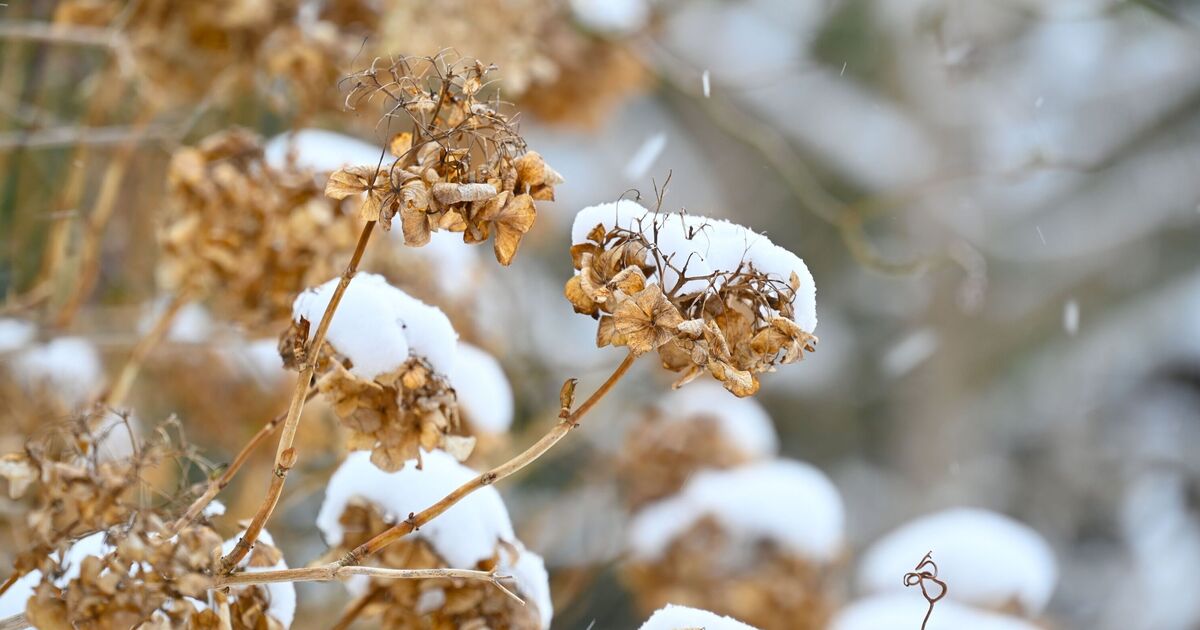
A gardening expert has warned that you could ruin your hydrangeas if you make one common mistake this month. Hydrangeas are popular shrubs known for their large, showy flower clusters that bloom in pink, blue, purple, and white.
But taking care of these beautiful blooms can be complicated, and many gardeners make a common mistake that leads to their hydrangeas not looking their best come spring. It is recommended not to prune the flowers in winter. Instead, leave the stems and deadheads on to provide moisture and protect the new buds from frost. Richard Barker, horticultural expert and commercial director at LBS Horticulture, told Ideal Home: “If you have mophead or lacecap hydrangeas, these flower on the previous year’s growth and should not be pruned until spring.” He added: “Hydrangeas that produce flowers on new growth can be pruned when they are dormant, but the best time for this is in late winter or early spring. Although the plants will be dormant in autumn, you still run the risk of pruning cuts becoming more damaged by the cold and frost.”
It is also recommended to mulch the shrubs. Removing the top inch of compost and adding a fine bark mulch to the base of the plant can add a layer of protection against cold and rain.
You also shouldn’t add any fertilisers during the winter months to deter any growth, which can be easily damaged by the colder temperatures and frosts.
Instead, keep the plant hydrated. Hydrangeas also love water, so even in the winter, they should be watered. Long, irregular waterings are better than constant, small ones.
The plants should also be moved to a sheltered part of the garden to prevent them from being hit by the worst of this winter’s frost. They can even be put in the garage.
If you’re expecting very cold temperatures, consider wrapping hydrangea in burlap or creating an insulated cage filled with leaves. If you get snow, brush it off to prevent the delicate stems from breaking.
Hydrangeas are supposed to be very hardy, even in cold climates, with panicle (H. paniculata) and smooth (H. arborescens) types being the most cold-tolerant. Bigleaf hydrangeas (H. macrophylla) are less reliably winter-hardy.
Comments are closed.