
Central Connecticut, USA;
We have four different highbush blueberry cultivars*. We bought them over a decade ago before we found a passion for ecology and native plants. To my eyes, their foliage and flowers all look the same. The only differences I can see are berry size and growth habit. For example, one remains upright when loaded with fruit, while another arches over under the weight.
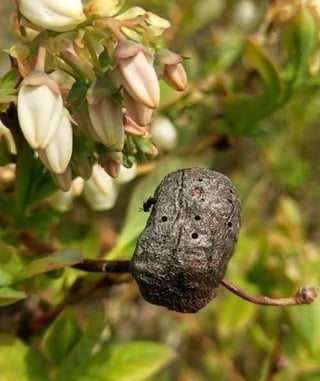
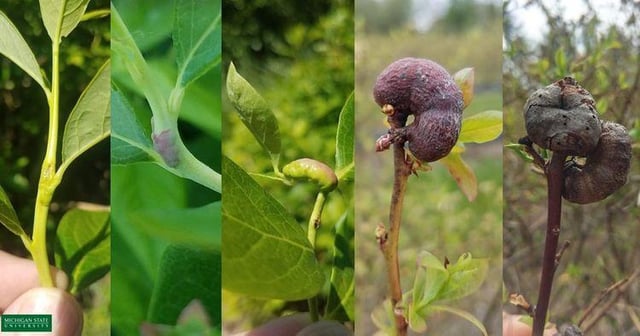
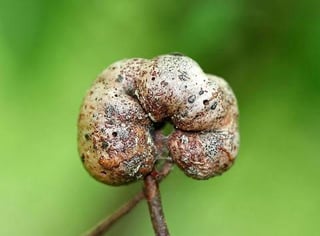
For several years now we’ve had blueberry stem gall wasps (see photos; not my own) making a home in one of the bushes. But only one of them. Despite very close proximity, the wasps have disregarded all the others. And there are plenty of galls on the shrub they favor – there’s no lack of population to migrate.
These wasps have taught me something: A cultivar doesn’t have to be conspicuously different for our friends to reject it. They see more than we do. They know these plants in ways we can’t even perceive.
I’m not here to berate anyone for planting cultivars, just relaying the wasp’s message 😁.
*I can’t remember the names of the cultivars. But even if I could, I wouldn’t know which was which 😂🤷🏻♂️.
(A note on cultivars: Not all are hybrids or cross bred. Some are naturally occurring, some were found in the wild. It’s really helpful to know the origin of a cultivar to determine if it’s right for you, and if it will be more or less helpful to your local fauna.)
by A-Plant-Guy
12 Comments
Especially with blueberries, I think a lot of the named varieties available are hybrids as well. Not all, but many.
A great reminder that many creatures see chemical signatures that we cannot. A host plant that is indistinguishable to us in a sea of similar foliage looks like a glowing neon sign to them.
This is why I always plant straight species. It requires humility to acknowledge that I am not perceptive in the same way they are.
I agree with everything you said except that galls – because they are essentially the plant tissues being biohacked by wasps – are not a matter of *seeing* but of *experimentation* by the wasps. They probably tried to hack the other varieties as well but maybe it just didn’t work?
I was listening to a podcast recently about chemical interactions between insects and plants. The focus was on flowers and pollinators, but the gist was that there are a lot of obscure and little known interactions between chemical products and how that influences how insects use the plant. It would be reasonable to extrapolate that when selecting for cultivars, we might be altering how those chemicals are expressed. For example (a hypothetical scenario), maybe one of them has an antibacterial property in the stems and a cultivar has lost that, so when the wasps lay their eggs, the ones in the cultivar have a high mortality rate but not the straight species.
Could be so many reasons why the cultivars aren’t popular.
Where do you get non-cultivar natives? Online or stumble across one in the wild or something?
Even the places nearby that say they are native plant nurseries sell only various cultivars
I couldn’t agree more. There’s so much we still don’t know about nature, so I choose to plant only wild type natives.
If someone wants to plant a cultivar because they prefer the look that’s one thing, but to tell themselves they’re “doing it for nature” is simply unproven and likely incorrect.
What you are probably not aware of is the fact that plants signal to insects which of them is under stress. These plants are the ones we most commonly find infections/colonies of pest insects.
The reality is that this plant is probably under more stress that the rest and that is why its being chosen as a host, not because one has a different clonal name than the rest.
People in here speculating that clonal variants somehow have different chemical signatures is just speculation, unless someone has an actual scientific study to cite you’re all just making conjecture.
Yeah, a lot of it is chemical, especially if they are selecting for pest resistance.
I saw the MSU stamp – shout out to Wildtype Nursery in Okemos, MI
The pattern recognition in insects is incredible.
Cultivars/nativars just don’t really provide the same wildlife benefit. As you said, you can plant them all right next to each other and it becomes very clear anything other than the straight species feels like a complete waste of time if your goal is to provide wildlife value.
Obviously the nuance being that if you’ve planted a multitude of straight species and things are buzzing along, a cultivar or nativar here and there isn’t a big deal. Also depends if you’re prioritizing your enjoyment of the garden, pollinators benefit, or trying to balance both.
I avidly disagree with my local watershed group about the pushing of cultivars to get people into native gardening. I understand why they do it, I understand the benefits of getting people to plant “natives”, but the value just isn’t there when you design a garden 100% full of cultivars and nativars. Before anyone gets upset at me, something is better than nothing.
I have a cultivar of rough goldenrod and the straight species of showy goldenrod. The level of pollinators between them wasn’t even remotely close. The showy goldenrod looked diseased from all the bees swarming it. The rough goldenrod wasn’t touched basically at all until the showy goldenrod stopped blooming.
I guess really my personal opinion on all of this is that the smaller the scale you’re gardening in, the more important prioritizing straight species is. If you’ve got acres and plan to turn huge swaths of land into prairie again with straight species AND have garden beds near your home that are more formal? At that point I don’t think it’s really worth worrying about.
There’s also the fact that seeds for straight species are very very cheap and often very easy to winter sow, making fleshing out a garden with proper pollinator plants very cheap. Nurseries push cultivars to make money.
I mean, if your goal is to grow blueberries it seems you discovered a marketable trait. Resistance to gall wasps would sell a lot of blueberry cultivars…
C 271