
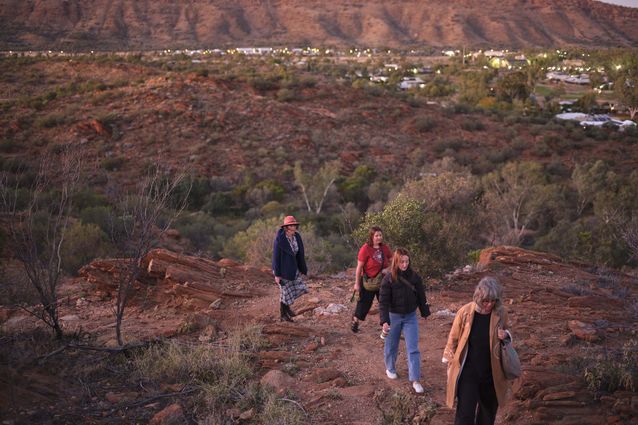
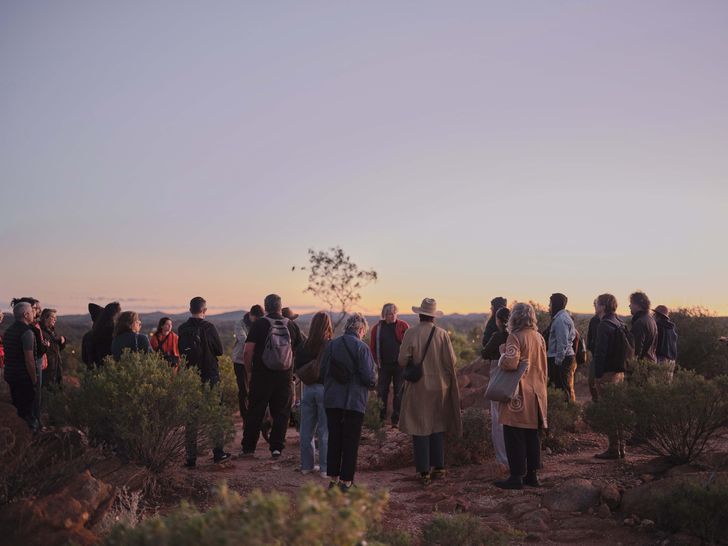
For the Regional Architecture Association’s recent experience in Mparntwe/Alice Springs, titled When you come to another country, creative directors Bobbie Bayley, Owen Kelly and Tonielle Dempers set an ambitious agenda: a three-day forum for sharing knowledge grounded in place.
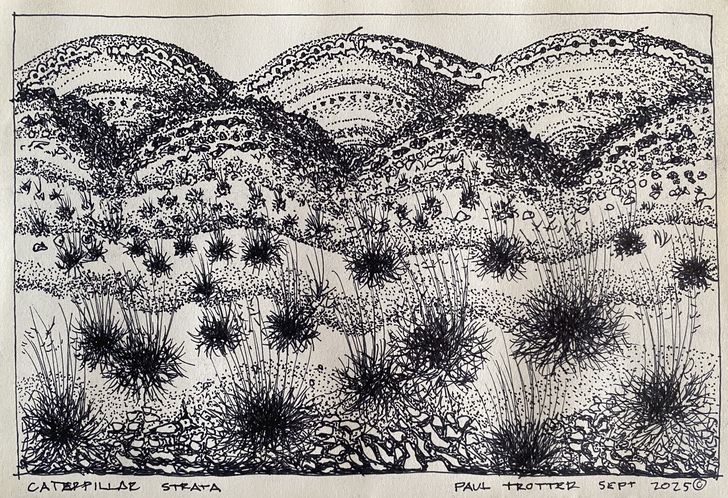
The directors were keen to start and finish in the natural landscape as a way of reinforcing that Country should be a primary consideration in everything we design, from beginning to end. And despite the event’s spectrum of settings, the hills of the Tjoritja/MacDonnell Ranges – with their ancient seabeds lifted, folded, jolted and eroded – were omnipresent. The landscape really was “another country” for those coastal dwellers in attendance.
View gallery
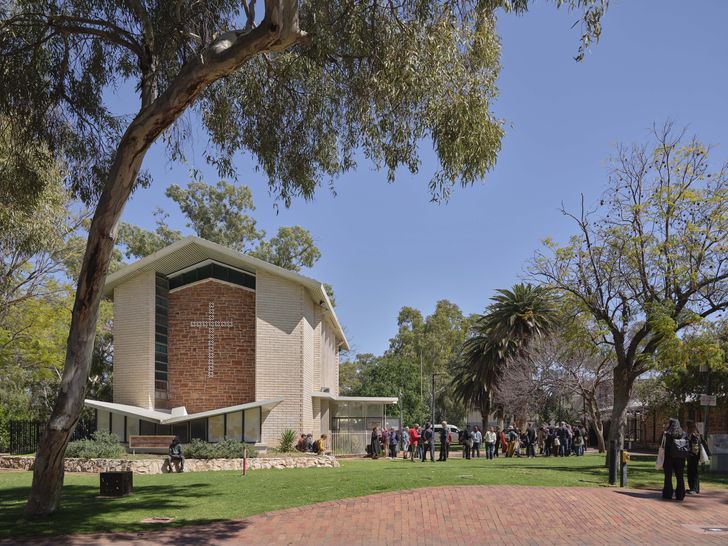
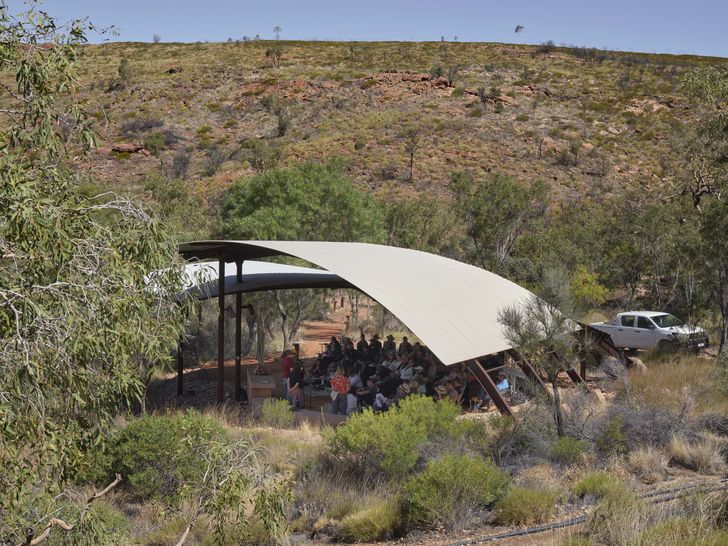
The 89 delegates – a diverse gathering of Mparntwe artisans, consultants, architects, academics and, importantly, students – spent two of the event’s days in the modernist John Flynn Memorial Church in central Alice Springs, a day on-Country in Orminston Gorge, and some time between at various projects and sites across town. Across these diverse locations, we heard from a wide array of inspiring speakers from Alice Springs and across Australia, whose experience designing and working on Country demonstrated the difference that can be made through research, listening and learning. Their insights raised these key provocations:
Start with questions, not answers
Vanessa Napaitjari Davies, senior Aboriginal researcher at the local Tangentyere Council, set the scene by speaking with humility and humour on previous attempts by governments to address the dire need for better quality Indigenous housing. Her presentation identified how past solutions imposed from fly-in-fly-out officials were inappropriate for their place, since they lacked cultural and climatic design considerations.
View gallery
Be in it for the long run
Local designer Bobbie Bayley and Newcastle-based architect David Donald, both of Healthabitat, likewise described the need for local decision-making, reminding us that something as simple as a broken shower poses the potential issue of overcrowding in low-income housing. In contrast to the usual emphasis on headline-grabbing capital funding programs, the pair put forward a case for steady cashflow to support cyclical maintenance.
Embrace the opportunity
Drawing on 30 years spent designing on Country in Alice Springs, the team at Susan Dugdale and Associates offered the insight that new arrivals in town were labelled either “missionaries, mercenaries or misfits,” observing that while Central Australia has been historically branded by “bad news” stories, much has changed for the better.
View gallery
Work with community
Speaking on his experience in Queensland, managing director of First Nations design agency Blaklash Troy Casey spoke of the studio’s evolution from public art consultation to community consultation work on large architectural masterplans and projects. Championing an approach that gives clients and communities the confidence that they are in “culturally safe hands,” Casey recognised the ongoing challenge of managing community expectations alongside problems resulting from accelerated programs and tight budgets.
Listen to the learnings
Likewise, Trent Woods, director of architectural practice Officer Woods, offered his honest account of the firm’s successes and failures in working on Country throughout regional Western Australia. We heard about the Indigenous community’s embrace of the “big box” East Pilbara Arts Centre, and about ongoing delays to the construction of the turtle-shaped Walliabup Aboriginal Cultural and Visitors Centre. For Woods, the value of these experiences is in listening to people who tell you “how it was for them”: their frustrations, mistakes and successes.
Unlearning is a form of learning, too
The value to be found in listening was echoed by camel drovers and artisans Elliat Rich and James B. Young, who, having settled in Alice Springs from Melbourne, shared that to stay on Country means to strip oneself of preconceptions, slow down and pay attention.
For Marni Reti, a young First Nations architect at Kaunitz Yeung Architecture, knowing how to respect colonial built form within the First Nations context was equally valuable.
View gallery
Over the three days, one thing became clear above all else – that the legacy of slow consultation and considered design work in Mparntwe/Alice Springs, and that across Indigenous Australia more broadly, is an example for the rest of us to follow.
– Paul Trotter is a lecturer at the Queensland University of Technology and a Regional Architecture Association member.
Comments are closed.