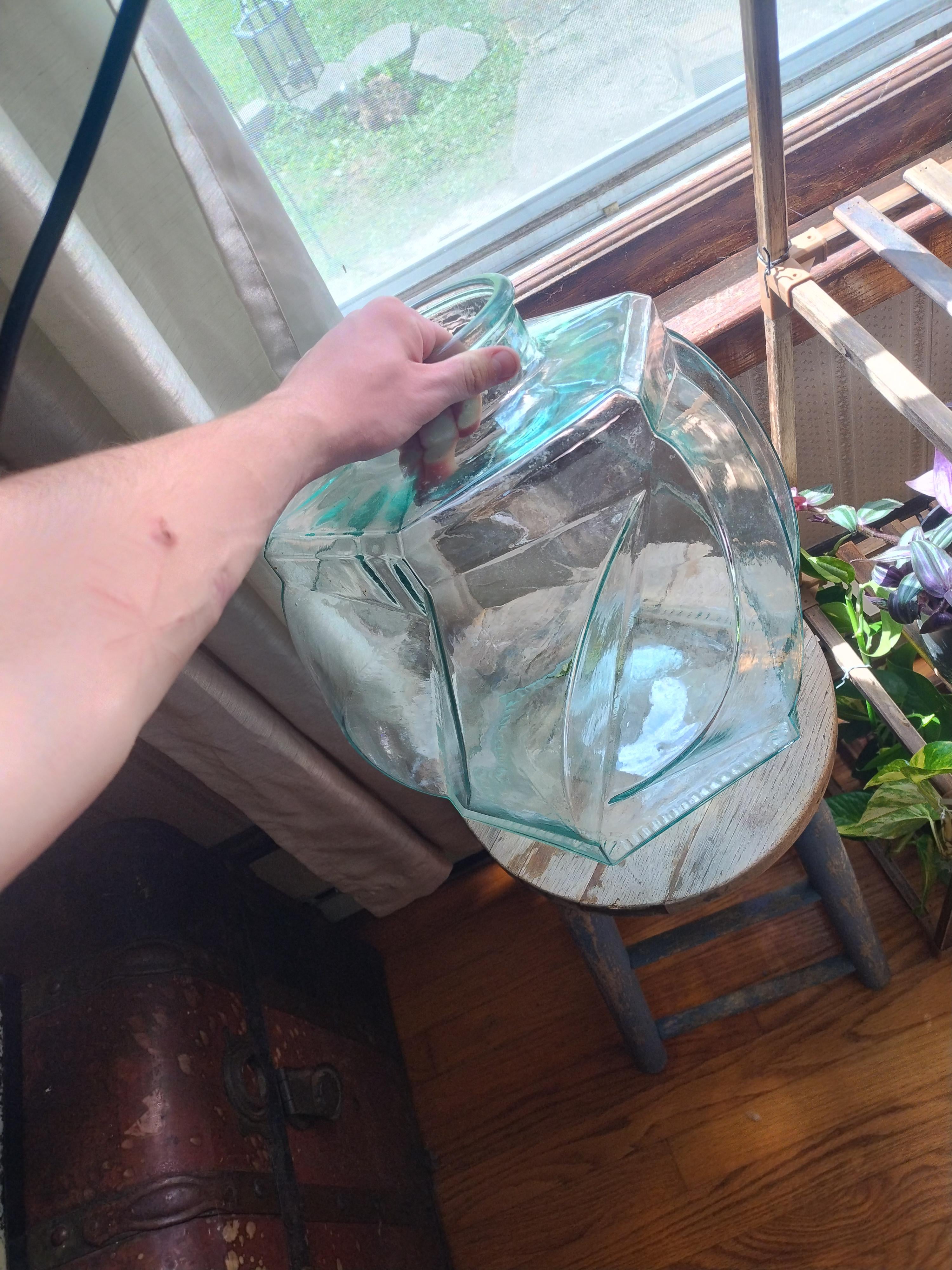
There’s a lot of great suggestions that would work for this terrarium! Here’s my go tos, and some I’d recommend avoiding. Keep in mind, I am assuming this is probably around 2-3 gallons? Even if it goes up to 5 gallons, this list wouldn’t change. It’s only at the 10 gallon range that I start pulling things off of the “Avoid list” and adding it in here(button ferns are an example). First though, we need to get on how to avoid hitchhikers.
**How to Avoid bad Hitch-Hikers** Like slugs and orchid snails.
Bleach dip. This is the most friendly tool for us, and you do this for EVERY plant you’re putting in, wether moss or fern or whatever.
To make a bleach dip, you combine 1 part bleach to 20 parts water, or 1.6 oz bleach in 1 gallon of water. Rinse the plant off well and ensure there is no soil on the roots, then place the plant in the bleach dip, and leave it in from 1 minute to 5 minutes, then rinse off well. The time varies depending upon how hardy the plant is. Ferns, Mosses, Violets and episcias, tender leaved plants should all be in for no more than 2 minutes. This should aid you in keeping bad hitchhikers that may eat your plants out of your terrarium. After that, it’s not my fault if any isopods you add start to eat your plants(and they will without some leaf litter!). lol
**Go-to’s.**
*Flowering plants*
– Episcias: These react well to pruning and do well with some moisture developing on their leaves. Flowers can be reds, oranges, yellows, even blues! They’re related to violets, but have trumpetlike flowers. They even can have very vibrant colored leaves.
– Mini or Micro Mini varieties of Violets: I’m not talking about babies or sproutlings, but ones who stay very small naturally. Example cultivars of Miniature violets are Jolly Fun, and Precious Red. An example of a micro miniature are “Teeny Bopper” and Rob’s Bunny hop. Be careful about directly misting these, they are a little more sensitive to moisture on their leaves and would be best kept in an open terrarium.
– Jewel Orchids: I would recommend everywhere you plant one of these if you opt for them, to mix in a little extra orchid bark around it’s roots, to ensure they have fairly airy soil. They are mostly grown for their amazingly patterned and sparkly leaves, but they do bloom by sending up a tall flower spike. If you leave a topper off it, the flower spikes will possibly come out. Some of Jewel orchids have really nice smelling flowers, even if the flowers are not that big or showy.
*Foliage*
Big:
– Rabbit’s foot fern: A perennial favorite of mine. They grow from a rhysome that will slowly creep over the top of your soil. They react well to trimming to keep them in control, and any clipping can be placed in a self watering pot full of sphagnum moss and always topped up with water to reroot and replant for future.
– Syngonium Wedlandtii. If given the room to climb, this plant will get progressively LARGER leaves, but in a terrarium setting, it behaves more like a prunable spiderplant, where it will grow about 3-5 leaves, then throw out a runner. You can let this runner grow and it will eventually root somewhere and throw out another stalk, or you can cut the runner off at the lowest last presentable leaf and remove it. Another growth will replace it, further adding bushiness to your plant.
– Pilea Microphylla: Also known as “Artillery Fern”. Though this plant can bloom, their blooms aren’t really much to call home over. It’s actually their variegated form I highly recommend as the small tight new growth of leaves look like a bunch of curled roses. They are often pruned and trained in smaller terrariums to resemble little bonsai trees, and are amazingly good at evoking that feel.
– Syngonium Mini Pixie: This is the only upright, non vining Syngonium I can recommend for this terrarium. It will eventually have to be pruned down to keep it from growing out, but it maintains small leaves.
– Pilea involucrata: A very vibrant plant that is known for it’s soft leaves and gorgeous colorations, from striped and purple to almost neon green. They are called “Friendship Plant” because they are easily propped and shared with friends.
Small/medium or Ground Cover:
– Nerve Plants! The GOAT of the terrarium plant world. Amazing colorations in leaves, slower growing, beautifully clumps, Trims back well, you can legitimately just plant the clippings right back in the soil to make a new bush. Comes in Pinks, whites, Reds, Red with lime green(Skeleton), A Purplish pink, Ruffly leaves, small leaves, large leaves…. though for this terrarium I would recommend sticking to the smaller leaved varieties. Get THIS instead of Polkadot Plants!
– Strawberry Begonias: Not an actual begonia(Is a Saxifraga with begonia-like leaves), and adore terrariums. They will spread, and can have beautiful variegation that gets pink with enough light. Will only bloom if given a cooler period.
– Pilea Depressa: Also known as “Baby tears”. This plant loves terrariums a lot, and will spread readily. It can be used as a groundcover. It comes in three main varieties, a big leaf “Baby tears”, a small leaf “Tiny Baby Tears”, and a silverish leaf “Blue baby tears”.
– Ficus Pumilla: Tons of varieties here. From small leafed to ivy leafed, large and small leaves to scalloped and Variegated. The ivy leafed form is called “String of Frogs”. Works great as a ground cover, and if given a centerpiece of some kind of wood, will grow ALL over and up it. Can climb walls, and will spread fast when given a moist and humid environment.
– Peperomia prostrata: Also known as “String of Turtles”. This is a creeping ground cover that does well in a terrarium, and comes with a bonus of how it looks. I would not mix it with Pilea Depressa or Ficus Pumilla, which would grow faster than it and may choke it out.
– Selaginella: Very much recommend the Peacock varietion of this, it’s shimmery and multicolor, and turns red in high light. This will grow fast though and may move into a viney thing that snakes around the walls of your terraium with time, but it prunes down well and transplants very well.
**Plants to Avoid**
*Too big* : These may be sold often as babies and marketed for Terrariums(aka, 2 inch pots), but they’re impossible to keep small and healthy, or prune to keep small. Though they do well in LARGE terrariums, they would not do well in one your size.
– Most syngoniums
– All Philodendrons
– All Anthuriums
– All Pothos
– All Monsteras (including Rhaphidophora)
– Most ferns (including boston/fluffy ruffles, lemon button, and maidenhair)
– All Calatheas, Marantas, Stromanthes
– All Begonias(Can be done, but won’t recommend, most want to grow tall and will need to be moved which may not be possible with a thin-necked bottle)
– All Spathiphyllum/Peace Lilies
*Too annoying*: For one reason or another, I’ve ripped them all out and never gone back.
– Polkadot plant: Though it is a great option for terrarium plants, it grows REALLY ridiculously fast, tries to bolt to flower, and isn’t really prunable into a satisfying shape after it’s grown past it’s cute little baby bush phase. HONESTLY, I do terrariums for something that’s mostly hands off that I may have to prune once every 2-3 months at MOST, and Polkadot plants will want your UNDIVIDED ATTENTION because they’re going to bolt to bloom so they can die off, like the assholes they are. They are akin to the plant version of trying to care for a toddler that just learned to walk and b-lines for any stairs they can see.
– Most other Peperomias: A lot of peperomias like moisture, but also like a dry out period, this can be pretty hard to maintain in a terrarium with othe plants we use, especially hard if you’re going to seal it. Many of them also fall into the “Too big” category above.
– Other Orchids(especially the common ones that you see people stick into terrariums): Unless you’re going to mount them on wood, and spot water when they’re showing dehydration, I would not recommend Orchids aside from jewel orchids in a terrarium. Aside from Jewel orchids and some ground orchids, most orchids you find are going to be epiphytic, meaning they grow on the side of trees, and cannot adapt to having their roots grow in soil. Doing so will kill them. Many of these also suffer from the “Too big” issue, as in they are sold as “Minis” but many people don’t realize that they will get about the same size leaf as standard sized orchids, and the “Mini” refers to phalaenopsis orchid species being crossed with another species to attain the smaller flower size before being brought back into the colors and presentation of traditionally sized orchids. Most orchids out there commercially and easily bought in stores are all Phalaenopsis, with an odd Oncidium, Dendrobium, Cattleya, Epidendrums, Cymbidium, or ground orchid showing up from time to time.
There’s definitely more I could add to this, but these names should help you get some ideas!

1 Comment
There’s a lot of great suggestions that would work for this terrarium! Here’s my go tos, and some I’d recommend avoiding. Keep in mind, I am assuming this is probably around 2-3 gallons? Even if it goes up to 5 gallons, this list wouldn’t change. It’s only at the 10 gallon range that I start pulling things off of the “Avoid list” and adding it in here(button ferns are an example). First though, we need to get on how to avoid hitchhikers.
**How to Avoid bad Hitch-Hikers** Like slugs and orchid snails.
Bleach dip. This is the most friendly tool for us, and you do this for EVERY plant you’re putting in, wether moss or fern or whatever.
To make a bleach dip, you combine 1 part bleach to 20 parts water, or 1.6 oz bleach in 1 gallon of water. Rinse the plant off well and ensure there is no soil on the roots, then place the plant in the bleach dip, and leave it in from 1 minute to 5 minutes, then rinse off well. The time varies depending upon how hardy the plant is. Ferns, Mosses, Violets and episcias, tender leaved plants should all be in for no more than 2 minutes. This should aid you in keeping bad hitchhikers that may eat your plants out of your terrarium. After that, it’s not my fault if any isopods you add start to eat your plants(and they will without some leaf litter!). lol
**Go-to’s.**
*Flowering plants*
– Episcias: These react well to pruning and do well with some moisture developing on their leaves. Flowers can be reds, oranges, yellows, even blues! They’re related to violets, but have trumpetlike flowers. They even can have very vibrant colored leaves.
– Mini or Micro Mini varieties of Violets: I’m not talking about babies or sproutlings, but ones who stay very small naturally. Example cultivars of Miniature violets are Jolly Fun, and Precious Red. An example of a micro miniature are “Teeny Bopper” and Rob’s Bunny hop. Be careful about directly misting these, they are a little more sensitive to moisture on their leaves and would be best kept in an open terrarium.
– Jewel Orchids: I would recommend everywhere you plant one of these if you opt for them, to mix in a little extra orchid bark around it’s roots, to ensure they have fairly airy soil. They are mostly grown for their amazingly patterned and sparkly leaves, but they do bloom by sending up a tall flower spike. If you leave a topper off it, the flower spikes will possibly come out. Some of Jewel orchids have really nice smelling flowers, even if the flowers are not that big or showy.
*Foliage*
Big:
– Rabbit’s foot fern: A perennial favorite of mine. They grow from a rhysome that will slowly creep over the top of your soil. They react well to trimming to keep them in control, and any clipping can be placed in a self watering pot full of sphagnum moss and always topped up with water to reroot and replant for future.
– Syngonium Wedlandtii. If given the room to climb, this plant will get progressively LARGER leaves, but in a terrarium setting, it behaves more like a prunable spiderplant, where it will grow about 3-5 leaves, then throw out a runner. You can let this runner grow and it will eventually root somewhere and throw out another stalk, or you can cut the runner off at the lowest last presentable leaf and remove it. Another growth will replace it, further adding bushiness to your plant.
– Pilea Microphylla: Also known as “Artillery Fern”. Though this plant can bloom, their blooms aren’t really much to call home over. It’s actually their variegated form I highly recommend as the small tight new growth of leaves look like a bunch of curled roses. They are often pruned and trained in smaller terrariums to resemble little bonsai trees, and are amazingly good at evoking that feel.
– Syngonium Mini Pixie: This is the only upright, non vining Syngonium I can recommend for this terrarium. It will eventually have to be pruned down to keep it from growing out, but it maintains small leaves.
– Pilea involucrata: A very vibrant plant that is known for it’s soft leaves and gorgeous colorations, from striped and purple to almost neon green. They are called “Friendship Plant” because they are easily propped and shared with friends.
Small/medium or Ground Cover:
– Nerve Plants! The GOAT of the terrarium plant world. Amazing colorations in leaves, slower growing, beautifully clumps, Trims back well, you can legitimately just plant the clippings right back in the soil to make a new bush. Comes in Pinks, whites, Reds, Red with lime green(Skeleton), A Purplish pink, Ruffly leaves, small leaves, large leaves…. though for this terrarium I would recommend sticking to the smaller leaved varieties. Get THIS instead of Polkadot Plants!
– Strawberry Begonias: Not an actual begonia(Is a Saxifraga with begonia-like leaves), and adore terrariums. They will spread, and can have beautiful variegation that gets pink with enough light. Will only bloom if given a cooler period.
– Pilea Depressa: Also known as “Baby tears”. This plant loves terrariums a lot, and will spread readily. It can be used as a groundcover. It comes in three main varieties, a big leaf “Baby tears”, a small leaf “Tiny Baby Tears”, and a silverish leaf “Blue baby tears”.
– Ficus Pumilla: Tons of varieties here. From small leafed to ivy leafed, large and small leaves to scalloped and Variegated. The ivy leafed form is called “String of Frogs”. Works great as a ground cover, and if given a centerpiece of some kind of wood, will grow ALL over and up it. Can climb walls, and will spread fast when given a moist and humid environment.
– Peperomia prostrata: Also known as “String of Turtles”. This is a creeping ground cover that does well in a terrarium, and comes with a bonus of how it looks. I would not mix it with Pilea Depressa or Ficus Pumilla, which would grow faster than it and may choke it out.
– Selaginella: Very much recommend the Peacock varietion of this, it’s shimmery and multicolor, and turns red in high light. This will grow fast though and may move into a viney thing that snakes around the walls of your terraium with time, but it prunes down well and transplants very well.
**Plants to Avoid**
*Too big* : These may be sold often as babies and marketed for Terrariums(aka, 2 inch pots), but they’re impossible to keep small and healthy, or prune to keep small. Though they do well in LARGE terrariums, they would not do well in one your size.
– Most syngoniums
– All Philodendrons
– All Anthuriums
– All Pothos
– All Monsteras (including Rhaphidophora)
– Most ferns (including boston/fluffy ruffles, lemon button, and maidenhair)
– All Calatheas, Marantas, Stromanthes
– All Begonias(Can be done, but won’t recommend, most want to grow tall and will need to be moved which may not be possible with a thin-necked bottle)
– All Spathiphyllum/Peace Lilies
*Too annoying*: For one reason or another, I’ve ripped them all out and never gone back.
– Polkadot plant: Though it is a great option for terrarium plants, it grows REALLY ridiculously fast, tries to bolt to flower, and isn’t really prunable into a satisfying shape after it’s grown past it’s cute little baby bush phase. HONESTLY, I do terrariums for something that’s mostly hands off that I may have to prune once every 2-3 months at MOST, and Polkadot plants will want your UNDIVIDED ATTENTION because they’re going to bolt to bloom so they can die off, like the assholes they are. They are akin to the plant version of trying to care for a toddler that just learned to walk and b-lines for any stairs they can see.
– Most other Peperomias: A lot of peperomias like moisture, but also like a dry out period, this can be pretty hard to maintain in a terrarium with othe plants we use, especially hard if you’re going to seal it. Many of them also fall into the “Too big” category above.
– Other Orchids(especially the common ones that you see people stick into terrariums): Unless you’re going to mount them on wood, and spot water when they’re showing dehydration, I would not recommend Orchids aside from jewel orchids in a terrarium. Aside from Jewel orchids and some ground orchids, most orchids you find are going to be epiphytic, meaning they grow on the side of trees, and cannot adapt to having their roots grow in soil. Doing so will kill them. Many of these also suffer from the “Too big” issue, as in they are sold as “Minis” but many people don’t realize that they will get about the same size leaf as standard sized orchids, and the “Mini” refers to phalaenopsis orchid species being crossed with another species to attain the smaller flower size before being brought back into the colors and presentation of traditionally sized orchids. Most orchids out there commercially and easily bought in stores are all Phalaenopsis, with an odd Oncidium, Dendrobium, Cattleya, Epidendrums, Cymbidium, or ground orchid showing up from time to time.
There’s definitely more I could add to this, but these names should help you get some ideas!