
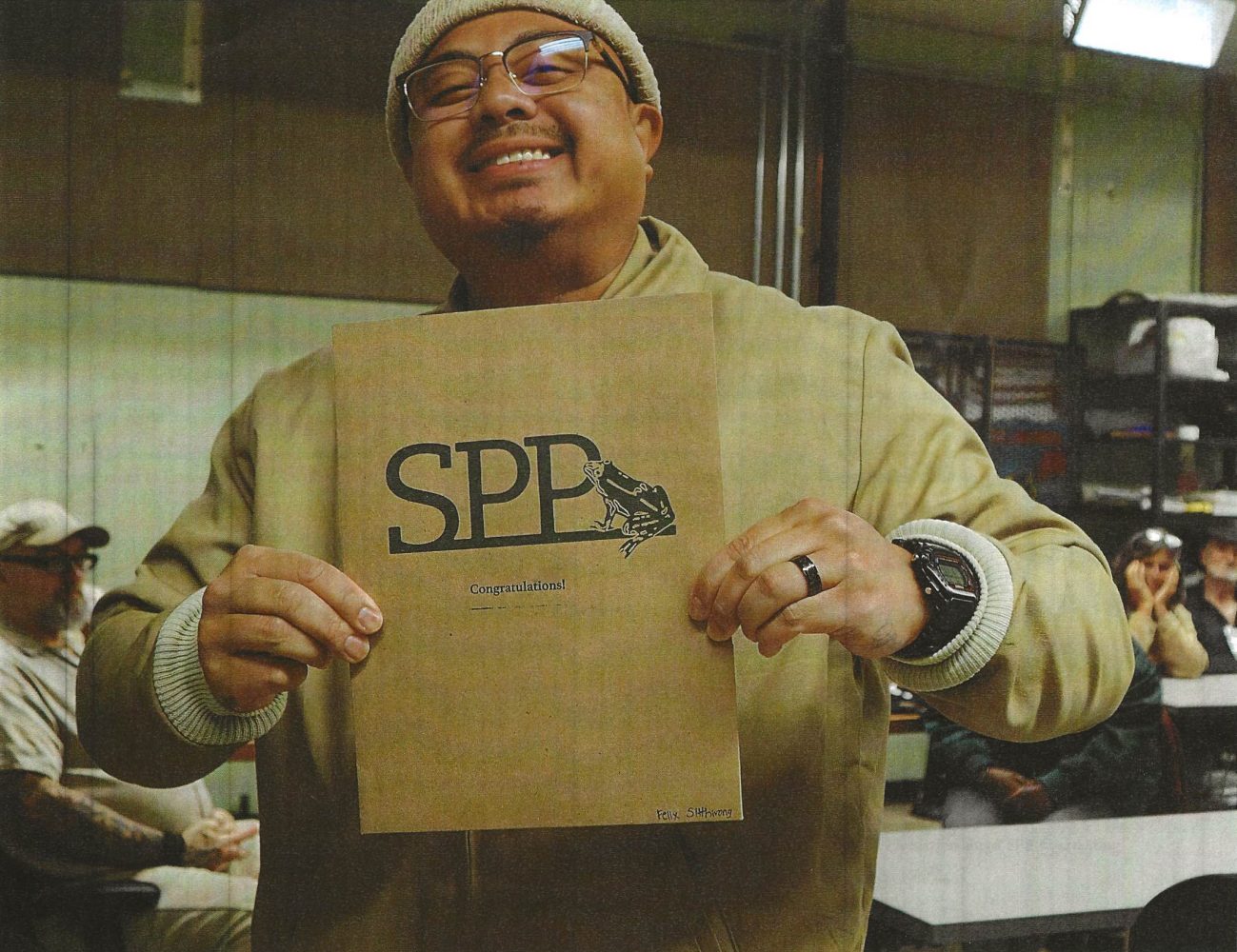
 On the Fence Line columnist Felix Sitthivong shows a certificate of completion for a composting course offered by the Sustainability in Prisons Project (SPP), in partnership with Evergreen State College. Image courtesy of Felix Sitthivong.
It’s a beautiful summer morning in the Pacific Northwest. The sun is cutting through the light morning fog, signaling another perfect day to come. As the sun continues to rise, bringing with it sounds of birds singing to one another, I’m standing in a field of greenery — a garden, actually.
As I water our little bundles of bok choy, collard greens, and radish, I smile at the sight of a tiny green tomato just beginning to sprout nearby, the first of many, I hope. The tomatoes almost didn’t make it this season due to our inexperience, so the fact that we have any at all is a miracle — they’re definitely survivors. Unfortunately, my cucumber plant wasn’t as lucky. I chuckle at the embarrassment of how sad that actually made me feel, and I make sure to show some extra love to our onions to avoid any more casualties.
Suddenly, the sounds of keys jangling and rapid footsteps break me out of my moment of bliss—guards running past me and responding to some sort of emergency in a nearby unit. And just as suddenly, I’m reminded of where I’m at: prison. As if the fences and razor wire would ever allow me to forget.
But this story isn’t about some rude-ass guards interrupting my peace. It’s about how a garden is teaching me about resistance and survival, in more ways than one.
This story actually began late last year when there was a flier and signup sheet posted in my living unit. As part of an incentive program, the announcement said there’d be a raffle held where approximately 20 winners could plant their own garden. The prison would provide the seeds and tools, and each person chosen would be responsible for a five by five plot of land. And as long as you didn’t have any major infractions, you were eligible. So I signed up — what could it hurt, right?
As luck would have it, I was one of the lucky few who were chosen!
This is probably an appropriate time to confess that I don’t know anything about gardening. In fact, I freaking hate getting dirty. Y’all, I can’t stand dirty sneakers. Lucky for me, I had some friends who were also chosen, and the four of us decided to put our plots together to create a mini community garden. Which is something I didn’t mind at all for obvious reasons. Don’t judge! My friends knew they were saving me from myself.
As the project was launching and I went to check out what was supposed to be our garden, I was horrified to see a desolate field filled with nothing but rocks and old roots. But my friends assured me we’d make it right. And so I committed to contributing as much as I could and to allow them to lead the way.
These jerks wasted no time and put me to work right away. And before I knew it, I was out there tilling the soil, sifting through rocks, and most tragic… ruining my shoes! But the funny part, I was also lightweight enjoying myself. I have to admit, the change of pace was nice — the blisters on my hands, however, weren’t. What can I say? I’m a city boy.
Once our soil was ready and our seeds were planted, all that was left was to wait and eat. Or so I thought… gardening takes a lot more patience than I anticipated. Well, patience and work.
Simultaneously, I also signed up for a foundations in composting class, that was created by a good friend who is also currently incarcerated, and offered by a program called the “Sustainability in Prisons Project (SPP),” in partnership with Evergreen State College. Why I signed up, I couldn’t tell you. Maybe I just thought it would be something cool to share with my mother-in-law who loves this stuff. And though I was right about that part, I also learned a lot about environmental injustices harming communities of color and how sustainable practices such as composting and gardening can be utilized to push back against these injustices.
By the end of class, I was somehow chosen and asked to continue on with the program and teach the curriculum since the current teachers are moving on and getting released. Trust me, I’ll keep y’all posted with how it goes in future installments of “On the Fence Line.” Wish me luck! But now back to our garden!
While I’m here, watering the vegetables that my friends and I cultivated and continue to nurture everyday, I’m at peace. In a poetic type of way, our garden, in the middle of a concrete prison, is proof that when we come together, even fields of rocks can be transformed into green beauty and life.
As a prison abolitionist, I believe wholeheartedly in developing alternative systems of accountability that do not rely on prisons, the state, or any other systems of harm. And while many may believe that prison abolition is only about shutting down prisons, which I’m definitely about, we often forget about the most important part—creating alternative systems of care that are healthy and sustainable, just like our garden. But equally important is to remember that the world we wanna see takes patience and work.
And so that’s what we do. Work for the world we wanna see, one green tomato at a time.
Free Palestine!
Until next time, keep dreaming!
Felix Sitthivong is an incarcerated storyteller, community organizer, and founding member of the Peoples’ Empowerment Assembly for Collective Equity (PEACE). Sitthivong is also the former president and senior advisor for the Asian Pacific Islander Cultural Awareness Group (APICAG). He is currently serving a 66-year sentence at the Washington Corrections Center in Shelton, WA. Reach him with questions for “On the Fence Line” via Securus (WA #354579) or write to him at Felix Sitthivong #354579, PO BOX 900, Shelton, WA 98584.
Comments are closed.