
With a new lynching memorial in Fort Worth, DesignJones continues to create landscapes of racial reconciliation.
By James Russell
 Image courtesy DesignJones LLC.
Fred Rouse was hanged from a hackberry tree north of downtown Fort Worth, Texas, on December 11, 1921. Not until local organizers and activists dug into his history did Rouse’s own grandson, Fred Rouse III, learn about the lynching. A century later, the murder was finally acknowledged with a marker telling of the Black man’s death at the hands of a white mob. Now, a vacant lot near the lynching site is set to become a memorial park designed by DesignJones LLC for the Tarrant County Coalition for Peace and Justice (TCCPJ), cofounded by Rouse to memorialize his grandfather’s life.
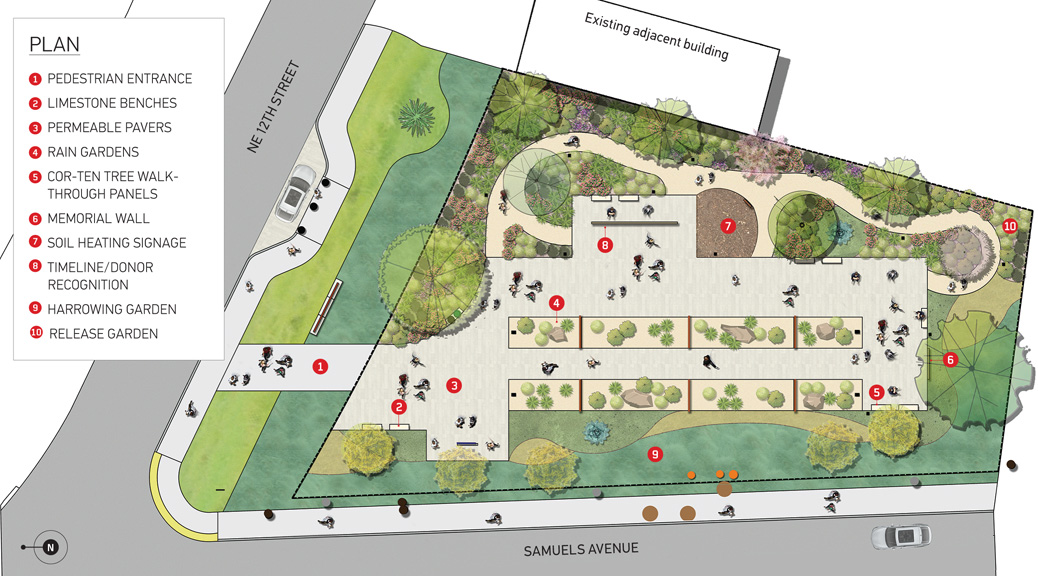
Rouse’s violent death and its legacy are central to the design, which takes the visitor on an emotional and physical journey, winding through a series of outdoor spaces—among them the Harrowing Garden and the Release Garden—and three pairs of Cor-Ten steel panels. Those panels, which evolved over time, are cut with silhouettes of the lynching tree, or “death tree,” as the local newspaper called it at the time, which still stands just south of the memorial site.
As a counterpoint to the weighty subject, the Release Garden offers a space away from the main memorial wall to reflect on Rouse’s life and his violent murder. Also proposed for the site is a pillar designated for Tarrant County from the National Memorial for Peace and Justice in Birmingham, Alabama, which has 805 steel pillars representing every county where a lynching occurred. (The Birmingham museum produced two sets of pillars: one to remain on-site and another slated for each county.)
 Conversations with residents and a desire to imbue the park with an ethic of environmental resilience informed the design. Photo by DesignJones LLC.
The design team also wanted to develop a space intertwining Black resilience and sustainability. “Resiliency, both social-cultural and environmental, is key to Black history and current life,” says Diane Jones Allen, FASLA, of DesignJones. “People of African descent practiced environmental resiliency within the world to which they were transplanted, bringing environmental and ecological knowledge from Africa and learning and adapting new techniques in the colonial world. This included the building of levees and drainage systems that protected the colonies from storms and the overtopping of rivers.”
The memorial uses stormwater management techniques and native plants to reflect those principles of resilience symbolically. The site, currently a barren lot with patches of dead grass and weeds crawling up two utility poles, is designed as an urban forest with a ground cover of native grasses of varying heights and sizes, such as Lindheimer’s muhly, little bluestem, and blue grama. “Basically, it’s lots of colors, with a seriousness around the memorial followed by these bursts of emotions,” says Ángeles Margarida, a landscape designer with DesignJones.
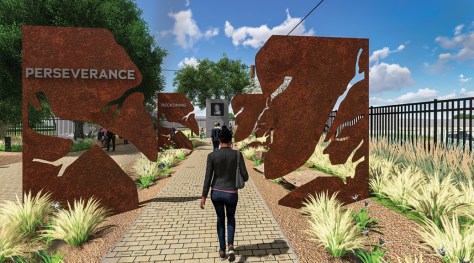 Visitors to the park will have opportunities to reflect on Rouse’s life while surrounded by subtle features referencing African American resilience. Image by DesignJones LLC.
The grade gradually sinks toward the park’s center, where rain gardens absorb and then release stormwater. “The soil cells hold and take care of plants, cleanse the water, and the overflow goes back into the city’s water system,” Jones Allen says, a cost-efficient, water-adaptive move that also nods to Black resilience.
Corrin Breeding, a landscape designer and vice president of the TCCPJ board, says the design is “breaking barriers. Lynching is a horrible part of history. The question is, how do you deal with it? How do you take an area where you transform and reflect? Through design, we can start the healing process.”
Like this:
Like Loading…