
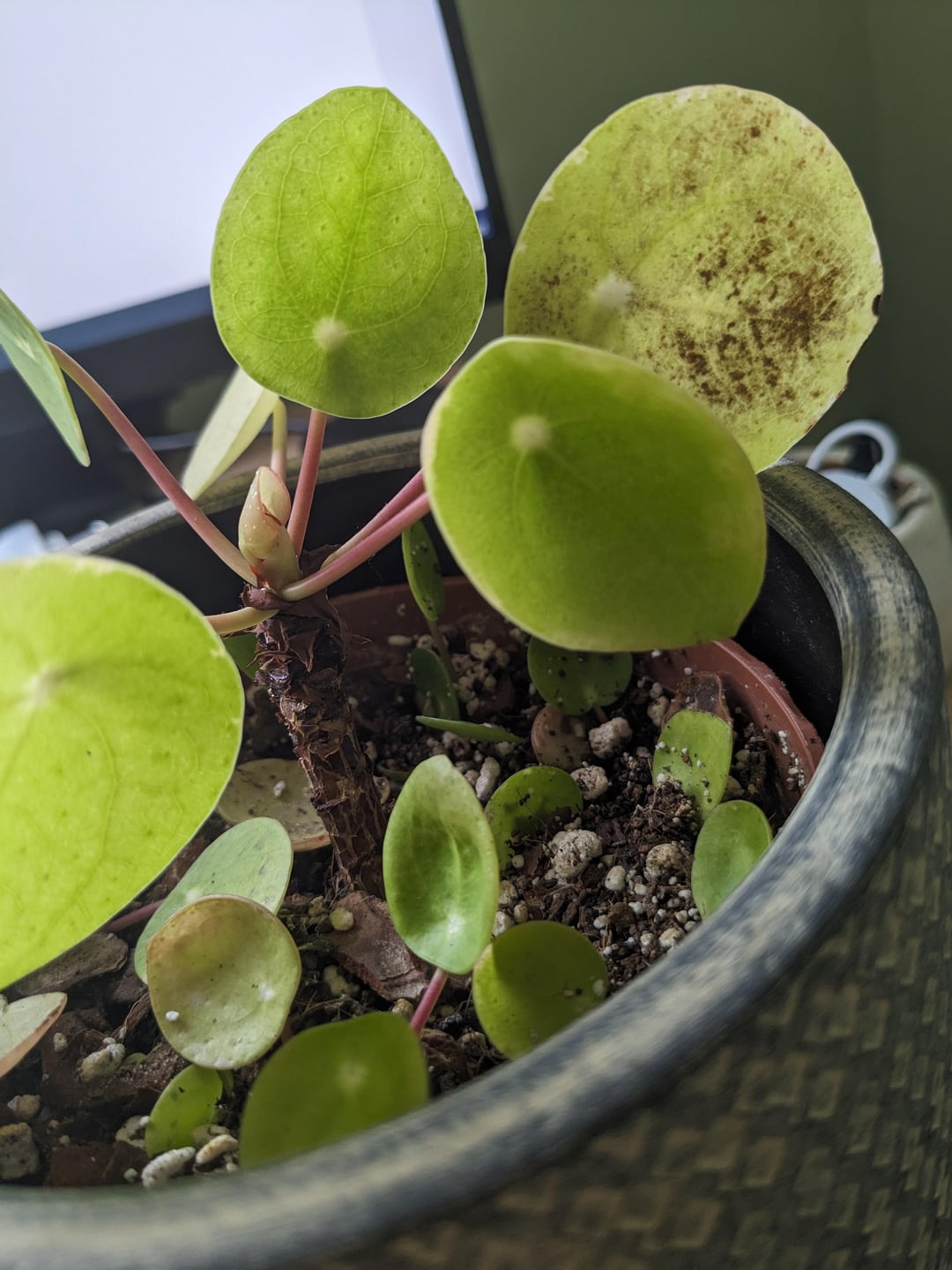
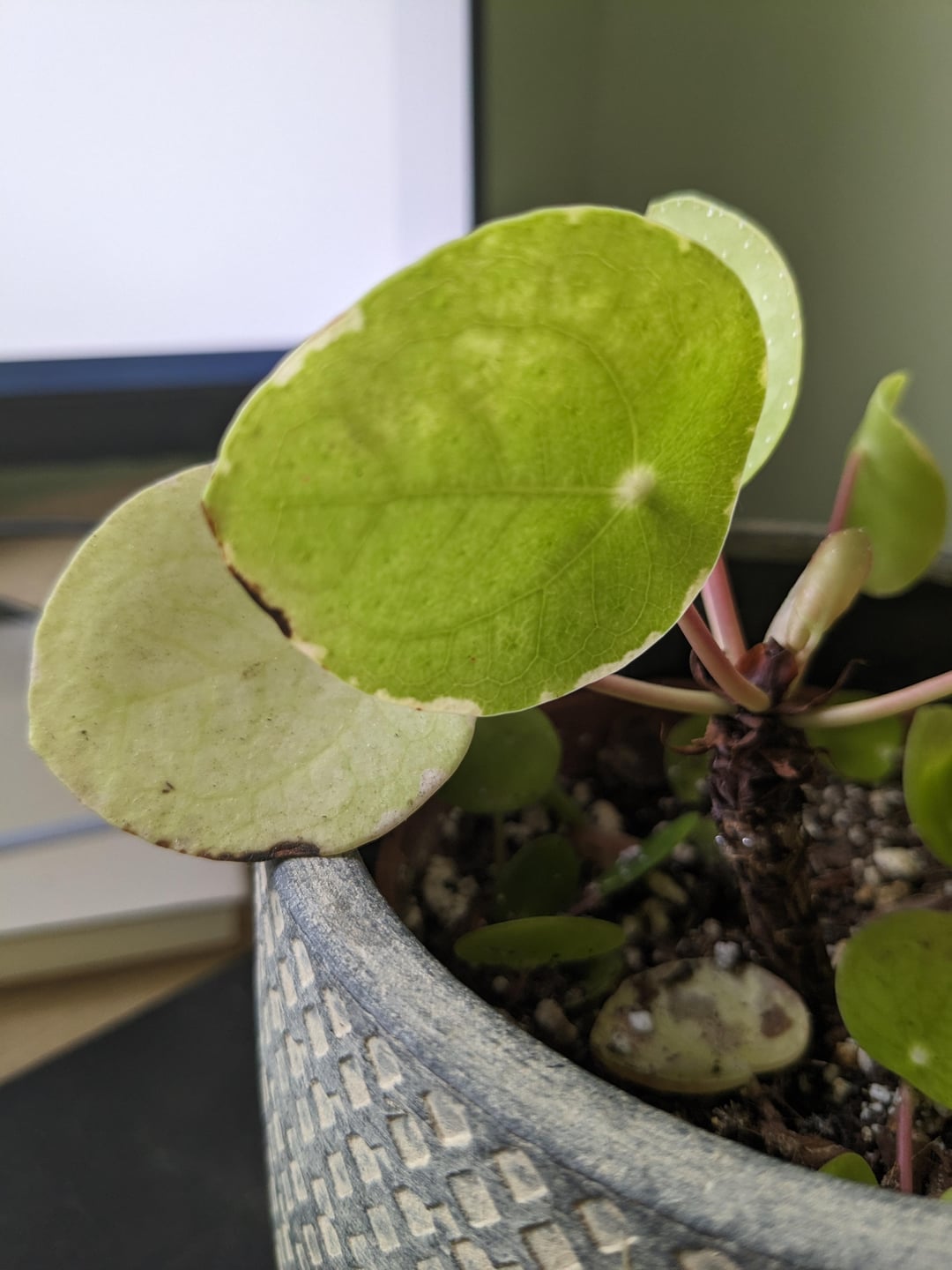
I got this pilea as a cutting about a year ago but it’s never really thrived. It forces out a leaf or two, then the older leaves blacken and die off (as starting to in picture 1). There’s loads of babies coming up but they never seem to get too far either!
I recently transplanted it into a slightly larger nursery pot because the babies were crowded to see if that helped. The roots were healthy. It’s kept about a foot away from a window, east facing
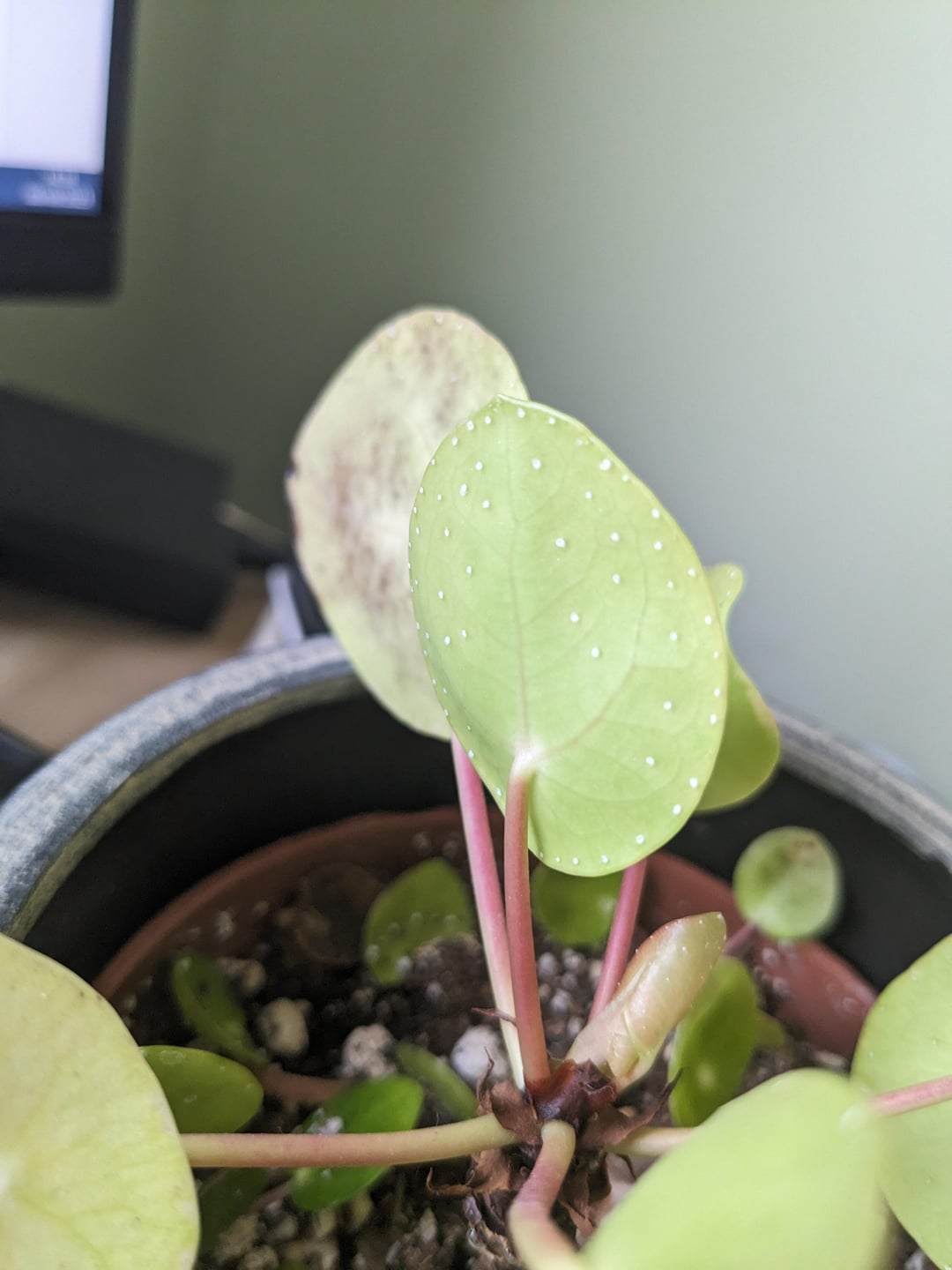
I’ve just noticed the white specks on the back of the leaves (picture 3), could they be a disease of some kind?
Any advice appreciated! Thanks!
by Vertigriss
7 Comments
Thank you for posting to r/plantclinic!
The subreddit moderation team has implemented a number of new tools to help users both give and receive the best help possible.
Please refer to the pinned post [here](https://www.reddit.com/r/plantclinic/comments/11dfcek/subreddit_moderation_adjustments/)
All posters receive an automod message requesting they supplement their post with basic care details.
This sub is being actively moderated. Please utilize the report functions to call attention to posts and comments that are counter to the mission of the sub.
—
*I am a bot, and this action was performed automatically. Please [contact the moderators of this subreddit](/message/compose/?to=/r/plantclinic) if you have any questions or concerns.*
White specks are salt deposits, typically normal but I’ve never seen them that big. How often are you watering, and what kind of water are you using?
How often do you water and how much sun does it get?
I water mine once a week and give it plenty of sun with southern exposure. It’s thriving
add a tablespoon of coffee grounds. sometimes lack of nitrogen is exhibited by lack of green
If the only light the plant gets is “indirect light”…. then you need to give the plant more light.
Light creates photosynthesis.
Photosynthesis creates glucose.
Glucose is used for cellular energy, and whatever isn’t getting used at the moment, gets stored in roots and tissues, then redistributed throughout the plant at night when the plant isn’t actively photosynthesizing.
Glucose is also used to build new cells and tissues.
Those first 2 reasons are the most important to a plant, and that last reason, comes last.
So if your plant barely grows, that’s most likely because it’s not producing enough EXTRA glucose each 24 hour period, to use in building new cells and tissues (leaves, stems, and roots)
I know you’ll hear “bright indirect light” all over the internet… but it’s actually not very bright at all.
Direct sunlight at noon on a cloudless summer day, is typically “10,000 footcandles (fc), or brighter”
Outdoor shade is usually somewhere between 500 to 2,000 fc
Indoor shade (“bright” indirect light) is usually no more than 50 to 300 fc… and sometimes 400 if you have really wide, floor-to-ceiling windows.
How much extra glucose a plant makes each 24 hour period, determines how quickly it’s going to grow.
You mentioned that it struggles to put out new leaves, and then it drops older leaves.
That could be due to not getting enough light…. where the plant HAS to drop older leaves, because it can’t provide glucose too all it’s current leaves, PLUS new leaves…
Or it could be due to the plant not being fertilized frequently enough, or at a high enough nutrient concentration.
(most likely the first)
If the plant isn’t getting a minimum of 200 fc of light intensity, for 12 hours a day… it’s not even worth fertilizing, because the plant can’t assimilate those nutrients you’re giving it.
You’re just wasting fertilizer at that point.
Out in nature (or in a greenhouse which replicates their natural light levels), those Pilea would be getting between 1,000 to 2,000 footcandles of light intensity, for 12 to 16 hours a day.
They produce a lot of glucose under those light levels, and therefore, they produce enough glucose for immediate use, for storage, and to build new cells and tissues with.
(which is partly why they look so nice when you pick one up from a greenhouse or a store that sells them (who probably just recently got a delivery of them, from a greenhouse).
How do you know if your plant is getting enough light?
With a light meter.
You’d take a light meter reading once an hour at the plant’s leaf surface, for every hour that the sun is up…
…add all those readings together into one large number…
Then divide that number, by the number of readings you took during the day.
That will give you an hourly average.
You want that average to be as close to 1,000 fc as possible… preferrably closer to 1,500.
You don’t need to try and obtain 2,000 fc… they’ll grow fine between 1,000 to 1,500
The problem is, you probably aren’t going to get an average that high, without using a grow light…. because any hour where the plant is getting indirect light, is going to drag that average down.
You’ll need to get the light levels up near that 1,000 fc, in order for the plant to EVER be healthy and grow quickly for you.
I would suggest a grow light, because that’s easier to control the light levels, than trying to rely 100% on natural sunlight (which can be too bright when the plant is getting direct sunlight, and not bright ENOUGH when it’s NOT getting direct sunlight.)
Those white specs COULD be salt deposits, as mentioned in another comment here… but you’d know that if you pulled one off, rubbed it between your fingers, and it felt gritty.
If it’s not gritty, and it’s just sticky… then it’s sap that’s being pushed out of the hydathodes on the leaves.
Hydathodes are small openings on the leaves that help regulate water pressure.
Plants that don’t have hydathodes, can suffer internal cell wall/tissue ruptures from internal water pressure… whereas plants with hydathodes, can release that pressure by secreting sap through them.
That sap CAN dry out, and dissolved minerals will crystalize… and this can happen pretty quickly when the air in your home is really dry.
(which most home’s air IS much drier than the air in a greenhouse.)
To get rid of that accumulated sap/crystalization, you can wet a cloth with warm water and wipe them away… or hold the leaves under running, warm water and rub them gently to dissolve and rinse them away.
That process where the plant is pushing sap/water out of the hydathodes, is called guttation.
The stomates on the leaf surfaces (which are open during the day to diffuse carbon dioxide into the plant, and release water vapor (wich pulls water into the plant through its roots) ) ….are closed at night.
Meaning, that ‘suction’ force created by the water vapor exiting the open stomates, stops.
But, that doesn’t completely stop water from entering the roots.
Osmosis of water into the plant still occurs.
Water with a lower salinity, always wants to move into, and dilute, water that has a higher salinity.
The root membrane is the only thing that’s separating the water held in the potting media, from the water that’s inside the plant’s roots….. and technically, the water outside the roots, and inside the roots, is connected through the tiny pores in that root membrane.
So, if the stomates are closed at night, and water is being forced into the plant by osmosis (where the water in the media is less saline than the water inside the roots), then water is still going to be forced into the plant, creating internal water pressure within the plant.
This is going to be elevated if you’re watering the plant with distilled water, because distilled water doesn’t have any dissolved minerals in it.
So, it increases the salinity gradient between the water in the media, and the water inside the plant.
Osmotic water movement stops, when “the body of water” has reached a salinity equilibrium.
The water in the media around the roots, and the water within the roots is technically, “one body of water”, since it’s connected at the pores in the root membrane.
You CAN used distilled or reverse osmosis water to water plants with… but you should always be adding fertilizer to that water, so that it doesn’t create that steep gradient in salinity between the media water, and the plant’s internal water.
Just as giving the plant adequate light is important… it’s just as important that you’re providing the plant with all the nutrients it needs.
If you constantly use super-clean water (reverse osmosis, or distilled), then the plant is going to suffer from nutrient deficiencies really quickly.
What does a plant do when it’s not getting enough nutrients?
It robs its old growth of nutrients, and moves those nutrients up to the new growth points where it’s needed to build new cells and tissues.
(another (possible) reason why your plant is dropping older leaves, as its growing newer leaves.)
IF you’re fertilizing… that’s good.
But the fertilizer that you use can be just as detrimental to the plants health, as all these other reasons.
You’ll want to be using an inorganic fertilizer, rather than an organic fertilizer.
Plants require INORGANIC mineral ions.
In an organic fertilizer, those inorganic mineral ions that plants USE, are locked within a larger, carbon-containing molecule.
The only way that the plant gets access to those inorganic ions, is when living organisms consume that organic molecule, and the acids in their digestive system breaks the molecular bonds between the carbons, hydrogens, oxygens, and the inorganic mineral ions…. which (some of them) get excreted back into the potting media… and then those inorganic ions can dissolve into the water, and then be taken up into the plant.
The problem is, potting media isn’t “soil”.
Soil, that you’d dig up with a shovel outside, has billions and billions of living organisms in a single spoonful.
Potting media isn’t soil.
Potting media is just a mixture of non-soil ingredients that are meant to replicate the physical characteristics of natural soils.
Potting media is typically sterlized prior to being bagged up, and so whatever microbes MIGHT have been present, are killed off.
Which is GOOD, because you don’t want there to be any pathogenic organisms IN your potting media.
Inorganic fertilizers, are simply those inorganic mineral ions, suspended in water (or dry minerals, added TO water, then added to the plant’s media)
Inorganic fertilizers don’t have that carbon-containing molecular structure surrounding them… and so they don’t need to be consumed by a living organism in order to be available for the plant to take them in.
Plants that are growing in potting media and given organic fertilizers, often times exhibit nutrient deficiencies, because those organic molecules aren’t broken down at the same rate that the plant REQUIRES THEM in order to grow…. because of the lack of living organisms in the potting media.
This is already a super long reply, so I’ll give you a chance to reply before I write any more.
Do you have a light meter?
If so, what’s the average amount of light your Pilea is getting in a 24 hour period?
Are you fertilizing?
If so, what fertilizer are you using?
How frequently are you using it?
Are you mixing it according to the instructions?
Or, are you using an EC meter to calculate the strength of the fertilizer?
(which we can get into later…)
Do you know the pH of the root zone?
(we can get into that later as well…)
Are you using tap water, or distilled/reverse osmosis water?
These are things I need to know (and you need to know) in order to get your plant back on track and be as healthy as it can be.
Water with distilled water. The white spots under the leaves are minerals coming out of the pores.
🥰🥰🥰🥰