Somebody got close with the weed eater and hope it isn’t too bad
spiceydog
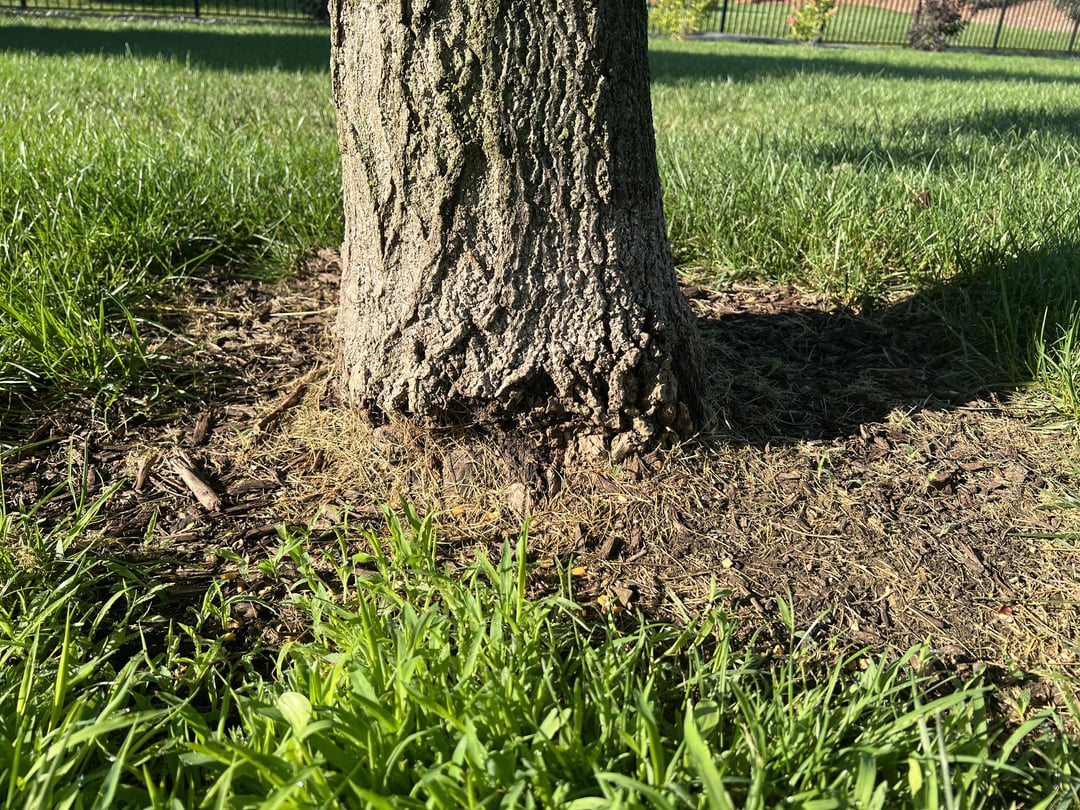
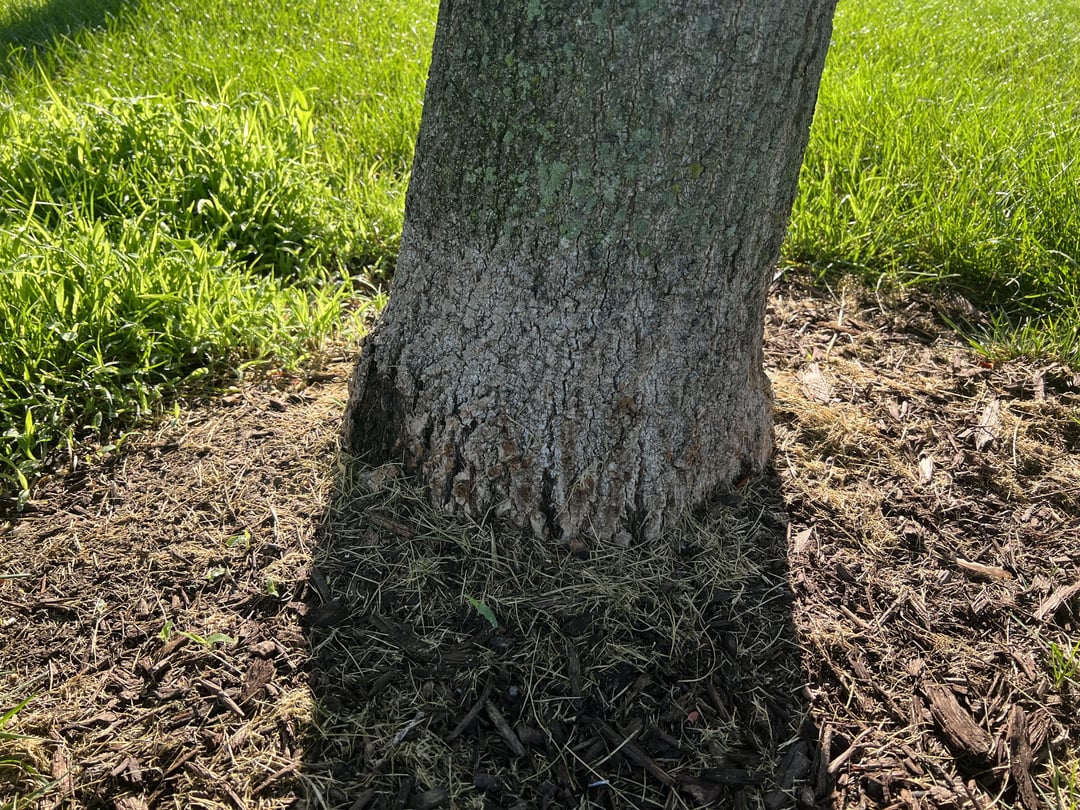
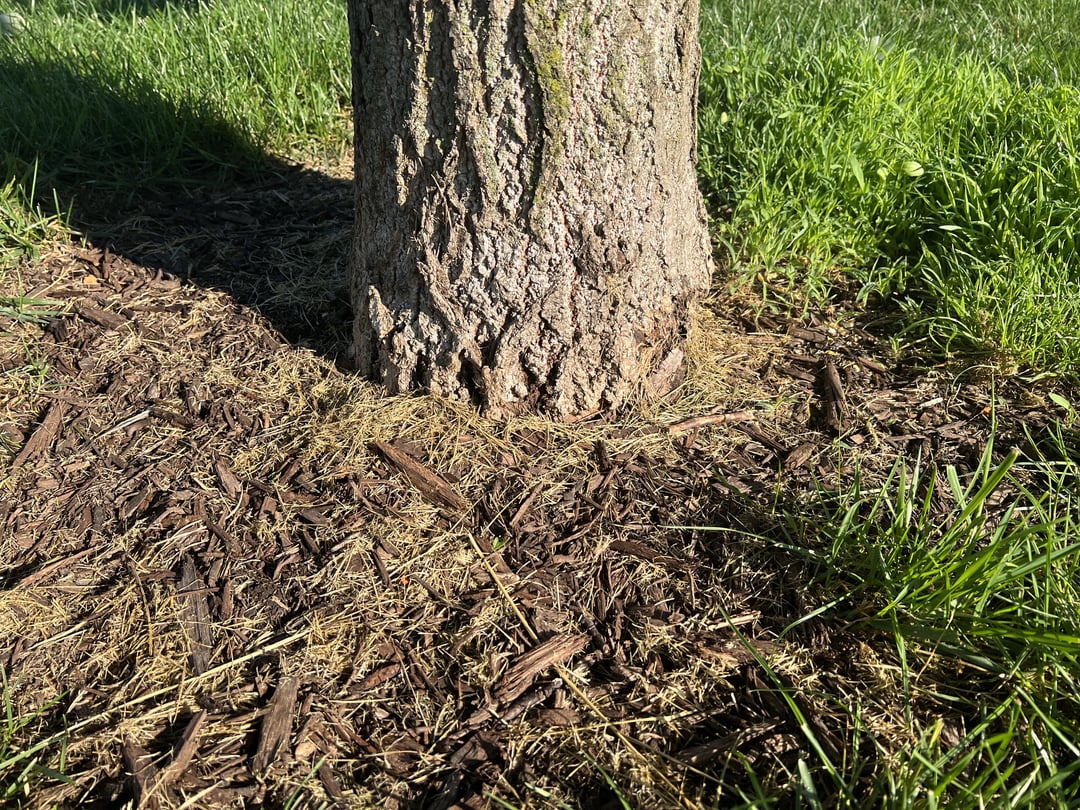
While it may certainly be the case that the tree was hit by a mower or trimmer, more critically is that the base of your tree has been buried; there is no [root flare](https://i.imgur.com/pmHFcQt.png) visible. That the bark appears to be starting to decay in this area is a super bad sign. When a tree looks like a telephone pole stuck in the ground it starts the countdown to a much shortened life.
Trees planted too deeply suffer because their roots cannot get proper nutrients, water and oxygen. **Mulch and soil should never be in constant contact with the trunks of trees because it causes stem rot, insect damage and girdling roots.** Mulch should be only [2-3″ deep and in a RING around the tree](https://cdn.imgchest.com/files/d7ogcbxomay.png), NEVER in contact with it. It’s the *roots* of trees that need the [benefit of a layer of mulch](https://hgic.clemson.edu/factsheet/mulch/), *not* the stems of trees.
I do not exaggerate when I say that this is an *epidemic* problem. The great majority of ‘pros’ are doing it wrong. [This Clemson Univ. Ext. publication](https://www.clemson.edu/cafls/vincent/articles/show_me_your_root_flare.pdf) (pdf) cites a study that estimates this occurs in an incredible **93%** of professional plantings. Planting too deeply usually accompanied by over/improper mulching are top reasons why transplanted trees fail to thrive and die early.
To understand what it means to expose your root flare, do a subreddit search in r/arborists, r/tree, r/sfwtrees or r/marijuanaenthusiasts using the term root flare; there will be a lot of posts where this has been done on young and old trees. You’ll know you’ve found it when you see **outward taper at the base of the tree** from vertical to the horizontal, **and the tops of large, structural roots**. Here’s[ a post from last year](https://old.reddit.com/r/arborists/comments/vn492d/) for an example of what finding the flare will look like. Here’s another [post from two years back about this](https://old.reddit.com/r/arborists/comments/jgnhji/rate_my_root_flare/); note that this poster found bundles of adventitious roots before they got to the flare, like those fibrous roots you’re seeing now (theirs was an apple tree) and a clear structural root which is visible in the last pic in the gallery.
See also the [r/tree wiki ‘Happy Trees’](https://old.reddit.com/r/Tree/wiki/happy_trees) root flare excavations section for more excellent and inspirational work, and the main wiki for a fuller explanation on planting depth/root flare exposure, proper mulching, watering, pruning and more.
Here is how you can arrange a [consult with a local ISA arborist in your area](http://www.treesaregood.org/findanarborist/findanarborist) (NOT a ‘tree company guy’ unless they’re ISA certified) or a [consulting arborist](https://www.asca-consultants.org/search/custom.asp?id=3818) for an on-site evaluation. A competent arborist should be happy to walk you through how to care for the trees on your property and answer any questions. If you’re in the U.S. or Canada, your Extension (or master gardener provincial program) may have a list of local recommended arborists on file. If you’re in the U.S., you should also consider searching for arborist associations under your state.

2 Comments
Somebody got close with the weed eater and hope it isn’t too bad
While it may certainly be the case that the tree was hit by a mower or trimmer, more critically is that the base of your tree has been buried; there is no [root flare](https://i.imgur.com/pmHFcQt.png) visible. That the bark appears to be starting to decay in this area is a super bad sign. When a tree looks like a telephone pole stuck in the ground it starts the countdown to a much shortened life.
Trees planted too deeply suffer because their roots cannot get proper nutrients, water and oxygen. **Mulch and soil should never be in constant contact with the trunks of trees because it causes stem rot, insect damage and girdling roots.** Mulch should be only [2-3″ deep and in a RING around the tree](https://cdn.imgchest.com/files/d7ogcbxomay.png), NEVER in contact with it. It’s the *roots* of trees that need the [benefit of a layer of mulch](https://hgic.clemson.edu/factsheet/mulch/), *not* the stems of trees.
I do not exaggerate when I say that this is an *epidemic* problem. The great majority of ‘pros’ are doing it wrong. [This Clemson Univ. Ext. publication](https://www.clemson.edu/cafls/vincent/articles/show_me_your_root_flare.pdf) (pdf) cites a study that estimates this occurs in an incredible **93%** of professional plantings. Planting too deeply usually accompanied by over/improper mulching are top reasons why transplanted trees fail to thrive and die early.
To understand what it means to expose your root flare, do a subreddit search in r/arborists, r/tree, r/sfwtrees or r/marijuanaenthusiasts using the term root flare; there will be a lot of posts where this has been done on young and old trees. You’ll know you’ve found it when you see **outward taper at the base of the tree** from vertical to the horizontal, **and the tops of large, structural roots**. Here’s[ a post from last year](https://old.reddit.com/r/arborists/comments/vn492d/) for an example of what finding the flare will look like. Here’s another [post from two years back about this](https://old.reddit.com/r/arborists/comments/jgnhji/rate_my_root_flare/); note that this poster found bundles of adventitious roots before they got to the flare, like those fibrous roots you’re seeing now (theirs was an apple tree) and a clear structural root which is visible in the last pic in the gallery.
See also the [r/tree wiki ‘Happy Trees’](https://old.reddit.com/r/Tree/wiki/happy_trees) root flare excavations section for more excellent and inspirational work, and the main wiki for a fuller explanation on planting depth/root flare exposure, proper mulching, watering, pruning and more.
Here is how you can arrange a [consult with a local ISA arborist in your area](http://www.treesaregood.org/findanarborist/findanarborist) (NOT a ‘tree company guy’ unless they’re ISA certified) or a [consulting arborist](https://www.asca-consultants.org/search/custom.asp?id=3818) for an on-site evaluation. A competent arborist should be happy to walk you through how to care for the trees on your property and answer any questions. If you’re in the U.S. or Canada, your Extension (or master gardener provincial program) may have a list of local recommended arborists on file. If you’re in the U.S., you should also consider searching for arborist associations under your state.