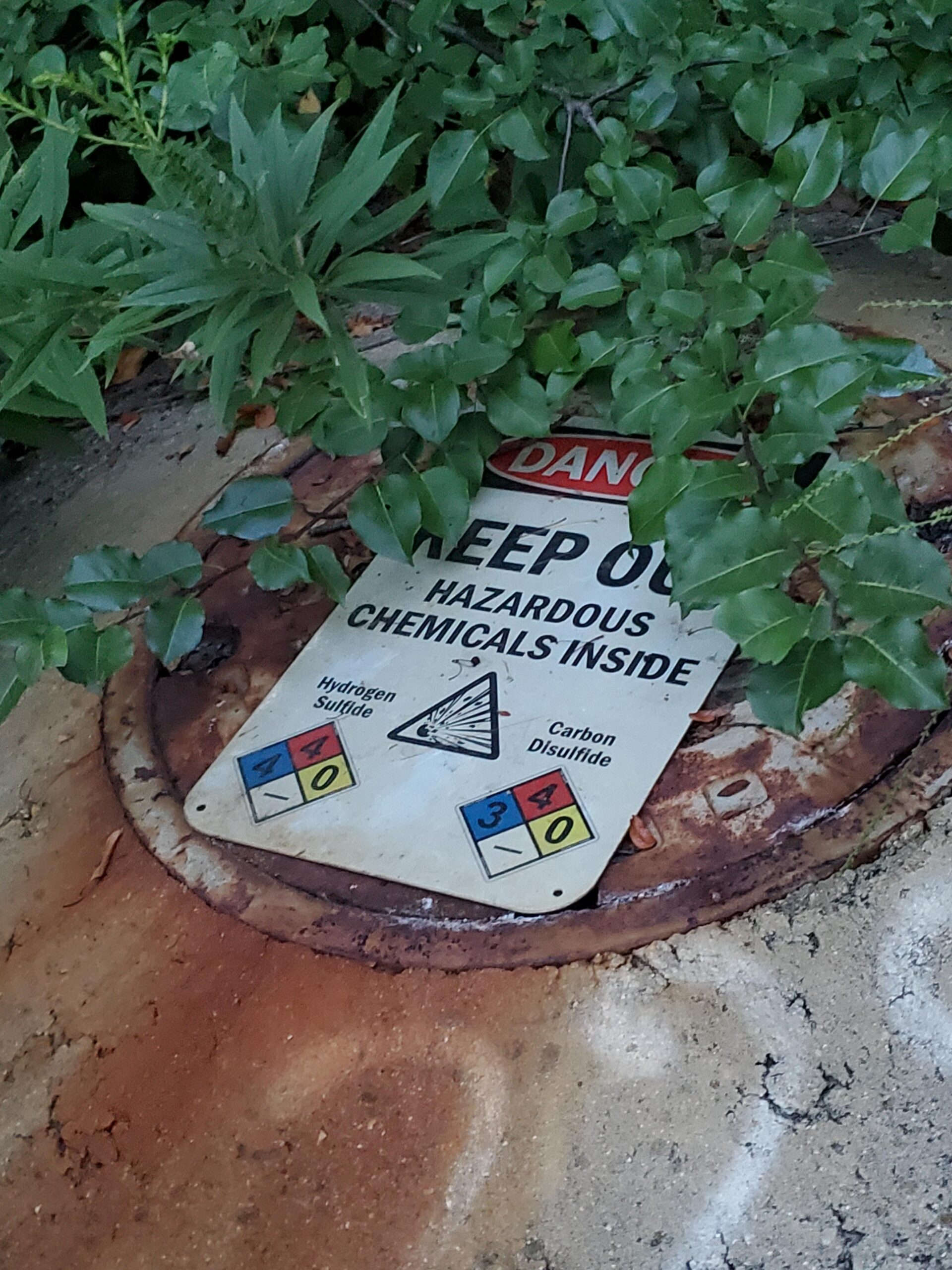
Found this concrete, chemical holding tank thing on our property tucked away in some trees. Anybody have any ideas on what it is and what it may have been used for?
Found this concrete, chemical holding tank thing on our property tucked away in some trees. Anybody have any ideas on what it is and what it may have been used for?
Just did a little googling and found nothing on why those two chemicals would be useful to have in a storage tank for personal use.
I did see *plenty*, though, on why you shouldn’t open it to find out.
I’d look up a local HazMat office and ask them for advice.
ChiTownDerp
Yes it’s Vault 111
SilverFalcon420
Was your property ever part of a large farm or industrial site?
Bobopep1357
Is it a pipeline going through your place?
ttkciar
Both hydrogen sulfide and carbon disulfide are side-products of rayon manufacturing, and highly toxic.
They are also both frequently produced by geothermal vents.
Is your homestead situated near natural hot springs, a geothermal power plant, or a textiles manufacturing facility?
InTheSlimeLight
Might be going out on a limb here, but I think it may have been used to store hydrogen sulfide and carbon disulfide.
Lars_and_Beans
All I have to say is there is a risk if you report this that you could be on the hook for the remediation (environmental clean up) which can be insanely expensive. Happened to a family member when they discovered a buried oil tank. This may not be a concern wherever it is your located but I just thought I’d chime in
jesse-taylor
Have you tried contacting the EPA?
paigeguy
I am so sorry for you. I hope its not too late for you to flee in panic.
PureTerror
That sign doesnt look that old, do you have all of the rights to your land?
IndysITDept
Check your property deed. You may have some responsibility for these chemicals. If the depot was not listed on your deed, you may have other problems.
ShackNastyNick
Hydrogen sulfide is a common byproduct of sewage and septic conditions. No clue about the carbon disulfide. The lid and cement ring look similar to a sewage manhole?
hadtobethetacos
in case it wasnt obvious, the middle icon means it extremely flammible, and will explode.
source: i worked in the oil field. for a long time. dont open that, and as others have said, call a hazardous materials office.
Designer-Wolverine47
Are you sure it’s not just a lid from an old 55 gallon drum?
blackdogpepper
I bet Desmond Hume is in there
tbd_1988
Maybe a tank for a manure biogas system.
BaseballMajestic4917
How long have you owned the property. How about the previous owners? That sign isn’t to terribly old. You should be concerned about the tank leaching into your groundwater.
Hydrogen sulfide is a “one breath and you fall down dead” type chemical at quite low concentrations in air. Do not fuck with it.
I sincerely hope the sign isn’t actually associated with the tank. You wouldn’t store those chemicals in a concrete container. It might be a deliberate mislabeling. Say to help hide somebody’s contraband stash. Or there might have been steel gas bottles inside the concrete bunker in the past, and now it’s empty. Or it could have leaky old bottles in it, and you die if you open it. No way to know!
My best guess for why H2S and CS2 would be used together, anywhere, ever, is for insecticidal fumigation. Perhaps a crop packing facility.
My recommendation is calling the local fire department to determine whether the container is safe to open, so you can figure out if there’s anything in it. They should have appropriate equipment for this. Less of a big deal than calling out the EPA.
Source: I am a chemical engineer who does some chemical exposure occupational safety work professionally in the oil industry. I’ve been trained on H2S safety.
From there you should be able to see a previous owner. In Texas we have the general land office that has property ownership records from the initial surveys. Looking at a map is great for visualizing how the parcels used to be owned and split up.
If you want some help, DM me and I might be able to help you find something.
Xyvexa
That is going to be a hardcore remediation. If you open that lid it might generate a spark and ignite any carbon disulfide in the tank. If that doesn’t kill you. Hydrogen sulfide is a poison inhalation zone B and will corrode your lungs.
That would be considered a confined space. If you for some wild reason decided to open the tank. DO NOT enter it even if it looks empty. You’ll pass out before you know what happened and that will be it. Any family member or friend who sees you go down will likely die as well. Shit happens in Houston TX all the time.
MysteriousTank6825
“It’s just an old crapper tank people “
12stringslinger
If it was an agricultural/farm spot prior to your ownership these are often used for irrigation systems, like a chemical feeder for fertilizers. I’ve been working on a weed farm built on an older hydroponic farm and these are all over the place
Cruisertown
Um, if this wasn’t disclosed when you bought the property there could be trouble. I agree with checking with a local historical society, I would definitely want to know.
Lopsided_procedur3
Hydrogen sulfide is “sewage gas” possibly this is an old septic tank or storage tank for sewage.
ChronicEntropic
Could also be a storage container of some type for benign supplies, and the sign was put on there to deter curious miscreants. I know we put radiation hazard signage all over our facility in Oakland to keep thieves out when we didn’t have all that much dangerous stuff in there at all.
1-11-1974
Carbon disulfide and hydrogen sulfide is used in farming, agriculture,and fumigation so if this was near farmland it was used on the crops. Bad for humans, good for plants
breastfedbeer
Those diamonds are NFPA 704 signs, designed to alert firefighters to hazardous materials bulk storage.
Blue is health hazard.
Red is fire hazard.
Yellow is instability.
Each is rated on a scale of 0-4. Higher numbers are more dangerous.
Carbon disulfide is immediately dangerous to life and health(IDLH) at 500 parts per million(ppm) and it is a flammable liquid.CS2 can be ignited by a light bulb.
Hydrogen sulfide, also known as sewer gas, is significantly more dangerous with an IDLH of 100 ppm and it is also a flammable gas. H2S is notorious and will kill you quickly.High concentrations of H2S can overpower your sense of smell quickly and it is invisible. So you don’t even know you are in the plume and about to die.
The good news is, neither is an exotic chemical or known carcinogen (as far as I know), but they are both acutely highly dangerous.
Source: I’m a firefighter and hazmat technician. Also, I looked up each in the NISOH manual.
I highly recommend you contact an attorney who specializes in environmental law to research the history of this hazmat and advise you on what to do. If you smell rotten eggs or a sweet ether-like odor or otherwise suspect an active leak, evacuate the area, go upwind and uphill, and call 911.
Perenium_Falcon
h2s will fuck you *hard*.
I used to work oil and gas and h2s is one of the few things even the cowboys out there are afraid of.
If there is even a remote chance there is some in there you should stay far far away until it’s remediated.
“According to the Occupational Health and Safety Administration, H2S is one of the leading causes of workplace gas inhalation deaths in the United States”
It smells like rotten eggs at low volume. In fact it’s one of the things that give farts their smell. At higher volumes its odorless and you just die.
“It has also been reported that 50 to 100 ppm causes mild conjunctivitis and respiratory irritation after 1 hour; 500 to 700 ppm may be dangerous in 0.5 to 1 hour; 700 to 1,000 ppm results in rapid unconsciousness, cessation of respiration, and death; and 1,000 to 2,000 ppm results in unconsciousness”
I cannot stress how seriously you need to take that warning placard until the tank is properly sniffed out with the proper sensing equipment and then removed/disposed of.
Enclosed spaces are something you should *never* fuck with as they can kill or incapacitate you fast, and then get the next few people who come in and try to save you. Entire crews have died due to one after the next entering an enclosed space that either has toxic or low air volume.
I was on the Q4000 during the Deepwater Horizon incident, we were working directly over the fucked up BOP and even with thousands of feet of water column between us and the seabed for any escaping gas to disperse we still had h2s sensors chirping all over the boat and flocks of birds all dying mid flight and crashing into the ocean. I was a ROV pilot and had my scba sitting right next to me.
Stay away and call the pros. Don’t leave this on your property if it turns out to be toxic.
Striking_Duty_1609
Curious is that sign affixed to the lis or is it just laying there. Sorry that your todo list just got more complicated.
GeraltsHomeboyDandi
Definitely ask your previous owners if they know. This should’ve definitely been disclosed on signing.

33 Comments
Body storage area
Just did a little googling and found nothing on why those two chemicals would be useful to have in a storage tank for personal use.
I did see *plenty*, though, on why you shouldn’t open it to find out.
I’d look up a local HazMat office and ask them for advice.
Yes it’s Vault 111
Was your property ever part of a large farm or industrial site?
Is it a pipeline going through your place?
Both hydrogen sulfide and carbon disulfide are side-products of rayon manufacturing, and highly toxic.
They are also both frequently produced by geothermal vents.
Is your homestead situated near natural hot springs, a geothermal power plant, or a textiles manufacturing facility?
Might be going out on a limb here, but I think it may have been used to store hydrogen sulfide and carbon disulfide.
All I have to say is there is a risk if you report this that you could be on the hook for the remediation (environmental clean up) which can be insanely expensive. Happened to a family member when they discovered a buried oil tank. This may not be a concern wherever it is your located but I just thought I’d chime in
Have you tried contacting the EPA?
I am so sorry for you. I hope its not too late for you to flee in panic.
That sign doesnt look that old, do you have all of the rights to your land?
Check your property deed. You may have some responsibility for these chemicals. If the depot was not listed on your deed, you may have other problems.
Hydrogen sulfide is a common byproduct of sewage and septic conditions. No clue about the carbon disulfide. The lid and cement ring look similar to a sewage manhole?
in case it wasnt obvious, the middle icon means it extremely flammible, and will explode.
source: i worked in the oil field. for a long time. dont open that, and as others have said, call a hazardous materials office.
Are you sure it’s not just a lid from an old 55 gallon drum?
I bet Desmond Hume is in there
Maybe a tank for a manure biogas system.
How long have you owned the property. How about the previous owners? That sign isn’t to terribly old. You should be concerned about the tank leaching into your groundwater.
I found this
https://pubmed.ncbi.nlm.nih.gov/23504874/
Get some testing kits and open it omg 😭😭😭
Hydrogen sulfide is a “one breath and you fall down dead” type chemical at quite low concentrations in air. Do not fuck with it.
I sincerely hope the sign isn’t actually associated with the tank. You wouldn’t store those chemicals in a concrete container. It might be a deliberate mislabeling. Say to help hide somebody’s contraband stash. Or there might have been steel gas bottles inside the concrete bunker in the past, and now it’s empty. Or it could have leaky old bottles in it, and you die if you open it. No way to know!
My best guess for why H2S and CS2 would be used together, anywhere, ever, is for insecticidal fumigation. Perhaps a crop packing facility.
My recommendation is calling the local fire department to determine whether the container is safe to open, so you can figure out if there’s anything in it. They should have appropriate equipment for this. Less of a big deal than calling out the EPA.
Source: I am a chemical engineer who does some chemical exposure occupational safety work professionally in the oil industry. I’ve been trained on H2S safety.
You could look at your county appraisal district website. https://publicrecords.netronline.com/state/IL
From there you should be able to see a previous owner. In Texas we have the general land office that has property ownership records from the initial surveys. Looking at a map is great for visualizing how the parcels used to be owned and split up.
If you want some help, DM me and I might be able to help you find something.
That is going to be a hardcore remediation. If you open that lid it might generate a spark and ignite any carbon disulfide in the tank. If that doesn’t kill you. Hydrogen sulfide is a poison inhalation zone B and will corrode your lungs.
That would be considered a confined space. If you for some wild reason decided to open the tank. DO NOT enter it even if it looks empty. You’ll pass out before you know what happened and that will be it. Any family member or friend who sees you go down will likely die as well. Shit happens in Houston TX all the time.
“It’s just an old crapper tank people “
If it was an agricultural/farm spot prior to your ownership these are often used for irrigation systems, like a chemical feeder for fertilizers. I’ve been working on a weed farm built on an older hydroponic farm and these are all over the place
Um, if this wasn’t disclosed when you bought the property there could be trouble. I agree with checking with a local historical society, I would definitely want to know.
Hydrogen sulfide is “sewage gas” possibly this is an old septic tank or storage tank for sewage.
Could also be a storage container of some type for benign supplies, and the sign was put on there to deter curious miscreants. I know we put radiation hazard signage all over our facility in Oakland to keep thieves out when we didn’t have all that much dangerous stuff in there at all.
Carbon disulfide and hydrogen sulfide is used in farming, agriculture,and fumigation so if this was near farmland it was used on the crops. Bad for humans, good for plants
Those diamonds are NFPA 704 signs, designed to alert firefighters to hazardous materials bulk storage.
Blue is health hazard.
Red is fire hazard.
Yellow is instability.
Each is rated on a scale of 0-4. Higher numbers are more dangerous.
Carbon disulfide is immediately dangerous to life and health(IDLH) at 500 parts per million(ppm) and it is a flammable liquid.CS2 can be ignited by a light bulb.
Hydrogen sulfide, also known as sewer gas, is significantly more dangerous with an IDLH of 100 ppm and it is also a flammable gas. H2S is notorious and will kill you quickly.High concentrations of H2S can overpower your sense of smell quickly and it is invisible. So you don’t even know you are in the plume and about to die.
The good news is, neither is an exotic chemical or known carcinogen (as far as I know), but they are both acutely highly dangerous.
Source: I’m a firefighter and hazmat technician. Also, I looked up each in the NISOH manual.
I highly recommend you contact an attorney who specializes in environmental law to research the history of this hazmat and advise you on what to do. If you smell rotten eggs or a sweet ether-like odor or otherwise suspect an active leak, evacuate the area, go upwind and uphill, and call 911.
h2s will fuck you *hard*.
I used to work oil and gas and h2s is one of the few things even the cowboys out there are afraid of.
If there is even a remote chance there is some in there you should stay far far away until it’s remediated.
“According to the Occupational Health and Safety Administration, H2S is one of the leading causes of workplace gas inhalation deaths in the United States”
It smells like rotten eggs at low volume. In fact it’s one of the things that give farts their smell. At higher volumes its odorless and you just die.
“It has also been reported that 50 to 100 ppm causes mild conjunctivitis and respiratory irritation after 1 hour; 500 to 700 ppm may be dangerous in 0.5 to 1 hour; 700 to 1,000 ppm results in rapid unconsciousness, cessation of respiration, and death; and 1,000 to 2,000 ppm results in unconsciousness”
I cannot stress how seriously you need to take that warning placard until the tank is properly sniffed out with the proper sensing equipment and then removed/disposed of.
Enclosed spaces are something you should *never* fuck with as they can kill or incapacitate you fast, and then get the next few people who come in and try to save you. Entire crews have died due to one after the next entering an enclosed space that either has toxic or low air volume.
I was on the Q4000 during the Deepwater Horizon incident, we were working directly over the fucked up BOP and even with thousands of feet of water column between us and the seabed for any escaping gas to disperse we still had h2s sensors chirping all over the boat and flocks of birds all dying mid flight and crashing into the ocean. I was a ROV pilot and had my scba sitting right next to me.
Stay away and call the pros. Don’t leave this on your property if it turns out to be toxic.
Curious is that sign affixed to the lis or is it just laying there. Sorry that your todo list just got more complicated.
Definitely ask your previous owners if they know. This should’ve definitely been disclosed on signing.