
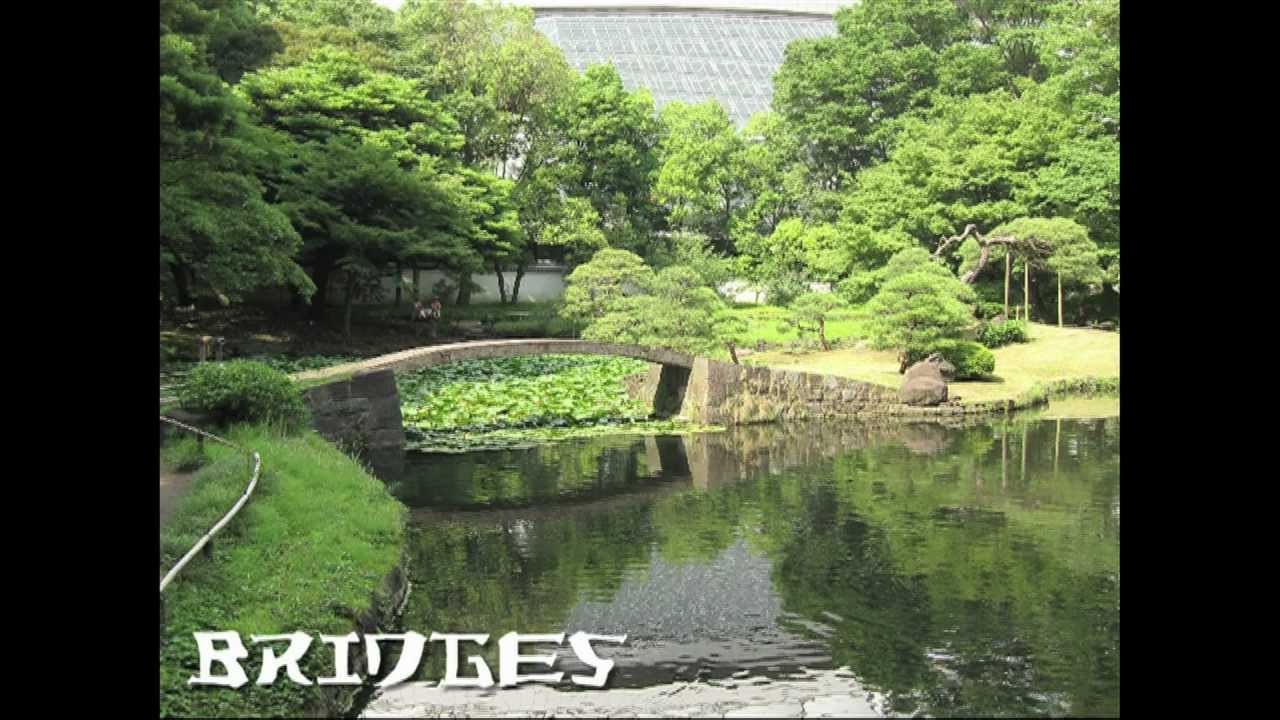
Part 1- teaches you the various components of Japanese Gardens.
Part 2- teaches you how to design Japanese Gardens using these components. Here: http://www.youtube.com/watch?v=46UDBAYnD04
Transcript
“Everyone loves Japanese gardens! I’m going to show you how to design them!”
This first video will show you the various elements of a Japanese garden and part 2 will show you how to design using these elements.
First a few principals of Japanese garden designs. Japanese gardens are traditionally designed to be a natural place for rest and relaxation and are not driven by ego. They exercise restraint and modesty. This doesn’t mean be boring, be Modest. Also part of the reason Japanese gardens feel so different is that there is often no geometric order that we are so used to seeing in gardens.
So lets get started. Here are some really interesting and traditional elements of Japanese gardens. These are garden components designed to be idealised representations of the landscape of Japan.
Water
Water is an extremely important part of Japanese Gardens. Water bodies were used to represent lakes, rivers, oceans and swamps. An important tip however for Japanese Gardens is to not show the entire water body. Have it disappearing around a corner or behind rocks.
A unique alternative to rocks however is the use of sand or granite aggregate to represent water. Often these are combed into shapes or patterns and are referred to as dry gardens.
Rock work
Waterbodies were often accompanied by large boulders or rocks representing the islands and mountains of Japan. Boulders can be clustered together or kept singular, like real islands, and they were often covered of partially covered in moss or vegetation. It is very important to bury the rocks two thirds deep to create the most natural looking rockwork.
Waterfalls.
Waterfalls were used regularly and often it was created in the valley between two rock mountains.
Hills
Hills were often created out of the left over soil from digging the pond. Traditionally 3 or 4 hills of different sizes were the best arrangement and a representation of Mt Fuji was considered to be most desirable.
Lets have a look at some of the features of Japanese gardens that aren’t idealised representations of the Japanese Landscape.”
For full transcript message me and I will get it to you ASAP! Thanks
24 Comments
Japanese gardens are beautiful, thanks for the info Tom!
very interesting, thanks
Fighting to hear you over the music, pity.
Excellent material that is concisely presented. However, perhaps you may want to make a new one without the music?
Hey, Isn't that the Japanese Garden Park in San Francisco?
Thanks for sharing the various components in building a Japanese Garden. Your video made me realize I should try it at home too and to my other known friends. I will watch the Part 2!
Great video… Thanks for sharing.
Nice video!
Was surprised that Hamburg appeared in the video!
I hope my parents will let me make a Japanese themed garden in our backyard. will it work still with a fence surrounding the garden? thanks
Maybe a few rocks placed in the shape of a turtle would be nice & I love those moss carpets. Maybe slowly I can change my backyard into a Japanese style Eden.
Awful camera work and background music. Cannot watch it.
The Teahouse at 3:56 is the one in the Cowra Japanese Gardens, NSW.
please … i'm beggin u .. I want full transcript if u can please tell me u still there
Do you have a books or anything that explain or something like a tutorial teachable vidoes for Lanscaping and garden design.
Good grief that music is terrible. I can't even hear half of what you're saying because of it T_T.
Beautiful stuff. It's got me feeling very inspired. I even wrote about it.
https://soundplaceandtime.blogspot.com/2018/06/zen-art-of-garden-maintenance-kyoto.html
Beautiful! But much more ambitious than we have room for.
the background music is so annoying , I had to stop listening thus losing a major part of the message. I never understood :What purpose does the music, sound or any irrelevant noise serve?
Love their gardens.
Can’t handle that music. Sorry cannot subscribe.
Beware of bamboo or worse kudzu and knotweed. They are amazing plants and very useful, but can get out of hand fast and are some of the worst plants to permanently remove… Where I live, the latter two are illegal to plant. I'd also like to point out that you can use special barriers to restrict plants that spread via their roots, but it's not foolproof…
good content
I hope you keep update 🙂
Thanks so much for this video. Thinking of using it with my landscape design students here in France. Would it be possible to have the full transcript? Congratulations for your work, very interesting and accessible for foreign students as well!
Hello my fellow students watching this I'm oreo