
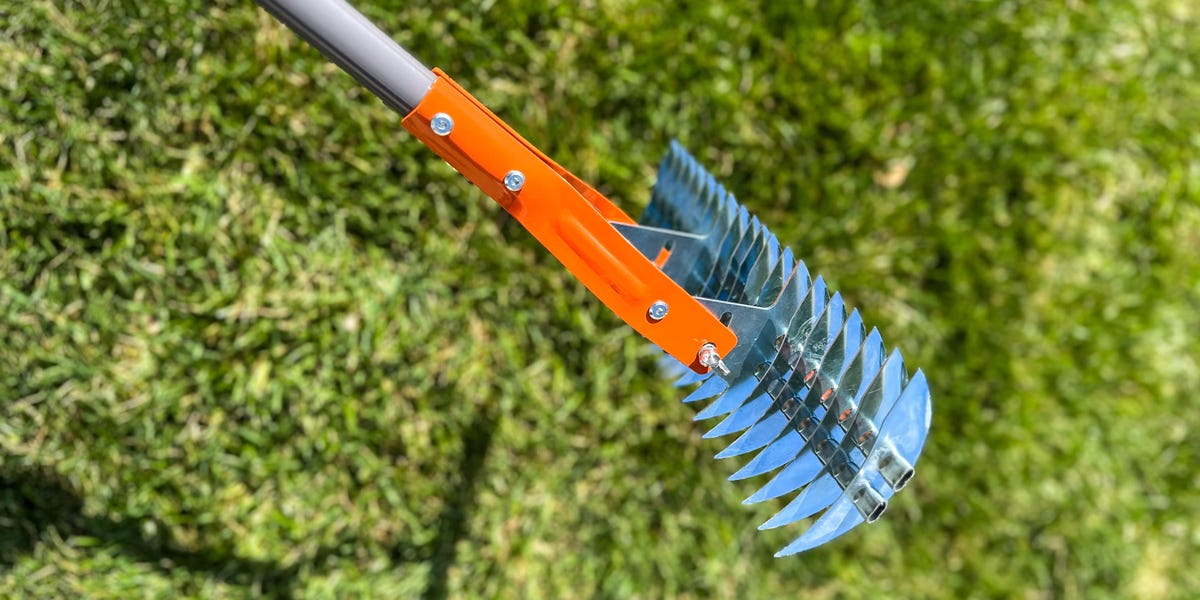
 5 min readSharp tines effectively pull up dead grass, mulched leaves, roots, and debrisThe rake’s sectional handle makes it versatile and easy to storeIt’s an affordable tool for an annual task
My lawn has a problem. A thick layer of organic material—thatch— built up on the soil surface over the winter. A thin layer of thatch is healthy, but if it gets too thick it can suffocate your grass and prevent air and water from getting to the roots. The solution is to remove this layer with a dethatching rake. It’s necessary task needed to give my lawn the boost it needs each spring, however, it’s a physically demanding chore that I loathe.
I wanted something more robust than a metal rake to handle the job, but I didn’t want to spend a lot of money for a tool that I knew I’d only use once a year. Motorized dethatchers, which look like modified lawn mowers, are great, but spending upwards of $150 didn’t make sense for me and those are best for larger lawns. Plus, I have no room in my garage for one of these machines.
What first attracted me to the Walensee 15-inch rake was its reasonable cost. It was worth testing to find out if it could get the job done for an affordable price. What I discovered is that while it may lack the durability and overall build quality of rakes that cost two or three times as much, it proved to be a more than adequate tool for dethatching my lawn, and was certainly a respectable choice for my annual dethatching chore.
Solid Results in 30 Minutes
A sign of a decent manual dethatcher is how well it pulls up dead grass, debris, roots, moss, and leaves. In that aspect, the Walensee performs quite well. Keep in mind that dethatching one’s lawn with a rake is not a task that I’d classify as easy. Thatch clings to the soil surface, and it’s generally reluctant to move from that spot, so pulling it up with any rake is going to be hard work. A dethatching rake makes this chore more doable, but it’s still a workout.
Related Story
One of the keys to pulling out thatch efficiently without pulling out a chunk of healthy grass is setting the angle of the head just so that it bites into thatch without pulling up turf. The Walensee’s head is adjustable which allows for finding that perfect angle. And since the adjustment uses wing nuts, I was able to make small changes to the head angle without having to go hunting for a wrench. I do wish the nuts would lock a little more securely in place, as they did work themselves loose after some extended raking efforts.
Once I got to work, the Walensee rake proved to be efficient. The rake has curved, half-moon shaped tines that bite deeply into thatch. After only 30 minutes of effort, I had pulled up large mounds of thatch in my front yard, a far better result than I’ve had using a standard metal rake, and similar in performance to other dethatching rakes I’ve tested.
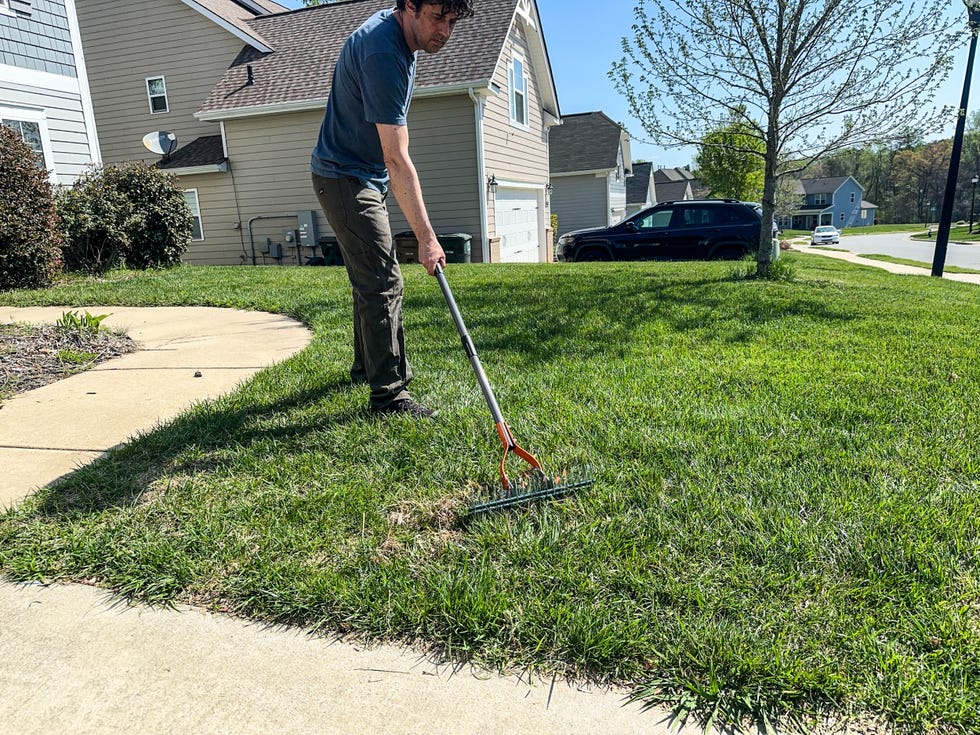 Anthony Carrick
The rake’s adjustable handle is an advantage for households with more than one willing dethatching participant since it can accommodate varying heights.
Average Build, But Adjustable
The Walensee dethatching rake is one of the more affordable dethatching rakes out there, and part of that has to do with its build quality. Don’t get me wrong, it’s a well-made rake in the areas that are most important for this type of tool. The head is made from thicker gauge stainless steel that feels just as durable as that of pricier rakes. It didn’t show any surface rust even when I intentionally left the tool out in the rain for a day.
Related Story
That said, there were a few build quality issues that negatively impacted performance. The handle comes in four separate sections that you thread onto each other and hand tighten. This design allows you to adjust the length of the rake from 40 inches to 70 inches in 15-inch increments. Essentially, you can add or remove a section from the handle to dial in the most comfortable height.
It’s a feature that would be a bigger deal to me if my wife had any interest in helping with the annual dethatching chore. She doesn’t. Even so, the adjustable handle is certainly an advantage for any household that has two willing dethatching participants of varying height.
The challenge with this multi-piece handle design is that it doesn’t always hold together well. Since the handle sections only hand tighten together, they tended to loosen over time, which required me to retighten the handle mid job. While this wasn’t a huge issue, it’s not a problem you’ll encounter with a higher-end wood-handled dethatching rake.
My Verdict
The Walensee dethatching rake performed exactly as I hoped. It pulled up thatch about as well as any rake I’ve tested, as the piles in my yard illustrate, and it offers the versatility of having an adjustable handle length. While it may not be as durable as pricier dethatching rakes, the Walensee is built substantially enough to handle the one or two times a year I’ll use it to dethatch my lawn or to help smooth out my garden soil prior to planting. Given that it retails for around $40, and can sometimes be found on sale for as little as $30, it’s a great deal.
In certain cases, it might make sense to upgrade to a higher-end rake. If you have a larger area to cover, denser thatch to lift, or need to dethatch more often, then you might want to upgrade to either a wood-handled rake or an electric dethatcher. The latter is also a smart alternative if using a dethatching rake is too physically demanding.
Benefits of Dethatching Your Lawn
There are several good reasons to make the effort to dethatch your lawn. By thinning out that layer of thatch, you’re making it easier for air, water, and nutrients to reach your grass roots, which makes for a healthier lawn. You’re also removing material that is prime nesting ground for thatch-loving pests like ants, armyworms, and chinch bugs.
When To Dethatch
Generally speaking, you should dethatch once a year, but it can vary depending on how much thatch your lawn produces. It can also be done in the fall before the first snow—late September or early October in many cases.
A 1/2-inch or less layer of thatch is healthy for your lawn as it feeds your lawn and helps to shield the soil against temperature extremes. If it gets thicker than that, it’s time to dethatch. Remove a plug of small shovel full of soil from your yard and measure the thatch layer to see if you need to dethatch.
More Dethatchers We Recommend
Best Overall
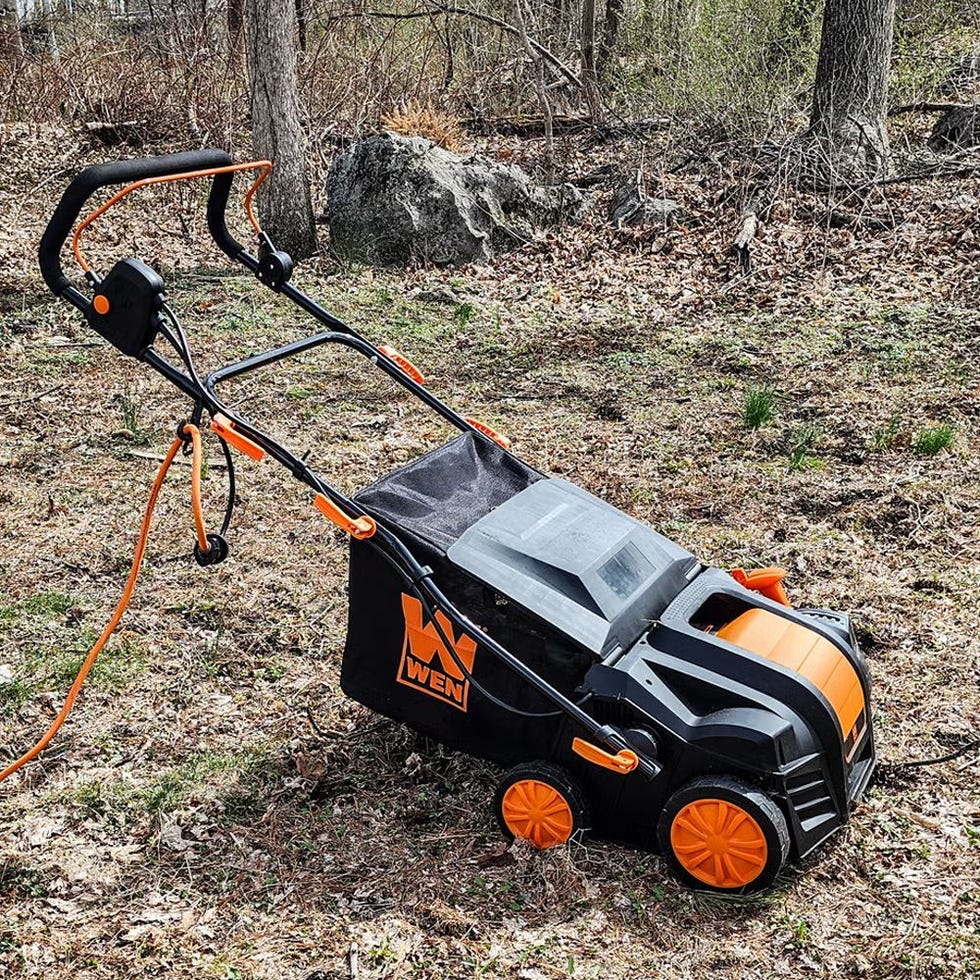
Wen
16-Inch, 15-Amp 2-in-1 Electric Dethatcher and Scarifier
This corded electric dethatcher removes large amounts of thatch with ease and is also capable of scarifying your lawn.
Most Durable Rake
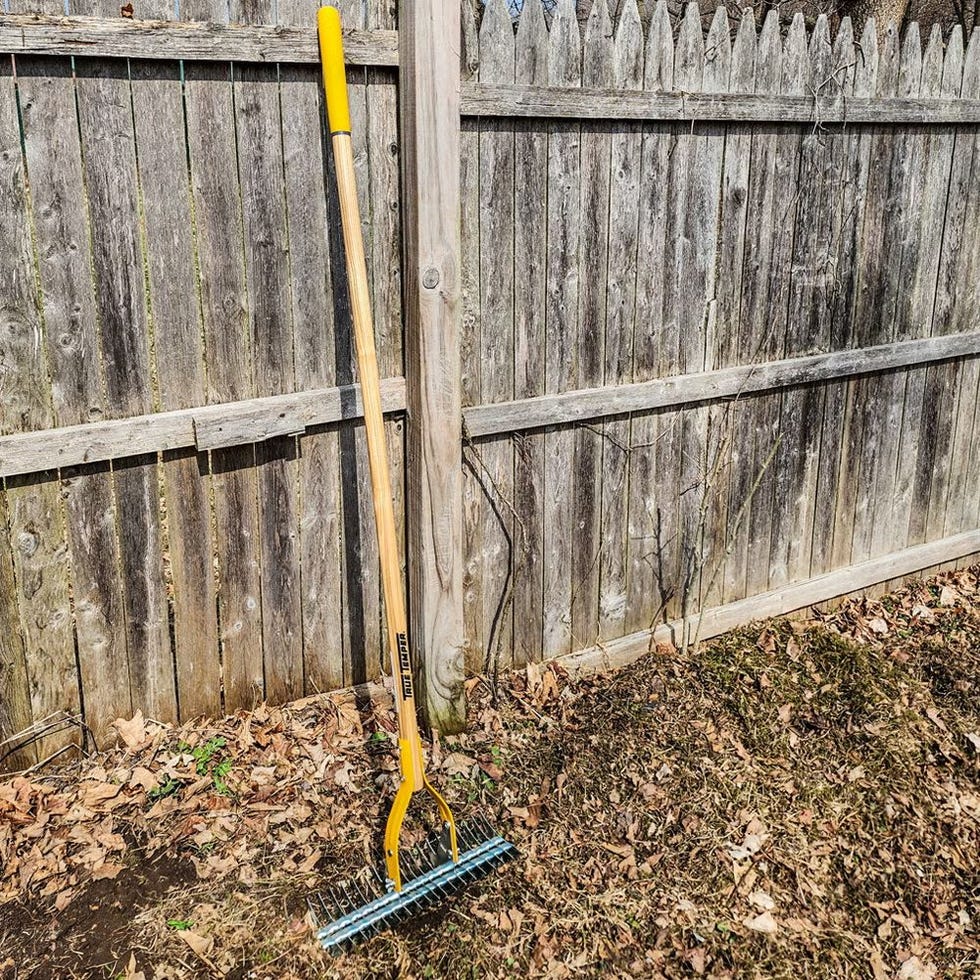
This heavy duty thatch rake features a hardwood handle and an adjustable head.
Best Cordless
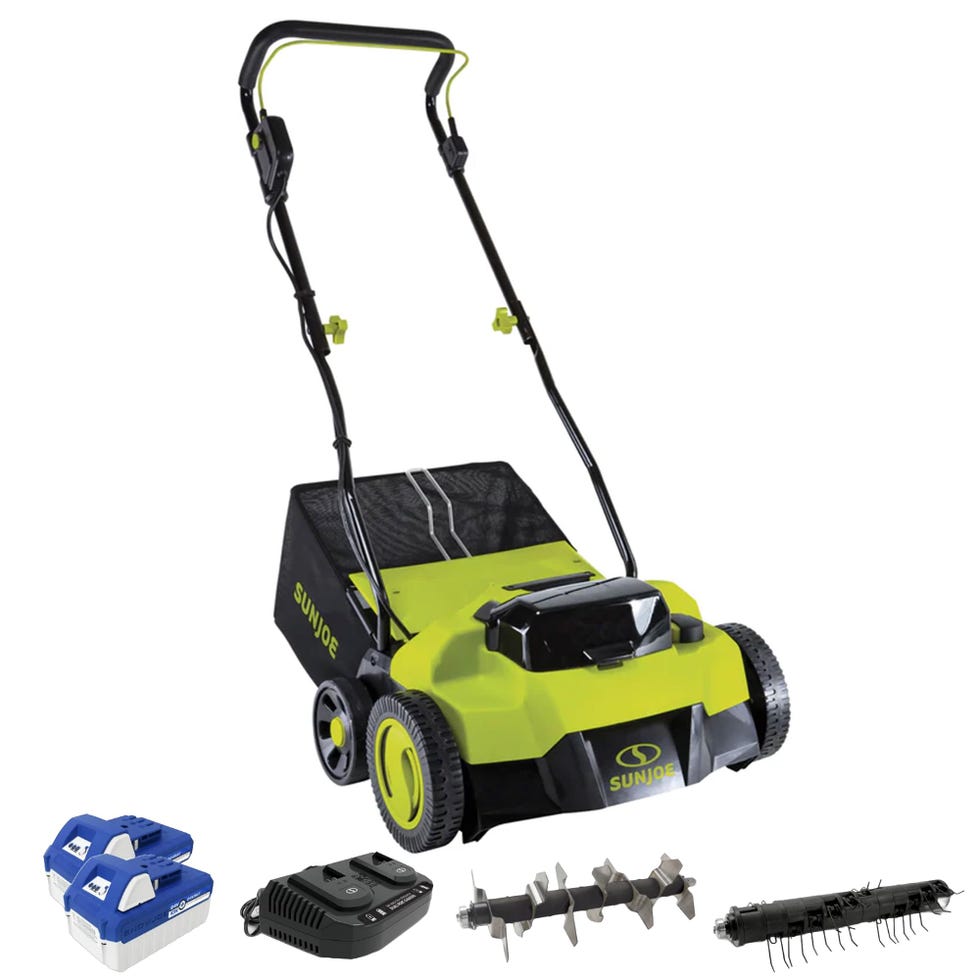 Sun Joe Cordless Scarfier and Dethatcher
Dethatch the average-sized yard on a single charge with this cordless model. It has five depth settings.

Tony Carrick is a full-time freelance writer who specializes in technology, home improvement, DIY, home security, and outdoor recreation. He’s tested and written about everything from home security systems to power tools to gas grills. His product guides, how-to articles, and feature stories can be found in such publications as Bob Vila, Angi, U.S. News and World Report, Field & Stream, Futurism, and Switchful. When Tony isn’t writing, he can be found working on his latest home improvement effort at his home in North Carolina.

Jamie, Senior Reviews Editor, joined the Hearst Enthusiast Group in 2021. She has covered technology and consumer lifestyle gadgets since 1995—and shared her expertise in print, digital, and in broadcast originating the role of The Gizmo Girl for ESPN’s Cold Pizza. She has written about, tested, and reviewed everything from turkey fryers to high-definition TVs. Her byline has appeared in TWICE, Sound & Vision, Consumer Reports, and many others. In her free time, Jamie is in a yoga class, searching for the perfect matcha latte, or walking the boards.
Comments are closed.