
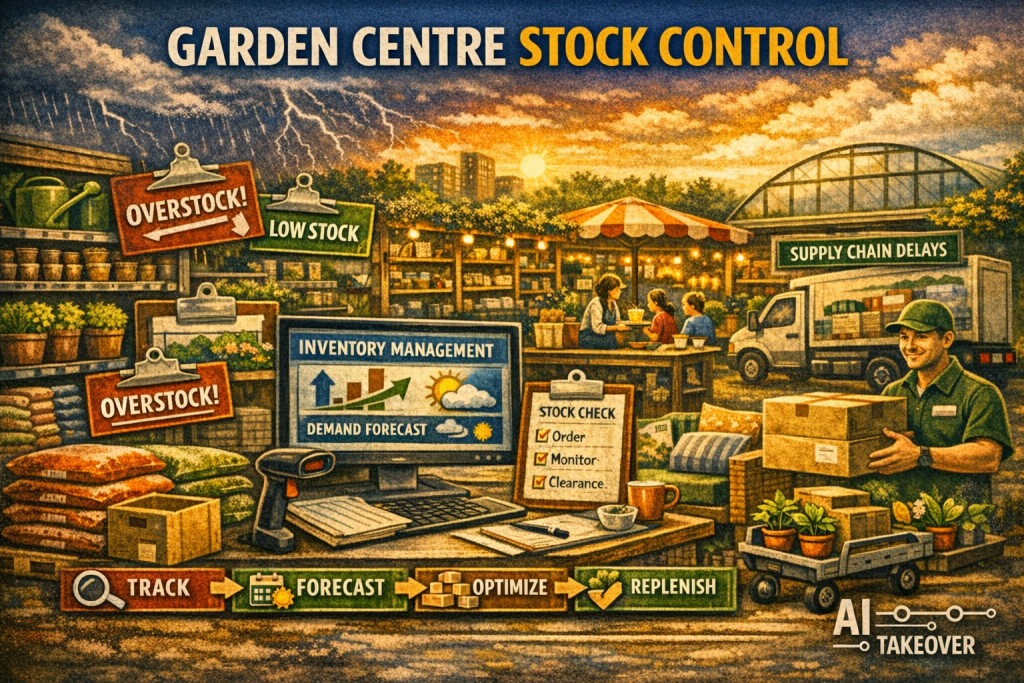
Each day in April, Garden Centre Retail will be posting an article ‘written’ by AI, following a list of topics that affect the garden retail landscape in the UK. Today’s topic is stock control.
Stock control has become one of the most strategically important issues for UK garden centres, and its significance is only growing as the sector heads into another year shaped by unpredictable weather, shifting consumer behaviour, and rising operational pressures. The ability to hold the right stock, in the right quantities, at the right time is no longer just an efficiency question; it is a core driver of profitability, customer satisfaction, and resilience. As April approaches and peak season intensifies, the consequences of poor stock control become sharper, while the benefits of getting it right become far more meaningful.
What Garden Centres Are Experiencing Today
Across the UK, garden centres are experiencing a familiar but increasingly complex mix of overstocking, understocking, and inconsistent sell‑through. Seasonal products are arriving too early or too late, tying up cash or missing demand entirely. Core lines are running out at critical trading moments, frustrating customers who expect reliability and choice. Teams are spending more time than ever manually checking stock, reconciling discrepancies, and firefighting issues that should be predictable. The volatility of British weather continues to distort footfall patterns and buying behaviour, making traditional forecasting methods less reliable. Meanwhile, supply chain delays and labour shortages are creating gaps that ripple through the business long after the initial disruption.
The Drivers Behind Stock Control Challenges
The root causes of these stock control challenges are varied but interconnected. Weather unpredictability has become a major driver, with sudden warm spells or prolonged cold snaps dramatically altering demand for plants, compost, chemicals, and outdoor living products. Consumer behaviour is also shifting, with customers increasingly expecting instant availability and a broader range of options, influenced by online retail norms. Supply chains remain fragile, with growers and manufacturers facing their own labour and cost pressures, which in turn affect lead times and product consistency. Many garden centres are also working with legacy systems or manual processes that simply cannot keep pace with the speed and complexity of modern retail. In some cases, buying decisions are still based on habit or intuition rather than data, leading to misalignment between stock levels and real demand.
Opportunities Hidden Within the Challenge
Despite these challenges, there are significant opportunities hidden within the stock control issue. Centres that improve forecasting accuracy can reduce waste, free up cash, and increase margin by aligning stock more closely with customer demand. Better visibility of stock movement can help identify slow sellers earlier, enabling more proactive markdowns or merchandising adjustments. Stronger supplier relationships can lead to more flexible ordering patterns, reducing the need to hold excessive safety stock. There is also an opportunity to differentiate through reliability; customers who know a centre consistently has what they need are far more likely to return. For centres with a strong sustainability focus, improved stock control can reduce waste, shrinkage, and unnecessary transport, supporting both environmental goals and brand reputation.
Practical Steps to Strengthen Stock Control
Practical actions can make a meaningful difference, even without major system overhauls. Reviewing historical sales patterns alongside recent trading behaviour can help refine ordering decisions, especially when combined with local weather trends. Improving communication between buying, plant area, and shop floor teams ensures that stock issues are spotted earlier and acted on quickly. Regular, structured stock checks—rather than ad‑hoc counts—can reduce discrepancies and improve confidence in system data. Working more closely with suppliers to understand their constraints and lead times can support more accurate planning. Many centres also benefit from tightening their product ranges, focusing on depth rather than breadth in key categories to reduce complexity and improve availability. Clearer merchandising and better stockroom organisation can reduce the time staff spend searching for items, improving both efficiency and customer experience.
How Leading Garden Centres Are Responding
Leading garden centres are approaching stock control with a more strategic mindset. They are investing in systems that provide real‑time visibility of stock levels, sales performance, and replenishment needs. Their buying teams are using data to guide decisions, identifying patterns that would be impossible to spot manually. They are also building stronger partnerships with growers and suppliers, sharing information to improve forecasting and reduce uncertainty. Some are adopting more agile ordering practices, placing smaller but more frequent orders to stay responsive to changing conditions. These centres treat stock control not as an administrative task but as a commercial discipline that directly influences profitability and customer loyalty.
Where AI Can Support Smarter Stock Decisions
AI is beginning to play a role in this area, offering tools that can analyse sales patterns, predict demand based on weather forecasts, and highlight anomalies in stock movement. For centres with large product ranges, AI can help identify which lines are likely to overperform or underperform, supporting more confident buying decisions. It can also assist with replenishment planning, suggesting optimal order quantities based on real‑time data rather than static assumptions. While AI is not a replacement for human expertise, it can significantly enhance decision‑making and reduce the manual workload that often overwhelms teams during peak season.
What the Future Holds for Stock Control
Looking ahead, stock control will only become more important as the sector faces continued cost pressures, evolving customer expectations, and increasingly unpredictable trading conditions. Centres that invest time and attention into improving their stock management now will be better positioned to navigate future challenges and capitalise on emerging opportunities. The gap between centres that manage stock well and those that struggle is widening, and the commercial implications are becoming more pronounced.
The core insight is that stock control is no longer a back‑office function; it is a strategic capability that shapes the entire customer experience and underpins financial performance. Centres that treat it as such will be the ones that thrive in the seasons ahead.
Comments are closed.