
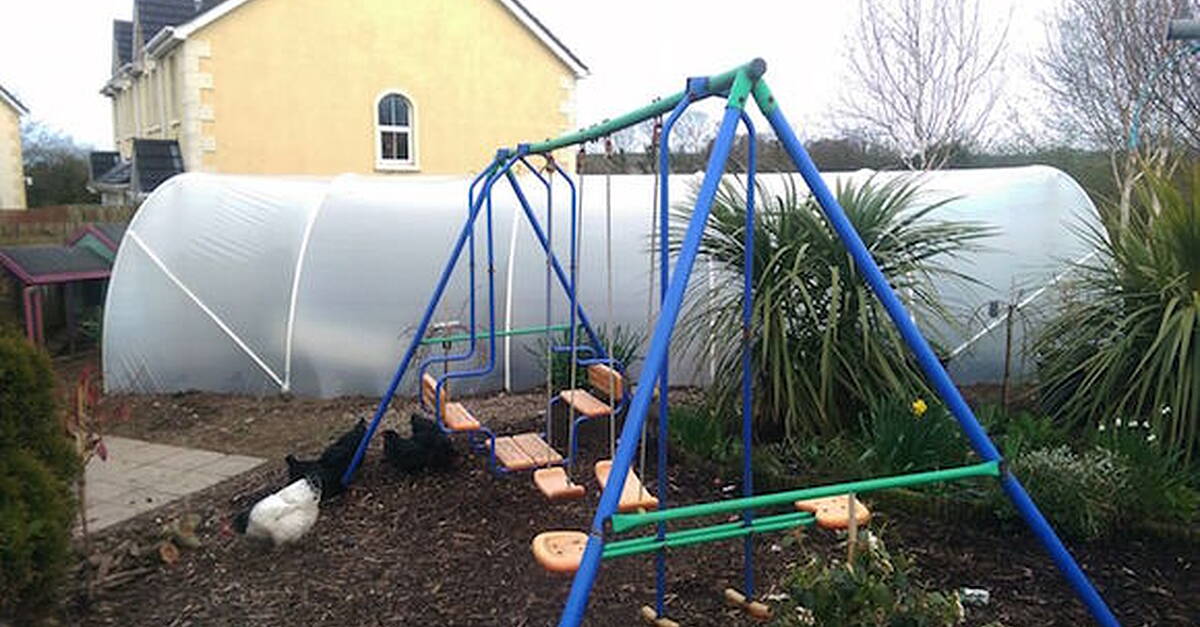
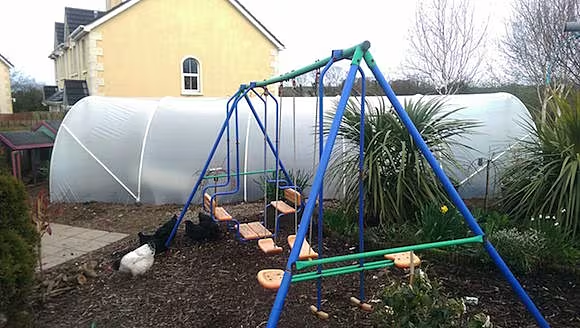
 Earlier this year when my polytunnel first went up.
Polytunnels, a point of dispute amongst gardeners, some think they’re ‘ugly’ others see them as essential bits of kit. One thing can’t be disputed, a Polytunnel allows you to both garden all year round, and be transported a thousand miles south.
Polytunnels aren’t as pretty as Glasshouses. I don’t think many people will disagree with that statement, an elegant garden glasshouse can be a thing of beauty, like a Brunel bridge, its workmanship and elegance can be something to admire. Where a Polytunnel is the army bridge, a functional product, brought about by necessity and meeting its objectives without fanfare.
For a small garden a glasshouse is the obvious choice, where you have space for a 8’x6’ structure a glasshouse can be easily fitted into a sunny corner and will be immensely productive.
But go above the 10’x12’ size and you’re into serious money and this is where Polytunnels come into their own. You get more Polytunnel for your buck, add in the lower maintenance costs , (anyone who has owned a glasshouse will be familiar with the need to annually replace glass panels) and the Polytunnel works out as good value.
The shape of the polytunnel leads itself to the climate in our part of the world too, its more aerodynamic with its dome shape, allowing it to be more wind tolerant than a glasshouse, and in turn not requiring as much shelter in situ, indeed I’ve seen videos of Polytunnels during a gale force winds flexing and puffing away – where as a Glasshouse would have every pane of glass gone.
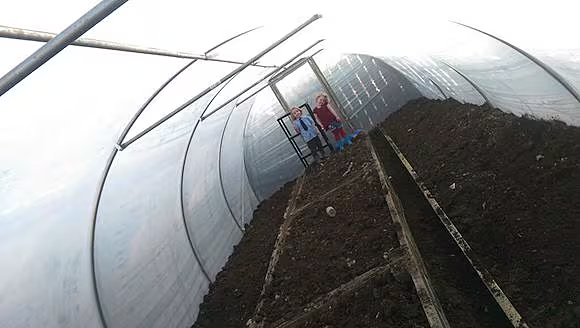 Getting the beds set up inside my tunnel
But the question I posed at the start ‘is it worth it?’, this is something I’ve just worked out for my own garden this year. Having gardened for the past 10 years with no protection, working up over these years from 3 raised beds to 9.
I decided to make the leap and put a polytunnel up in my own back garden. I opted for a 10’x30’ as it would fit the side of the house perfectly. I couldn’t fit a tunnel any wider – as (a) I didn’t have any more space & (b) When you go wider than 10’ the tunnels get higher – great for Horticulture but not great when you live in a housing estate – I wanted to keep the visual intrusion from the tunnel down.
I worked out that :
The Polytunnel would increase by total crop output by 140% – as it would lengthen my season of production, broaden my production range and quicken my cropping. Also it would make any gardening more enjoyable as I’d be out the rain doing it!
Also I can use the Polytunnel for drying clothes in the winter (I know not a Horticultural reason but a good idea all the same!), I could house my hens in the tunnel in the winter – thus stabilising egg production.
I think in a climate like what we have here a Polytunnel is a necessity for anyone looking to grow some serious veg or plants. However they’re not without their downfalls. We mentioned before the visual downside but also when it comes to Polytunnels everything which is bad also grows quickly, so fungal diseases can be an issue owing to the tunnel being constantly warm and damp, pollination can be an issue if there’s not enough ventilation, the crop is entirely dependent on you the gardener to do all the watering.
We’ll cover in future weeks more of managing pests and diseases in polytunnels, but the number 1 place to start is on ventilation…..I’ll say it again ventilation. Open the doors and leave them open, this supply of fresh air will help reduce disease, improve pollination, increase biodiversity, bring carbon dioxide in for photosynthesis and take the oxygen out.
Here in the North West we are fortunate to have a company who makes (and erects) Polytunnels of all shapes and sizes – Gillespie Polytunnels – based near Ballybofey in County Donegal.
You may also be interested in


Dean Gillespie has a great show site at his engineering business where he has a range of polytunnels built, all planted up with delicious fruits and vegetable and all laid out inside in different styles – some with raised beds, some concrete some plain soil beds.
A visit to Dean is worth it to see these different methods of planning the inside, but to also see the different heights, widths and the likes you can get. For details see www.gillespiepolytunnels.com .
So to simplify Is a Polytunnel worth it….Yes!.
Our Garden of Focus this week is the organic garden of Paddy McCartney in Greencastle.
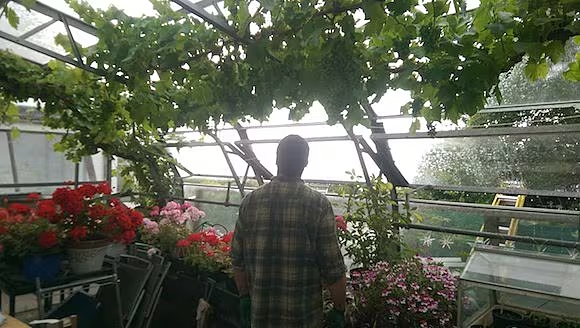 The Vinery in Paddys Garden
Not open to the public….yet…but soon it will be. Paddy’s garden is situated in the scenic Greencastle area of Donegal, and the garden itself enjoys views across the Foyle to Benone and Magilligan on a gentle slope.
Paddy is a long-term member of the Irish Seed Savers, a garden centre pioneer of the early 80’s, fully organic vegetable grower, and a recently retired Secondary School science teacher – this combination gives Paddy a vast knowledge of Horticulture, which is evident in the garden at Shroove.
Paddy’s garden is split into 3 sections. The front Garden with its packed borders of nectar rich perennials and strategically planted Artichokes for drama, the upper back garden with its wildlife pond, more nectar rich planting and a Vinery and then the lower garden with its 2 rooms of raised vegetable beds, extensive fruit gardens and beehives.
The ornamental planting is very Robertsonian in its approach, by this I mean there is little bare soil being exposed, the borders are full to bursting with foliage and flowers – the flowers chosen to attract wildlife and to offer as much biodiversity as possible in the garden, something which can be seen by the array of butterflies, moths and insects hopping about the garden.
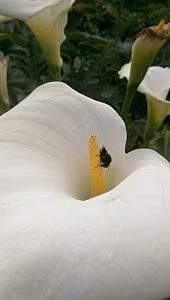 Bees in Paddy’s garden
The back garden is what most attracts people to Paddys garden in Greencastle, first you have the Vinery full of Black Hamburg grapes which Paddy uses as his potting and propagating house, outside this there is large cold frames and more standing area for plants.
The upper back garden contains a small wildlife pond, surrounded by perennials and evergreens – these evergreens offer shelter and protection for birds. Then you follow the path through a small gate and then boom….the first of the vegetable rooms appear in front of you. Long raised beds full of Raspberries and Strawberries, more beds full of rocket, Kohl Rabi, Herbs, Peas, Potatoes decorate each side of the gravel path which leads to a large escallonia hedge and then behind this more raised beds full of lush produce, and below these a small gate which opens into a field containing some Bee-hives. All in all there must be 200ft of raised beds all together….an impressive show!
As mentioned before Paddy is a committed organic grower, so he has large beds of Comfry for making fertiliser with, composting areas are found in every section of the garden, he has the aforementioned focus on biodiversity- which attracts natural predators into the garden to control unwanted bugs, he also only uses recycled rainwater to water all his beds and tunnels (large collection drums gather water from the house roof, which is piped then to the lower garden).
Myself and a group of Horticulture students have been working on the garden over the past few weeks, helping get new paths re-laid, beds revitalised and helping to get the garden back into ship-shape again.
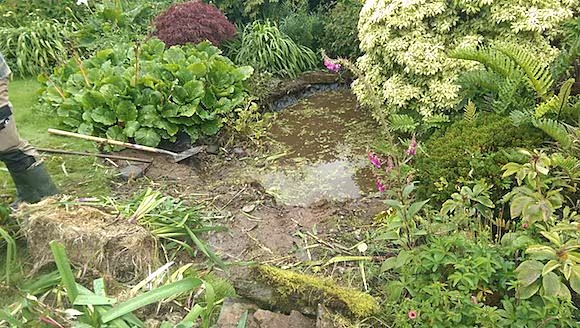 Replanting the wildlife pond in Paddy’s garden
Paddy hopes to re-open his garden to the public in 2016….and it should be a defo visit on your bucket list!
 Gareth Austin
Gareth Austin is resident Horticulturist with BBC Radio Foyle, a member of the Chartered Institute of Horticulturists and Horticultural Lecturer with the National Learning Network. For more see www.garethaustin.com or join Gareth on Twitter @GardenerGareth .
Comments are closed.