
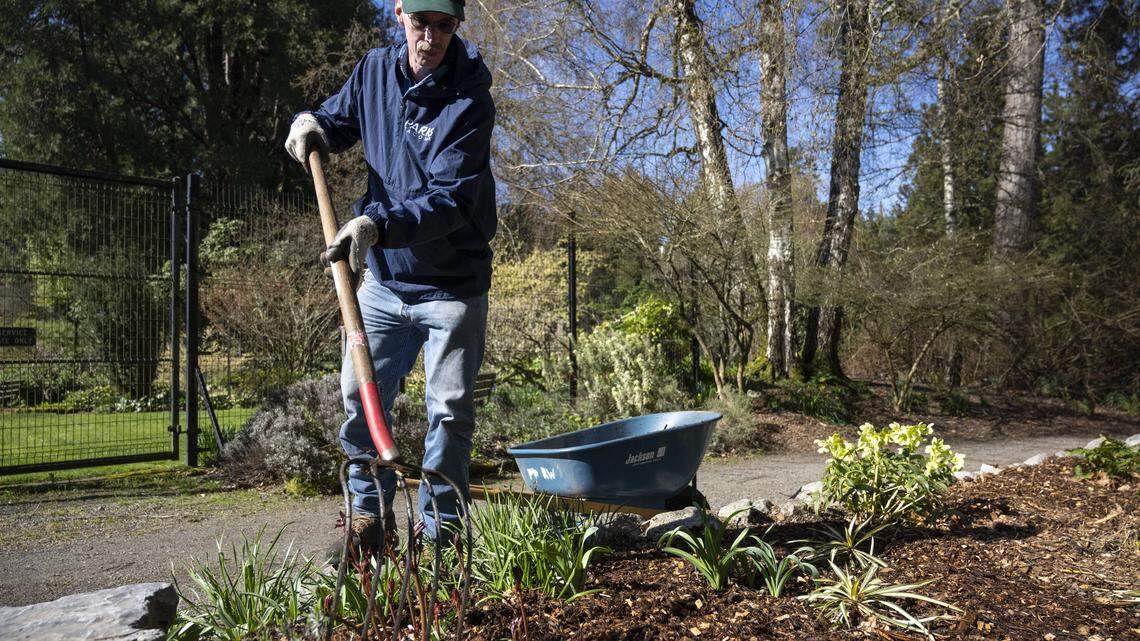
The second week of April is time to get fit with the garden marathon we call spring.
First, build muscles in your arms and shoulders by raking debris, moss and thatch from your lawn. Collect all this organic matter and add to a compost pile or store it in plastic garbage bags until rotted and use it as a mulch. Next, work out the back and hips by bending down to pull weeds and shovel mulch. Garden aerobics will get you and the landscape in better shape.
The magic of mulching
Think of mulch as a frosting for the soil. It makes gardening sweeter by improving the appearance, smothering weeds, sealing in moisture and improving the soil. All mulches are not the same. Some are better at blocking weeds, some are more attractive to the eye and some contain organic matter that breaks down to improve the soil.
Super Doo for super results
For a rich, dark look and for improving the soil, consider using composted dairy manure, preferably from an organic farm. In the Enumclaw-Auburn area, Hy-Grass Farms sells “Super Doo.” It is available at local soil and bark outlets or can be picked up at the farm.
Beauty Bark
Less expensive, but not as good of a soil conditioner, are the bark products sold by the bag at big box stores or by the truckload at local nurseries. The thick chunks of bark are good at keeping weeds in check, especially if you first layer newspaper down with three to four inches of bark chips on top.
This is most effective between trees and shrubs rather than using it around young perennials or annuals. Do not use sheets of plastic or weed block fabric under bark as it tends to become exposed over time and is not biodegradable. Cardboard under bark for big weeds and newspaper under bark for smaller areas is less expensive and will compost into the soil.
Rock and gravel
An old trick is to dig out the most offensive patch of blackberries, horsetail or thistle and plant a boulder into the hole. Surround a boulder with large rocks then add smaller, round rocks about the size of walnuts. Rocks and gravel are best for longevity as they last longer than bark or compost as they do not decompose.
Rocks and gravel will heat up in the sun, making this mulch too warm for rhododendrons, azaleas and camellias. Great at blocking weeds, gravel mulches can be harder to keep free of fallen leaves and debris.
Q. When can I divide hosta plants? T, Tacoma
A. In our Western Washington climate you can divide hosta plants any time the ground is not frozen, so dig in and start dividing so you can multiply. A large clump of hosta can be thought of as a pie. Use an ax or saw to remove a wedge-shaped section of the hosta or just take a sharp shovel and push it deep into the center of the hosta plant so you can cut off smaller chunks. If hosta leaves fall off during the transplant operation, don’t worry. Hosta roots are tough and new shoots will emerge once the plant settles into its new home.
Q. When can I move my hydrangea plant? W.T., Olympia
A. Hydrangeas prefer to be moved when they are dormant or sleeping in the winter, but from experience, I can say that hydrangeas can be transplanted with success in the spring, summer or fall. Just be aware that your hydrangea may skip flowering for a year after the relocation.
Marianne Binetti has a degree in horticulture from Washington State University and is the author of several books. Reach her at binettigarden.com.
 Marianne Binetti The Olympian
Comments are closed.