
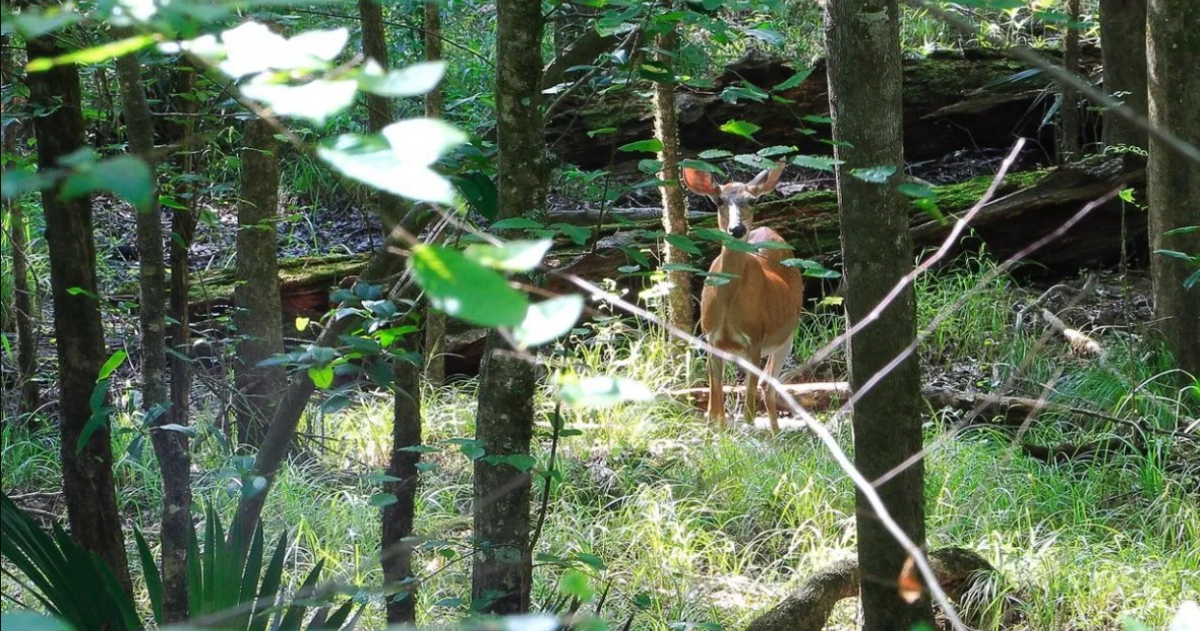
It’s not surprising the deer in West Ashely are hungrier than ever. The last 1.5 miles of forest between West Ashley Circle and Highway 17 South are rapidly being cut down and replaced with apartments, townhouses and subdivisions.
In a classic study from 2000, Howard Kilpatrick and Shelley Spohr determined that female white-tailed deer inhabit a range as large as 106 acres, although they spend most of their time in a core area of 18 acres. An area of 106 acres south of my house includes most of this new development. The deer that previously foraged there are on the move, competing with other deer in the area.
Plants previously left alone by the deer that consider my yard part of their range are now in the “eaten regularly” category. These plants include a number of my favorite winter annuals:
Usually, only the buds and flowers are eaten, except for parsley and dwarf snapdragons, where non-blooming shoots also disappear.
Summer annuals and perennials sampled or eaten include:
Shrubs also are not immune, including nandina and the newest 6 to 12 inches of my new “Purple Pillar” rose of Sharon, which is now protected with chicken wire.

Salvia Amistad is a popular hardy cultivar that blooms well in a variety of conditions.
Anthony Keinath/Provided
My approach to this new gardening challenge is to double down on the long-blooming plants that are still unpalatable to deer. These ornamentals bloom from four weeks to four months, giving a large reward for minimal labor.
Cool season annuals and perennials are a difficult category to fill, because deer eat most annuals that bloom during the winter in South Carolina. Daffodils and foxgloves planted in the fall bloom beautifully but not until spring. My Lenten roses have been sampled a couple of times but then left alone, confirming that the same deer visit the same areas and can learn from their mistakes.
Spring is the time for native blue-eyed grass to shine. In moist soil, one plant will spread into a clump or, even better, a drift. The purple variety is less vigorous than the natural blue form.
Crinum lilies also start blooming in spring. The earliest, Orange River lily (Crinum bulbispermum), bloomed last week in my backyard. Later blooming cultivars like Ellen Bosanquet open as late as July.
For a ground cover in moist soil, buy one, and only one, pot of native swamp crinum and let it spread naturally. Note that this aggressive plant does not recognize or respect the boundary between a perennial bed and the lawn.
Orange River Lily is a cold-tolerant, early-blooming crinum suitable for all of South Carolina.
Anthony Keinath/Provided
Late spring to early summer is the main blooming period for agapanthus or lily of the Nile. It’s useful that they naturally form a clump, as each plant does not bloom every year. Although lily of the Nile is drought-tolerant, it blooms better when planted in rich, loamy soil than in sandy soil.
The main benefit from summer annuals is the long, continuous flowering period. Vinca and marigolds (the old-fashioned kinds with an odor) are reliably deer-resistant. Be sure to choose “Cora XDR” vinca, the only cultivar resistant to deadly Phytophthora blight that attacks stems and leaves and causes entire plants to collapse.
Salvias (sages) are a large group of spring- and summer-flowering annuals and perennials, mostly in shades of reds, blues and purples. The simple key to picking the ones that are deer-resistant is choosing those with a distinct odor. Note that fragrant pineapple sage is as pleasing to deer as to humans.
Salvias suited to less than well-drained soil include anise-scented sage (Salvia guaranitica), bog sage (Salvia uliginosa) and purple “Amistad” (a Salvia guaranitica hybrid).
The heat of mid-summer is what gingers (Hedychium) wait for. To ensure that they survive cold winters like 2025-2026, cover the rhizomes with a 3-to-4-inch layer of mulch after the tops freeze back.
Some of these plants are deer-resistant because they are toxic to mammals, including dogs and cats. If you are concerned about pets, check the ASPCA lists of poisonous plants.
Hungry deer limit what we can grow, but they don’t have to limit a gardener’s ability to enjoy flowers most of the year with careful plant selection.
Comments are closed.