
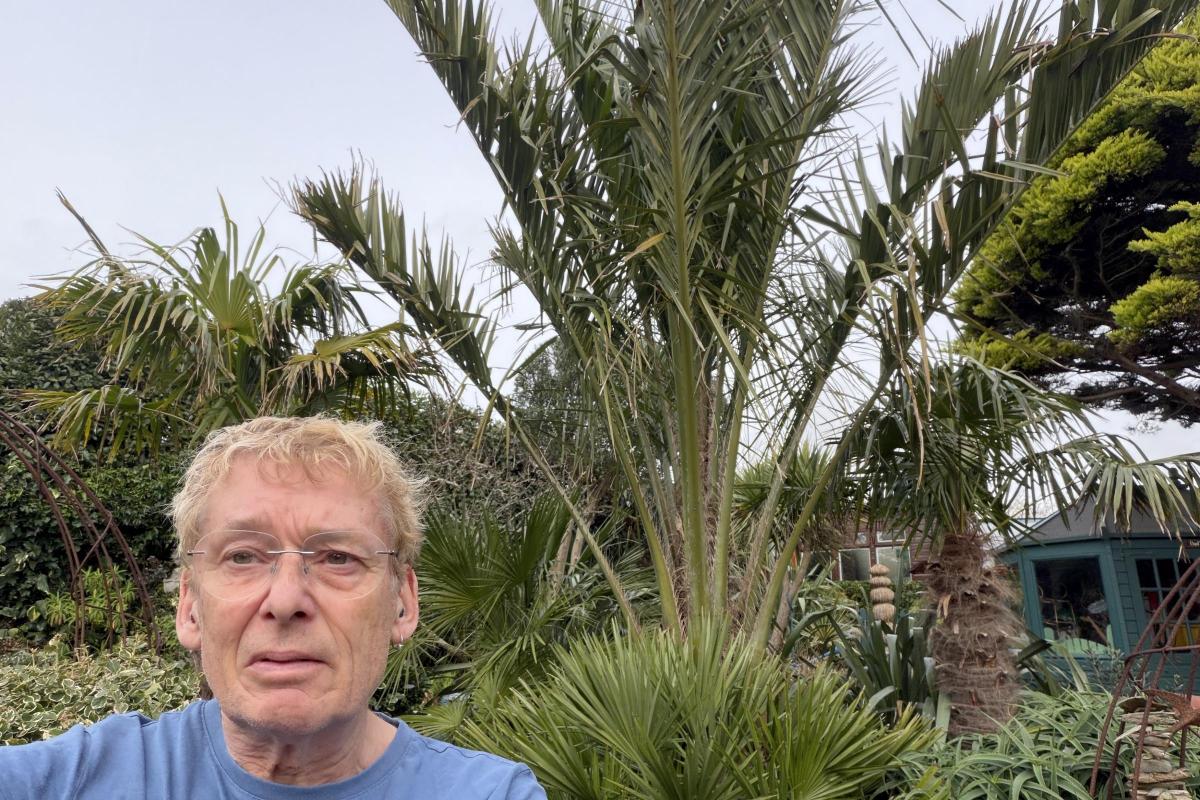
I was talking last week about my collection of agave and promised more information this week.
With over 80 different-sized containers of the plants at Driftwood, it can be a time-consuming passion. Succulents are more than just trendy additions to the garden. They symbolise resilience, adaptability, and the potential for growth. Their ability to thrive in challenging environments, both indoors and outdoors, makes them a perfect representation of new beginnings. I suppose my interest in them began back in 2012 when I purchased a few agave Americana to sit in the sunny beach garden through the summer months. I acquired more and was given some larger plants that the owners could no longer take care of, and I vividly remember the BBC Gardeners’ World film crew taking an interest in those that I had, when they filmed the first of their two sessions in the garden back in 2016. By the time the BBC shot the second film, eight years later in 2023, my obsession had grown, with succulents everywhere, caught on camera.
Agaves are amazing exotic, drought-tolerant plants that are native to Mexico and the north, central and south of the United States. They are very popular ornamental plants in the UK. Here are several of my favourites in the collection. Agave ovatifolia, or the whale’s tongue agave, is an oval-leaved agave. It is easy to grow and very cold hardy, down to -15/-16 degrees given good drainage. It is a stunning agave with silvery blue-coloured leaves with beautiful pronounced patterns on their upper surface. Characterised by large basal rosettes of thick, fleshy leaves typically having spiny margins and a sharp terminal point, it is better to plant them away from walkways. They are fabulous in exotic gardens, with their bold silhouette making a wonderful architectural centrepiece. It originates from the badlands of Mexico and the south-western states of America. This species is more tolerant of cold and moist climates than many other species and is the only one I leave out throughout the winter months.
Another is the Agave horrida ssp. horrida, which is a very showy fast-growing agave. Rigid fleshy upright leaves which are oblanceolate (meaning the widest part of the leaf is near the apex), are glossy green in colour forming compact symmetrical rosettes. The smooth textured leaves often have a faint paler coloured central stripe and also beautiful and unique imprinted patterns on their surfaces left by the teeth of the following leaves. Its scalloped edges are heavily toothed with marginal teeth, being dark when young but maturing to a silver-grey. Be mindful of where to plant as each leaf also has a stout sharp terminal point. I always make sure mine are positioned away from pathways.
Agave ‘Mediopicta Alba’ is a medium to smaller growing form of agave Americana. Easy to grow and cold hardy down to -8 degrees. It is one of the most stunning and pretty agaves with its fleshy arching leaves which are arranged in rosettes and are characterised with a bold greenish cream central stripe and blue green margins with grey/blue spined edges and a long terminal spine. Great again for exotic gardens as its bold silhouette makes a wonderful architectural centrepiece.
I have both the agave Americana and Americana variegata in the garden. The agave Americana ‘Variegata’ is easy to grow and cold hardy down to -9 degrees. It is one of the most dramatic and stunning agaves. Its fleshy arching leaves are arranged in rosettes and are characterised with a broad creamy margin and spiny edges.
Agave Americana is a beautiful, highly architectural species, regarded by many as an indoor or seasonal plant for growing outdoors in summer. It eventually forms an enormous rosette of stiff, dangerously pointed leaves. It’s known as the century plant as it supposedly takes 100 years to flower. Grow in well-drained soil in full sun. When mature it will be able to cope with cold and frosts provided it’s protected from winter wetness.
If you wanted to get out and visit some gardens this weekend with the National Garden Scheme, why not pop along to see the new garden opening for the first time in 2026, Quarry Wood Farm and Tilsmore Vineyard in Newick Lane, Mayfield Saturday April 11 from 10.30am to 3.30pm with entry £6. This is a two-acre organic garden set in a beautiful valley, surrounded by wildflower meadows and mature woodland. It features extensive spring bulbs and flowering shrubs, mixed herbaceous borders and colourful pots. There is a Mediterranean garden, as well as vegetable and cut flower gardens with raised beds. Enjoy woodland walks, see the vineyard and an orchard. Also open this weekend on both days between 2pm and 5pm is Rymans in Appledram Lane South, Apuldram near Chichester. Full details on both gardens at www.ngs.org.uk.
Read more of Geoff’s garden at www.driftwoodbysea.co.uk or follow both him and the garden on social media.
Comments are closed.