
It’s one of the many curious things about our modern world that as human beings get larger – the average Irish adult is now more than 10cm taller than their equivalent of 100 years ago – our gardens are shrinking. And not just by a little, but by a lot. Recent guidelines issued by the Irish Government for local authorities, for example, recommend reducing the minimum outdoor private space for a 3+ bedroom house from between 50sq m and 75sq m to as little as 40sq m, even less in situations where ready access to semi-private open spaces is available. For a modern one-bedroom house, it’s as little as 20sq m.
It goes without saying that these kinds of ultra-compact outdoor spaces require a disciplined approach when it comes to planting. Your average fruit tree isn’t going to cut it, for example, unless you buy one with a very dwarfing rootstock. The very same goes for many traditional varieties of ornamental shrubs and trees that were once staples of Irish gardens.
Plants such as Magnolia x soulangeana, for example, which can reach a height and spread of 6m, and whose sculptural, cup-shaped, edible blooms can be seen lighting up older, larger suburban Dublin gardens in spring. Or Hydrangea paniculata ‘Grandiflora’, a giant of a shrub with an abundance of huge white flowers in late summer, which can easily reach a height and spread of 4m x 2.5m. Or Syringa ‘Charles Joly’, a classic variety of lilac whose large panicles of purple-scented flowers are one of the joys of the May garden, but which can reach an average height of 6m x 4m. For those with pocket-sized gardens, these don’t leave a whole lot of space for a garden table and chairs, let alone all the other paraphernalia of modern life.
Recognising the growing need for smaller plants, plant breeders and nurseries have worked hard in recent decades to produce a new generation of ornamental shrubs and trees designed for today’s more petite gardens. The results, admittedly, haven’t always been pretty. Too often, a graceful growth habit has been sacrificed in favour of an extreme dwarf plant with little else to recommend it. Or the natural vigour of the species is lost in the race to produce something of marketable appeal. But there have been plenty of successes too.
One example is Hydrangea ‘Bobo’, an award-winning Belgian-bred variety of Hydrangea paniculata introduced as the result of a controlled breeding programme. Hardy, ultra-compact, very floriferous, with stiff, upright flower stems that aren’t inclined to droop and large flower panicles that first emerge in a shade of soft lime-green/white and slowly fade to pale pink, it will grow happily in sun or shade and reach a height and spread of just 1m – less than half the size of its popular rival, Hydrangea ‘Limelight’.
Another outstanding example is Magnolia ‘Genie’, a very compact New Zealand-bred hybrid variety that has the aforementioned Magnolia x soulangeana as one of its parents. The product of a long and complex breeding programme spanning 15 years, it’s hardy, floriferous, exceptionally early into flower, really small for a magnolia (an average height and spread of just 2.5m x 2m) and highly decorative, with large, deep rose-pink, cup-shaped, slightly scented flowers that appear on the plant’s bare branches at around this time of year. You can even grow it in a large pot or tub, making it suitable for very small courtyard gardens.
Philadelphus – or mock orange, as this ornamental, deciduous shrub is popularly known on account of its deliciously scented early summer flowers – has also come under the beady eye of modern plant breeders. New varieties designed for smaller gardens include the award-winning Philadelphus ‘Petite Perfume Pink’, an awful name for a pretty shrub that won RHS Chelsea Plant of the Year at last year’s show. Not only does it only reach an average height and spread of just 1.5m, but its scented flowers are blush-pink, a breakthrough in philadelphus breeding. Other ultra-compact varieties include the white-flowered ‘Snowbelle’ and the repeat-flowering ‘Pearls of Perfume’.
Meanwhile, if you’re a lilac lover but just don’t have space for the older, traditional varieties, then seek out the Boomerang series, which not only reach an average height and spread of just 1.5m but are repeat-flowering, producing their scented blooms on and off until autumn, thus earning their keep in smaller spaces.
[ Why are flowers not reappearing in my wildflower meadow?Opens in new window ]
Or if you’re a lover of pittosporum but are daunted by this evergreen, ornamental shrub’s naturally fast-growing ways, then seek out the compact variety known as Pittosporum ‘Golf Ball’. A naturally occurring variety from New Zealand, it was discovered by chance but has quickly become a firm favourite on account of its dense, vigorous growth habit and small, fine, apple-green leaves that make it suitable for topiary or hedging. Suitable for milder gardens, including those in coastal areas, it’s happy in sun or light shade and reaches a compact height and spread of just 1.2m.
Or perhaps you’re on the hunt for a dwarf flowering cherry tree small enough to grow comfortably in a tub or large pot? If so, then try the Fuji cherry, Prunus incisa ‘Kojo-no-mai’, which was first discovered growing wild on the slopes of Mount Fuji in Japan. Hardy, floriferous and delicately pretty with gently zig-zagging branches and snow-white blossom that appears in spring, it naturally reaches a height of around 2.5m but will happily tolerate very hard pruning without sacrificing its flowers if you want to keep it properly bonsai-sized.
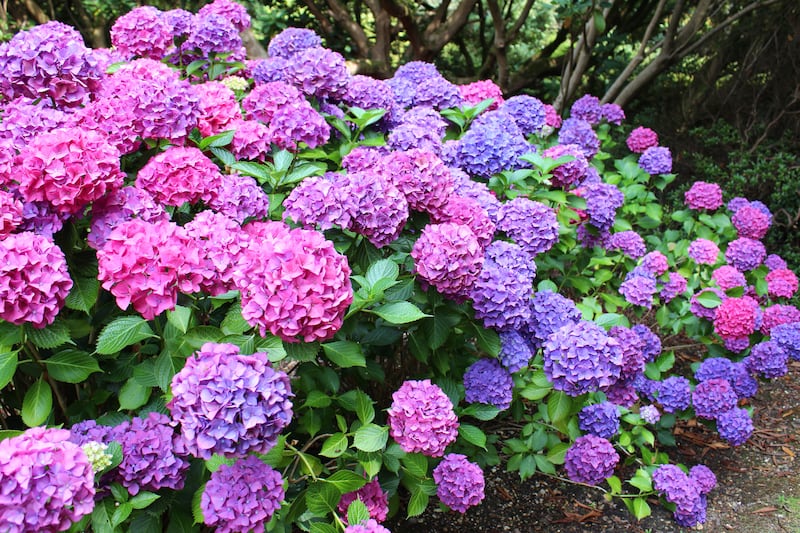 Hydrangea macrophylla: Now is the time to carefully cut away faded flower heads and weak, dead or damaged stems. Photograph: Getty Images This week in the garden:Unlike paniculate-type hydrangeas, traditional mopheads and lacecaps (Hydrangea macrophylla) dislike hard pruning. But this is a good time of year to carefully cut away their faded flower heads, taking care not to damage the young leaf buds just beneath them. Any dead, damaged or spindly stems should also be cut to the ground.Harsh, late spring frosts can badly damage the blossom of fruit trees at this time of year, even that of trees growing under cover in a polytunnel, with serious consequences for the plants’ ability to produce fruit. So, try to keep some garden fleece or bionet at hand to protect the blossom on icy nights, making sure to remove it in the morning to allow insects access for good pollination.Dates for your diary
RHSI Annual Plant Sale, Royal St George Yacht Club, Carlisle Pier, Dún Laoghaire, Co Dublin. Saturday, April 18th (11am-2pm); rhsi.ie.
Alpine Garden Society’s Annual Plant Sale, Cabinteely Community School, Johnstown Road, Cabinteely, Dublin 18. Saturday, April 25th (1.30pm-4pm); alpinegardensociety.ie
Comments are closed.